
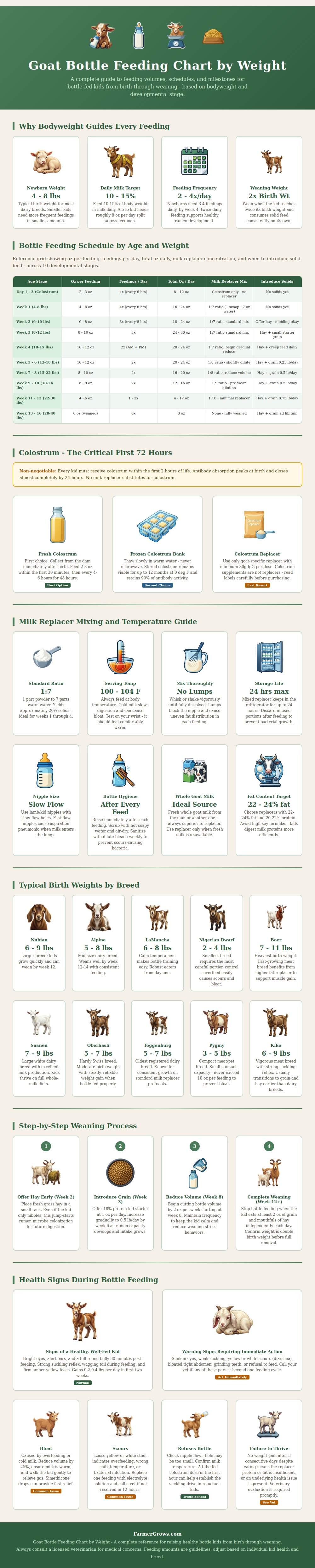
To determine how to raise bottle-fed goat kids, you must calculate the amount of food that the goat kid of the current weight should receive. Many people makes the mistake of guessing at how much food to provide to bottle-fed goat kids. Other people make the mistake of establishing a feeding schedule for bottle-fed kids that dont take into account the weight of the goat kid.
Five-pound goat kids is not the same as eight-pound kids, and, therefore, five-pound kids should be treated different than eight-pound kids. If you treat bottle-fed kids of different weights the same, the kids might experience slow growth or digestive upset. A feeding chart can help you to determine the amount of food to provide to each kid and how frequent to feed them.
How to Feed Bottle-Fed Baby Goats by Weight
Memorizing the amount of food to feed each kid is a mistake. Instead, use the kid’s current weight and age to determine feeding amounts. Kids of the same age might have the same weight, but kids of different age has different digestive systems and needs.
For instance, the youngest kids are learning how to function as a digestive system, while others are eating hay and grain. The feeding chart allows you to compare these different ages and weights so that you can calculate feeding amounts for each kid. The weight of each kid also can help you to determine when to move the kid to the next stage in their diet.
It is not a good idea to try to force each kid to consume as much milk as possible from the bottle. Providing milk daily will help the kid maintain their strength and will prevent overloading their digestive system. When a kid reaches twice their birth weight and begins to express interest in solid foods, milk from the bottle is less important to their diet.
Each kid will reach this stage at a different time, so it is important to regular monitor the kids weight. Colostrum is an essential part of a kid’s diet and contains antibodies that protect the kid from sickness. During the first few hours after birth, the kid can absorb the antibodies from the colostrum into their bloodstream.
After this period, milk cannot provide the same antibodies that were included in the colostrum. Some people choose to store frozen colostrum to ensure that kids recieve the antibodies in the days following birth when births might occur at different times. The feeding chart is used to ensure that kids are fed colostrum during this period.
The feeding of milk replacer come with specific rules. The milk replacer that you use must contain the proper ratio of fat to protein. If the milk replacer is too cold, the kid’s digestion may slow.
If the milk replacer is too strong, the kid might develop bloat. The feeding chart includes information about these ratios for milk replacer to ensure that feeding is done correct. Not all breeds of goats are alike in relation to feeding.
Some breeds of kids will start at a higher weight and become more accustomed to eating more food than others. The feeding chart is a point of departure for feeding, but you must account for the breed of kid. For example, Nigerian Dwarf kids will require different meals than Boer or Nubian goat kids of the same age.
Observing the weight of the kids will show the effectiveness of the feeding adjustments. Weaning kids from milk is a process that should account for time. It is not a good idea to stop feeding milk to kids all at once.
Instead, gradually decrease the amount of milk will encourage the kids to eat solid food and will prevent stress behaviors from the kid. By the time the bottle is removed from the kid, the kid should be eating hay and grain every day. Using the kid’s weight during weaning ensures the kid’s digestive system is functioning correct.
Observing the health of bottle-fed kids daily is essential. If you notice any changes in the kid from one day to the next, it might be a good idea to adjust the kid’s feeding schedule. The feeding chart cannot determine the cause of an illness in a kid, but it can help determine if feeding caused the kid to develop the sickness.
Using the feeding schedule and monitoring the kid’s weight will turn bottle feeding into a repeatable process.