Ginger Plants Per Acre Calculator
Estimate ginger plant population from bed centers, rows per bed, in-row spacing, seed-piece count, stand survival, rhizome order weight, and fresh rhizome yield for baby ginger or mature ginger fields.
Use the actual planted bed area, not the whole farm block if roads, wash lanes, or headlands are excluded. The calculator separates row-end loss, sprouting rate, field survival, cutting buffer, and harvest weight so ginger seed orders stay traceable.
Ginger Acre Plan
Enter a ginger layout to estimate plants per acre, seed rhizome needs, and expected yield.
| Bed or ridge center | Rows per bed | In-row spacing | Approx. seed pieces per acre |
|---|---|---|---|
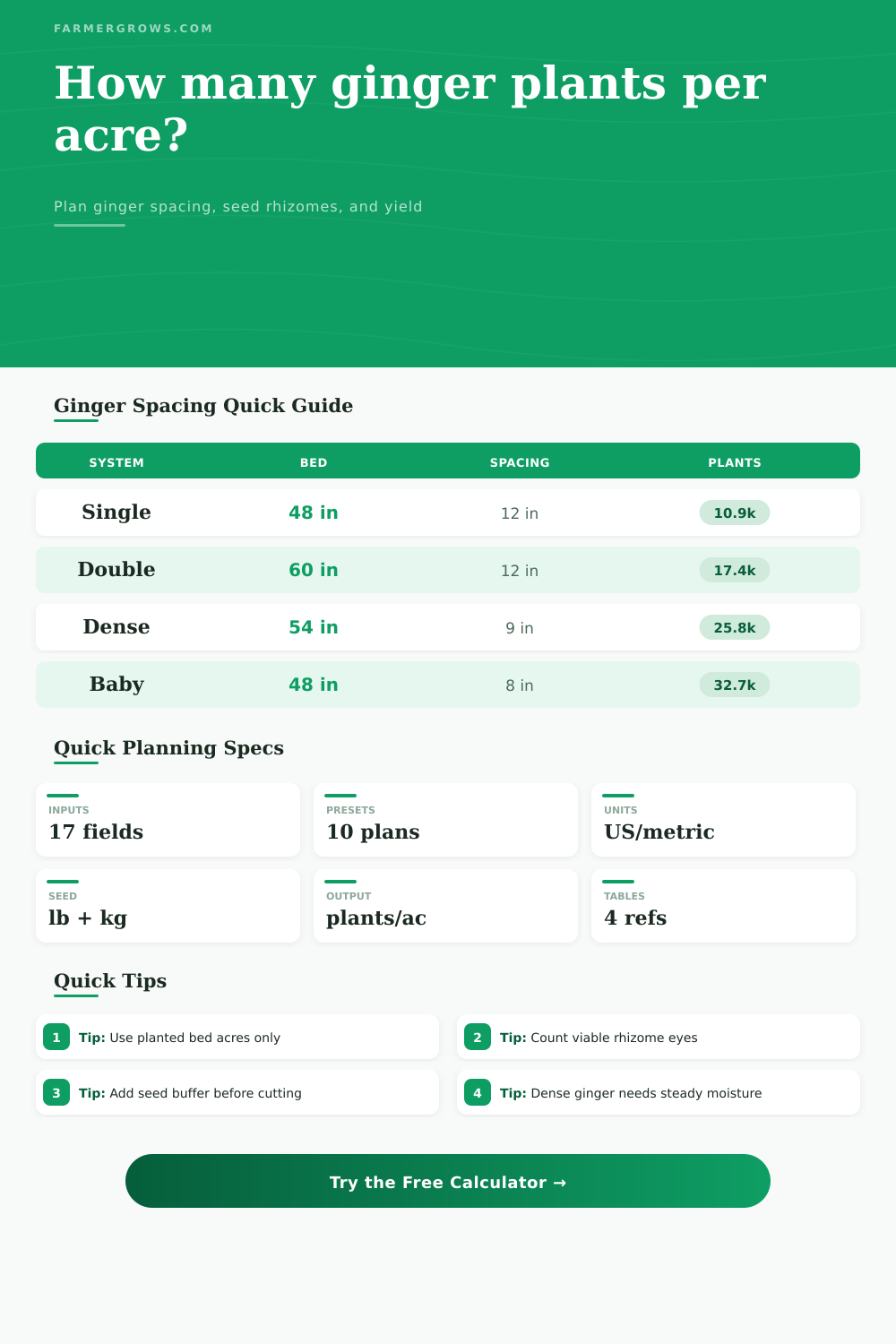
| 48 in center | 1 row | 12 in | 10,890 pieces/ac |
| 54 in center | 1 row | 10 in | 11,616 pieces/ac |
| 60 in center | 2 rows | 12 in | 17,424 pieces/ac |
| 60 in center | 2 rows | 10 in | 20,909 pieces/ac |
| 54 in center | 2 rows | 9 in | 25,813 pieces/ac |
| 48 in center | 3 rows | 8 in | 49,005 pieces/ac |
| Seed piece weight | Pieces per 50 lb | Pieces per 100 lb | Best planning use |
|---|---|---|---|
| 1.0 oz piece | 800 pieces | 1,600 pieces | Small baby ginger cuts. |
| 1.5 oz piece | 533 pieces | 1,067 pieces | Dense market bed planting. |
| 2.0 oz piece | 400 pieces | 800 pieces | Common mature ginger seed. |
| 2.5 oz piece | 320 pieces | 640 pieces | Large eyes or rough seed lots. |
| 3.0 oz piece | 267 pieces | 533 pieces | High-vigor seed pieces. |
| Plan | Typical layout | Population target | Planning note |
|---|---|---|---|
| Mature fresh ginger | 1 row, 10-14 in | 10k-14k plants/ac | Leave room for large rhizomes. |
| Raised-bed market ginger | 2 rows, 10-12 in | 17k-21k plants/ac | Balanced count and harvest size. |
| Baby ginger | 2-3 rows, 8-10 in | 25k-35k plants/ac | Harvest young before crowding. |
| High tunnel ginger | 2 rows, 9-12 in | 18k-27k plants/ac | Use high sprout and survival rates. |
| Organic cultivation | 1 row, 14-16 in | 8k-12k plants/ac | Prioritize weed-tool clearance. |
| Seed-rhizome nursery | 2 rows, 9-10 in | 22k-29k plants/ac | Track seed weight carefully. |
| Crop type | Live plants/ac | Marketable weight/plant | Example yield |
|---|---|---|---|
| Baby ginger | 26,000 plants | 0.35 lb | 9,100 lb/ac |
| Fresh market ginger | 16,000 plants | 1.10 lb | 17,600 lb/ac |
| Mature ridge ginger | 11,000 plants | 1.60 lb | 17,600 lb/ac |
| High tunnel ginger | 20,000 plants | 1.35 lb | 27,000 lb/ac |
Separate seed pieces from live plants. Ginger seed weight is ordered before sprouting, while yield depends on the surviving clumps after sprout rate and field survival are applied.
Use bed centers for acre math. A double-row bed at 60 inch centers has the same bed count as a single row, but twice the row length for plant stations.
Are you staring down an empty acre of land, wondering exactly how many rhizomes you need to plant in there? There’s something particular about the panic that grips you then. It is not so much about the square footage but more about the dollar amount. Each ginger seed rhizome cost a pretty penny, so if you don’t plant enough, you end up with a patchy crop… and if you do, you end up with a field full of pathetic-looking skinny sticks instead. You want the right number of plants to balance vigor with volume. The following calculator does this geometry math for you, enter in your spacings and bed centers, press the “go” button, and it will tell you how many to aim for between the sweet-spot extremes.
But the planting system is one of the first variables you grapple with. Most growers work either double rows, for market-quality crops, or single rows (on a ridge) for gingers destined for maturity. The latter can be planted at ten thousand to fourteen thousand plants per acre. The former at seventeen thousand or more. What’s the difference? More than layout. At the high end of that range. Double rows… You’re packing more plants onto an area, so they must cooperate: you get more total yield but less individual plant size. The tool shows you this tradeoff. It converts your chosen in-row spacing and bed width into actual plants per acre, right there on screen. No guessing if you’ve made your spacing too tight; you’ll see the numbers.
How to Use the Ginger Calculator
Seed weight is another area where intuition goes wrong. A rhizome isn’t just a cube. It’s a tangle of roots, eyes pointed in various directions, some sprouting and others not. When you purchase 50 pounds of seed, you could have anywhere from three hundred to eight hundred seed pieces depending on the size of your cuts. To account for this, the calculator requires an estimate of both the expected sprout rate and average weight of each seed piece. Why? Because it doesn’t matter if you’re planting one eye per piece (a big piece) or three eyes per piece (three smaller pieces). Planting empty spots in your field will result from ordering by weight alone. When you know how many viable stations there are, you can order confidenty. You will know exactly how many bags you need to fill your rows.
And then there is real life, as in how many survive in the field. Not everything sprouts evenly. Some get rotted. Your stand gets thinned by lack of water. Bits get dug up by birds. A wise plan allows for losses. With this tool you can plug in a post-sprout survival rate. If I want twenty thousand plants but expect twenty percent to go bye-bye, I’m planting for twenty-five thousand. Better to have more than none. That’s the margin between disappointment and profit. This isn’t seed-planting; it’s hope-planting. And hope requires insurance.
The same principle applies to the yield estimate. The raw weight depends on size of the live plants (which produce weight in rhizomes). Not everything that’s harvested will be good enough to go to the market. Some rhizome will be too small. Others will have damage. What does this mean? The calculator splits out the raw harvest from the marketable part. It then adds a recovery percentage to your total yield. This allows for a realistic view of how many plants end up in the truck. You can compare that number with your seed cost. You can assess whether your spacing actualy makes sense. When you grow dense baby ginger, you get more plants, but each one has a lower yield per plant. The tool accounts for both.
But there’s also the table of references on the page for a sanity check. It will give you examples of common plans and what they tend to produce. Then you can compare them with your own. Is yours radically different? Maybe you’ve entered something wrong. Or maybe you’ve discovered a more moddern, efficient method of growing. Either way: data. Not guesswork. Planning.
Ultimately, then, ginger farming is an exercise in both soil and spacing. You want to give every ginger rhizome enough room to reach its potential, while also using as much square footage as possible by planting as many plants as you can within a given area. That’s what the above calculator does, it translates those fuzzy concepts into real-world measurements. It allows you to consider your crop as a whole, not merely as a series of separate units but as a system. Adjust your seed weight. Tweak your spacing. Play out different scenarios. Then, when you do go into the ground, you’ll know exactly where every piece will go. You are not just planting, but you are constructing a crop. Knowing how many pieces you need to make the puzzle work is the first step.