Germination Rate Calculator
Turn seed test counts into lab germination, viable seed, field emergence, and seeds to plant for a target stand.
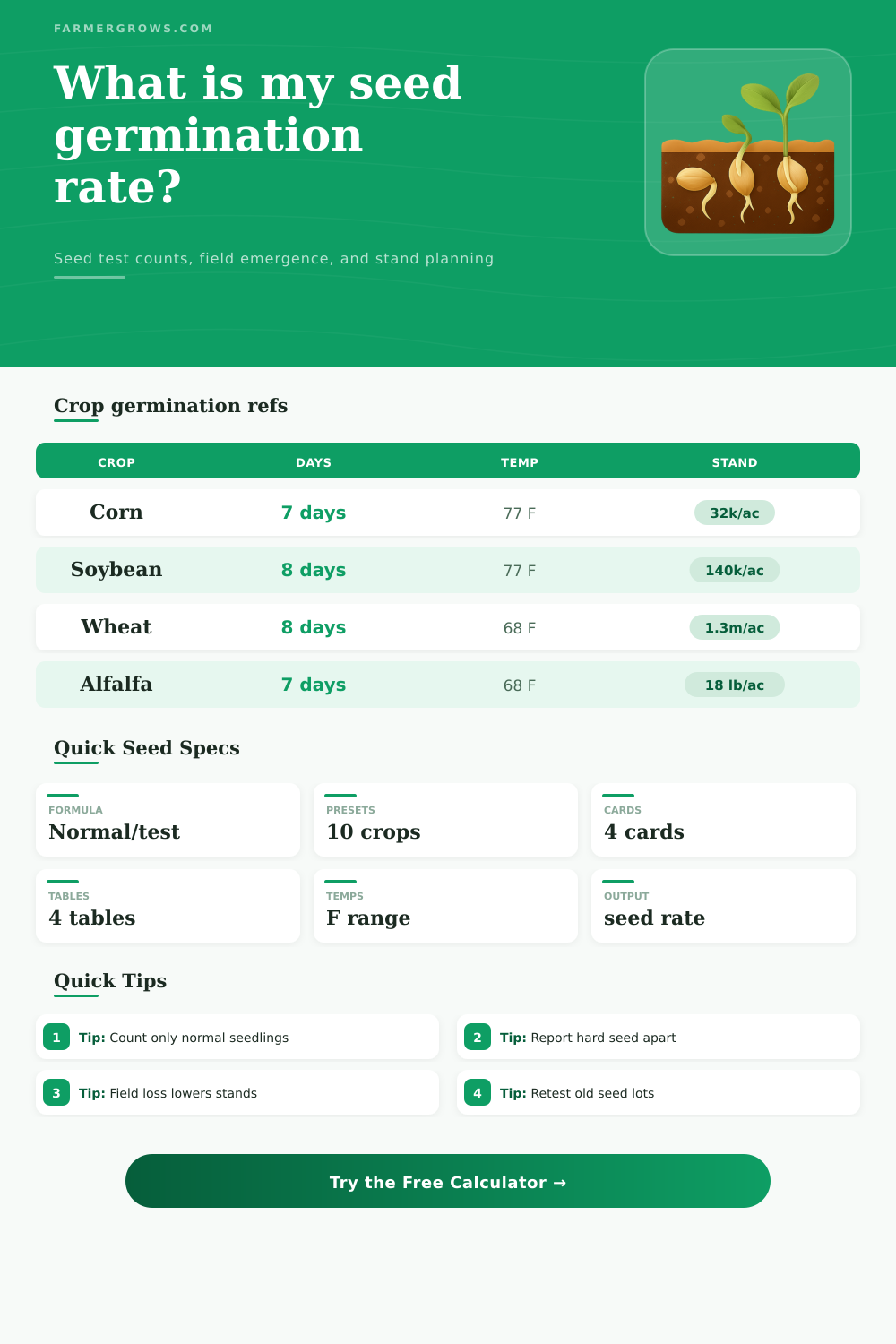
| Crop | Typical final count | Common test temperature | Useful target stand |
|---|---|---|---|
| Corn, field | 7 days | 68–86°F alternating or 77°F | 28,000–36,000 plants/ac |
| Soybean | 8 days | 77°F, warm moist test | 100,000–160,000 plants/ac |
| Wheat | 8 days | 59–68°F, cool-season test | 1.0–1.5 million plants/ac |
| Alfalfa | 7 days | 68°F, hard seed reported separately | 12–20 lb seed/ac by region |
| Tomato | 14 days | 68–86°F alternating | Greenhouse tray or plants/ac |
| Lettuce | 7 days | 68°F, light-sensitive lots vary | Direct-seed by bed density |
| Rice | 14 days | 77–86°F, warm saturated media | 60–120 lb seed/ac by system |
| Pea | 8 days | 68°F, cool bench test | 80,000–120,000 plants/ac |
| Seed test class | Counts in germination %? | Formula use | Planning note |
|---|---|---|---|
| Normal seedlings | Yes | Normal ÷ tested | Primary lab germination value |
| Abnormal seedlings | No | Abnormal ÷ tested | Shows weak or damaged seed performance |
| Hard seed | No, report separately | Hard ÷ tested | Important in legumes with impermeable coats |
| Dormant seed | No, report separately | Dormant ÷ tested | May germinate after after-ripening or treatment |
| Dead or missing seed | No | Tested - all counted classes | Raises seeding rate or triggers retest |
| Seedbed condition | Suggested adjustment | When to use it | Example effect |
|---|---|---|---|
| Excellent | 93–98% | Warm soil, even depth, good moisture | 95% lab becomes 88–93% usable |
| Good | 85–92% | Normal field planting conditions | 90% lab at 88% field = 79.2% usable |
| Fair | 75–84% | Cool soil, crust risk, uneven residue | 90% lab at 80% field = 72.0% usable |
| Stressful | 60–74% | Cold, wet, salty, compacted, or dry seedbed | Planting rate rises sharply |
| Lab germination | Lot rating | Common action | Stand planning response |
|---|---|---|---|
| 95% and higher | Excellent | Use normal field adjustment | Small planting-rate increase |
| 90–94% | Good | Plant if vigor and tag are current | Moderate adjustment |
| 80–89% | Marginal | Consider vigor test or retest | Raise seeding rate carefully |
| Below 80% | Risky | Retest or replace lot when possible | High rate may not fix weak vigor |
When a person receive a new seed lot from the grower, that person must determine how many of the seeds in that lot will grow into plants. The lab germination percentage will always be available from the seed company that sold the seed, but that percentage is only useful if you translate that percentage into a real field stand. Only by knowing how many seeds will germinate in the field can a farmer determine how many seeds to plant to achieve the desired stand of plants.
Germination test rule state that the only seeds that will be counted toward the germination percentage are normal seedlings that grow from the planted seeds. Normal is used to describe the emergence of both root and shoots from the seed. Any abnormal seedling will not be counted in the germination percentage.
How to Use Lab Germination to Find Field Emergence
Additionally, any seeds that germinate as hard seeds will also not be counted toward the germination percentage. However, those same hard seeds will be counted separately from the germination percentage. Each of these category counts toward something different, and knowing how many seeds is in each category can tell a farmer about the potential of that seed lot to germinate and emerge from the soil.
The inputs into the calculator will be the same as the values on the lab test report. The farmer will enter the total number of seeds tested, the number of normal seedlings, abnormal seedlings and hard or dormant seeds. From these values, the calculator will output the lab germination percentage.
Then, the calculator will add the number of hard and dormant seeds to the total number of seeds tested to calculate the potential viable seed count. This value can be displayed next to the germination percentage on the calculator so that the farmer can compare the two values. Field emergence will rarely be the same as the percentage of seeds that germinated in the lab test.
Various field factor can impact the emergence of the plants. These factors can include soil temperature, soil moisture, soil crusting, insects and planting depth. In the calculator, an emergence adjustment can factor these variables in the determination of field emergence.
For instance, planting in warm and moist soil will have a different emergence percentage than planting in cool and wet fields with soil crusts on the field’s surface. This emergence adjustment is simply an accounting of the conditions of the field’s seedbed. Once emergence rate is calculated, the farmer must determine how many seeds will need to be planted per acre or hectare.
Using the calculated emergence rate, the farmer must determine how many seeds to plant to achieve the target stand of plants. If the farmer plants too few seeds, they will lose the potential crop yield. However, if they plant too many seeds, they will waste money on seeds and experience more competition between the emerging crop plants.
The calculator will provide the division needed to calculate how many extra seeds will need to be planted to achieve the target emergence rate. Depending on the crop type, the emergence rate from the lab tests may differ. Corn will usually produce a high germination rate when tested in the lab if the corn seeds are sound.
However, if the soil temperature is too low, the emergence rate will be low. Soybean seeds easily crack when they are handled during transport from the farm to the farm implement and storage facilities. Thus, a high germination rate may be seen in the lab, but the soybean emergence rate in the field may be much lower.
Additionally, wheat is a cool-season crop, so its seed germination rate in the lab will be tested at lower temperatures than warm-season crops. Alfalfa seeds contain many hard seeds. These hard seeds will germinate later than the rest of the alfalfa seeds, so they are tested separately from the germination percentage.
This reference table can be used to compare the emergence rate to the industry standards for various crops. The germination percentage test does not account for the vigor of the seed. Two different lot of the same crop may have the same germination percentage.
However, they may behave differently once planted in the soil. The vigor of the seeds can usually be accounted for by watching the emergence of normal seedlings during the germination test. If the normal seedlings emerge quickly and even from the seeds, the vigor of those seeds will likely emerge quickly and show good field performance.
On the other hand, if the normal seedlings emerge slowly and unevenly, the vigor of the seeds will likely show low emergence rate in the field. Old seed lots should be scrutinized more closely than new lots from the same grower. The germination rate of old seeds may drop quickly once the lot passes its prime.
Thus, retesting the old seed lot before planting will ensure that the farmer has viable seeds to plant in the field. Using the calculator, the farmer can input the new numbers from the retesting of the old seed lot to determine how many extra seeds will need to be planted to reach the target emergence rate. If the rate is too high, the old seed lot may not be worth the risk of using in the field.
The farmer has more control over the conditions of the field’s seedbed than the quality of the seed lot. For instance, the farmer can wait for the soil to warm up after spring seeding; improve the management of crop plant residue; or adjust the planting depth to improve emergence rates. These factors will impact the emergence rate, and the emergence adjustment for the field’s seedbed.
The emergence adjustment should not be higher than the conditions of the field’s seedbed. Using an emergence adjustment that is higher than the actual conditions of the field may hide a problem with the field until the crop stand is too short for the crop stand’s requirements. Instead of aiming for the perfect germination percentage for emergence in the field, the farmer should aim to gain an understanding of the germination and emergence capability of the crop seed lot.
This understanding will allow for better decision to be made regarding whether or not to use that type of seed lot or to purchase a new lot of that same crop seed. When a person receive a new seed lot from the grower, that person must determine how many of the seeds in that lot will grow into plants. The lab germination percentage will always be available from the seed company that sold the seed, but that percentage is only useful if you translate that percentage into a real field stand.
Only by knowing how many seeds will germinate in the field can a farmer determine how many seeds to plant to achieve the desired stand of plants. Germination test rule state that the only seeds that will be counted toward the germination percentage are normal seedlings that grow from the planted seeds. Normal is used to describe the emergence of both root and shoots from the seed.
Any abnormal seedling will not be counted in the germination percentage. Additionally, any seeds that germinate as hard seeds will also not be counted toward the germination percentage. However, those same hard seeds will be counted separately from the germination percentage.
Each of these category counts toward something different, and knowing how many seeds is in each category can tell a farmer about the potential of that seed lot to germinate and emerge from the soil. The inputs into the calculator will be the same as the values on the lab test report. The farmer will enter the total number of seeds tested, the number of normal seedlings, abnormal seedlings and hard or dormant seeds.
From these values, the calculator will output the lab germination percentage. Then, the calculator will add the number of hard and dormant seeds to the total number of seeds tested to calculate the potential viable seed count. This value can be displayed next to the germination percentage on the calculator so that the farmer can compare the two values.
Field emergence will rarely be the same as the percentage of seeds that germinated in the lab test. Various field factor can impact the emergence of the plants. These factors can include soil temperature, soil moisture, soil crusting, insects and planting depth.
In the calculator, an emergence adjustment can factor these variables in the determination of field emergence. For instance, planting in warm and moist soil will have a different emergence percentage than planting in cool and wet fields with soil crusts on the field’s surface. This emergence adjustment is simply an accounting of the conditions of the field’s seedbed.
Once emergence rate is calculated, the farmer must determine how many seeds will need to be planted per acre or hectare. Using the calculated emergence rate, the farmer must determine how many seeds to plant to achieve the target stand of plants. If the farmer plants too few seeds, they will lose the potential crop yield.
However, if they plant too many seeds, they will waste money on seeds and experience more competition between the emerging crop plants. The calculator will provide the division needed to calculate how many extra seeds will need to be planted to achieve the target emergence rate. Depending on the crop type, the emergence rate from the lab tests may differ.
Corn will usually produce a high germination rate when tested in the lab if the corn seeds are sound. However, if the soil temperature is too low, the emergence rate will be low. Soybean seeds easily crack when they are handled during transport from the farm to the farm implement and storage facilities.
Thus, a high germination rate may be seen in the lab, but the soybean emergence rate in the field may be much lower. Additionally, wheat is a cool-season crop, so its seed germination rate in the lab will be tested at lower temperatures than warm-season crops. Alfalfa seeds contain many hard seeds.
These hard seeds will germinate later than the rest of the alfalfa seeds, so they are tested separately from the germination percentage. This reference table can be used to compare the emergence rate to the industry standards for various crops. The germination percentage test does not account for the vigor of the seed.
Two different lot of the same crop may have the same germination percentage. However, they may behave differently once planted in the soil. The vigor of the seeds can usually be accounted for by watching the emergence of normal seedlings during the germination test.
If the normal seedlings emerge quickly and even from the seeds, the vigor of those seeds will likely emerge quickly and show good field performance. On the other hand, if the normal seedlings emerge slowly and unevenly, the vigor of the seeds will likely show low emergence rate in the field. Old seed lots should be scrutinized more closely than new lots from the same grower.
The germination rate of old seeds may drop quickly once the lot passes its prime. Thus, retesting the old seed lot before planting will ensure that the farmer has viable seeds to plant in the field. Using the calculator, the farmer can input the new numbers from the retesting of the old seed lot to determine how many extra seeds will need to be planted to reach the target emergence rate.
If the rate is too high, the old seed lot may not be worth the risk of using in the field. The farmer has more control over the conditions of the field’s seedbed than the quality of the seed lot. For instance, the farmer can wait for the soil to warm up after spring seeding; improve the management of crop plant residue; or adjust the planting depth to improve emergence rates.
These factors will impact the emergence rate, and the emergence adjustment for the field’s seedbed. The emergence adjustment should not be higher than the conditions of the field’s seedbed. Using an emergence adjustment that is higher than the actual conditions of the field may hide a problem with the field until the crop stand is too short for the crop stand’s requirements.
Instead of aiming for the perfect germination percentage for emergence in the field, the farmer should aim to gain an understanding of the germination and emergence capability of the crop seed lot. This understanding will allow for better decision to be made regarding whether or not to use that type of seed lot or to purchase a new lot of that same crop seed. When a person receive a new seed lot from the grower, that person must determine how many of the seeds in that lot will grow into plants.
The lab germination percentage will always be available from the seed company that sold the seed, but that percentage is only useful if you translate that percentage into a real field stand. Only by knowing how many seeds will germinate in the field can a farmer determine how many seeds to plant to achieve the desired stand of plants. Germination test rule state that the only seeds that will be counted toward the germination percentage are normal seedlings that grow from the planted seeds.
Normal is used to describe the emergence of both root and shoots from the seed. Any abnormal seedling will not be counted in the germination percentage. Additionally, any seeds that germinate as hard seeds will also not be counted toward the germination percentage.
However, those same hard seeds will be counted separately from the germination percentage. Each of these category counts toward something different, and knowing how many seeds is in each category can tell a farmer about the potential of that seed lot to germinate and emerge from the soil. The inputs into the calculator will be the same as the values on the lab test report.
The farmer will enter the total number of seeds tested, the number of normal seedlings, abnormal seedlings and hard or dormant seeds. From these values, the calculator will output the lab germination percentage. Then, the calculator will add the number of hard and dormant seeds to the total number of seeds tested to calculate the potential viable seed count.
This value can be displayed next to the germination percentage on the calculator so that the farmer can compare the two values. Field emergence will rarely be the same as the percentage of seeds that germinated in the lab test. Various field factor can impact the emergence of the plants.
These factors can include soil temperature, soil moisture, soil crusting, insects and planting depth. In the calculator, an emergence adjustment can factor these variables in the determination of field emergence. For instance, planting in warm and moist soil will have a different emergence percentage than planting in cool and wet fields with soil crusts on the field’s surface.
This emergence adjustment is simply an accounting of the conditions of the field’s seedbed. Once emergence rate is calculated, the farmer must determine how many seeds will need to be planted per acre or hectare. Using the calculated emergence rate, the farmer must determine how many seeds to plant to achieve the target stand of plants.
If the farmer plants too few seeds, they will lose the potential crop yield. However, if they plant too many seeds, they will waste money on seeds and experience more competition between the emerging crop plants. The calculator will provide the division needed to calculate how many extra seeds will need to be planted to achieve the target emergence rate.
Depending on the crop type, the emergence rate from the lab tests may differ. Corn will usually produce a high germination rate when tested in the lab if the corn seeds are sound. However, if the soil temperature is too low, the emergence rate will be low.
Soybean seeds easily crack when they are handled during transport from the farm to the farm implement and storage facilities. Thus, a high germination rate may be seen in the lab, but the soybean emergence rate in the field may be much lower. Additionally, wheat is a cool-season crop, so its seed germination rate in the lab will be tested at lower temperatures than warm-season crops.
Alfalfa seeds contain many hard seeds. These hard seeds will germinate later than the rest of the alfalfa seeds, so they are tested separately from the germination percentage. This reference table can be used to compare the emergence rate to the industry standards for various crops.
The germination percentage test does not account for the vigor of the seed. Two different lot of the same crop may have the same germination percentage. However, they may behave differently once planted in the soil.
The vigor of the seeds can usually be accounted for by watching the emergence of normal seedlings during the germination test. If the normal seedlings emerge quickly and even from the seeds, the vigor of those seeds will likely emerge quickly and show good field performance. On the other hand, if the normal seedlings emerge slowly and unevenly, the vigor of the seeds will likely show low emergence rate in the field.
Old seed lots should be scrutinized more closely than new lots from the same grower. The germination rate of old seeds may drop quickly once the lot passes its prime. Thus, retesting the old seed lot before planting will ensure that the farmer has viable seeds to plant in the field.
Using the calculator, the farmer can input the new numbers from the retesting of the old seed lot to determine how many extra seeds will need to be planted to reach the target emergence rate. If the rate is too high, the old seed lot may not be worth the risk of using in the field. The farmer has more control over the conditions of the field’s seedbed than the quality of the seed lot.
For instance, the farmer can wait for the soil to warm up after spring seeding; improve the management of crop plant residue; or adjust the planting depth to improve emergence rates. These factors will impact the emergence rate, and the emergence adjustment for the field’s seedbed. The emergence adjustment should not be higher than the conditions of the field’s seedbed.
Using an emergence adjustment that is higher than the actual conditions of the field may hide a problem with the field until the crop stand is too short for the crop stand’s requirements. Instead of aiming for the perfect germination percentage for emergence in the field, the farmer should aim to gain an understanding of the germination and emergence capability of the crop seed lot. This understanding will allow for better decision to be made regarding whether or not to use that type of seed lot or to purchase a new lot of that same crop seed.
When a person receive a new seed lot from the grower, that person must determine how many of the seeds in that lot will grow into plants. The lab germination percentage will always be available from the seed company that sold the seed, but that percentage is only useful if you translate that percentage into a real field stand. Only by knowing how many seeds will germinate in the field can a farmer determine how many seeds to plant to achieve the desired stand of plants.
Germination test rule state that the only seeds that will be counted toward the germination percentage are normal seedlings that grow from the planted seeds. Normal is used to describe the emergence of both root and shoots from the seed. Any abnormal seedling will not be counted in the germination percentage.
Additionally, any seeds that germinate as hard seeds will also not be counted toward the germination percentage. However, those same hard seeds will be counted separately from the germination percentage. Each of these category counts toward something different, and knowing how many seeds is in each category can tell a farmer about the potential of that seed lot to germinate and emerge from the soil.
The inputs into the calculator will be the same as the values on the lab test report. The farmer will enter the total number of seeds tested, the number of normal seedlings, abnormal seedlings and hard or dormant seeds. From these values, the calculator will output the lab germination percentage.
Then, the calculator will add the number of hard and dormant seeds to the total number of seeds tested to calculate the potential viable seed count. This value can be displayed next to the germination percentage on the calculator so that the farmer can compare the two values. Field emergence will rarely be the same as the percentage of seeds that germinated in the lab test.
Various field factor can impact the emergence of the plants. These factors can include soil temperature, soil moisture, soil crusting, insects and planting depth. In the calculator, an emergence adjustment can factor these variables in the determination of field emergence.
For instance, planting in warm and moist soil will have a different emergence percentage than planting in cool and wet fields with soil crusts on the field’s surface. This emergence adjustment is simply an accounting of the conditions of the field’s seedbed. Once emergence rate is calculated, the farmer must determine how many seeds will need to be planted per acre or hectare.
Using the calculated emergence rate, the farmer must determine how many seeds to plant to achieve the target stand of plants. If the farmer plants too few seeds, they will lose the potential crop yield. However, if they plant too many seeds, they will waste money on seeds and experience more competition between the emerging crop plants.
The calculator will provide the division needed to calculate how many extra seeds will need to be planted to achieve the target emergence rate. Depending on the crop type, the emergence rate from the lab tests may differ. Corn will usually produce a high germination rate when tested in the lab if the corn seeds are sound.
However, if the soil temperature is too low, the emergence rate will be low. Soybean seeds easily crack when they are handled during transport from the farm to the farm implement and storage facilities. Thus, a high germination rate may be seen in the lab, but the soybean emergence rate in the field may be much lower.
Additionally, wheat is a cool-season crop, so its seed germination rate in the lab will be tested at lower temperatures than warm-season crops. Alfalfa seeds contain many hard seeds. These hard seeds will germinate later than the rest of the alfalfa seeds, so they are tested separately from the germination percentage.
This reference table can be used to compare the emergence