Garlic Plants Per Acre Calculator
Estimate garlic plants per acre, total seed cloves, bed and row footage, seed garlic weight, stand density, harvest bulbs, and yield from field area, garlic type, spacing, and emergence assumptions.
Use net planted area for garlic population. Bed centers should be measured from the center of one garlic bed to the next, while in-row spacing is the distance between planted cloves within each garlic line.
Garlic Planting Results
Enter spacing and area to estimate garlic plant population.
| Bed center | Rows per bed | Clove spacing | Plants per planted acre |
|---|---|---|---|
| 48 in bed | 4 rows | 6 in | 87,120 plants/ac |
| 48 in bed | 4 rows | 5 in | 104,544 plants/ac |
| 60 in bed | 4 rows | 6 in | 69,696 plants/ac |
| 60 in bed | 3 rows | 7 in | 44,811 plants/ac |
| 36 in row | 1 row | 6 in | 29,040 plants/ac |
| 72 in bed | 5 rows | 4 in | 108,900 plants/ac |
| Garlic class | Usable cloves per bulb | Seed bulbs per pound | Planning note |
|---|---|---|---|
| Softneck storage | 9 to 14 cloves | 6 to 9 bulbs/lb | Good for dense planting and braiding. |
| Hardneck general | 5 to 8 cloves | 4 to 7 bulbs/lb | Large cloves reduce cloves per pound. |
| Porcelain hardneck | 4 to 6 cloves | 3 to 5 bulbs/lb | Wide spacing protects bulb size. |
| Rocambole specialty | 6 to 9 cloves | 4 to 6 bulbs/lb | Cull small cloves from seed stock. |
| Elephant garlic | 3 to 6 cloves | 1 to 3 bulbs/lb | Treat as a wide-spaced specialty crop. |
| Plan | Typical layout | Population target | Use case |
|---|---|---|---|
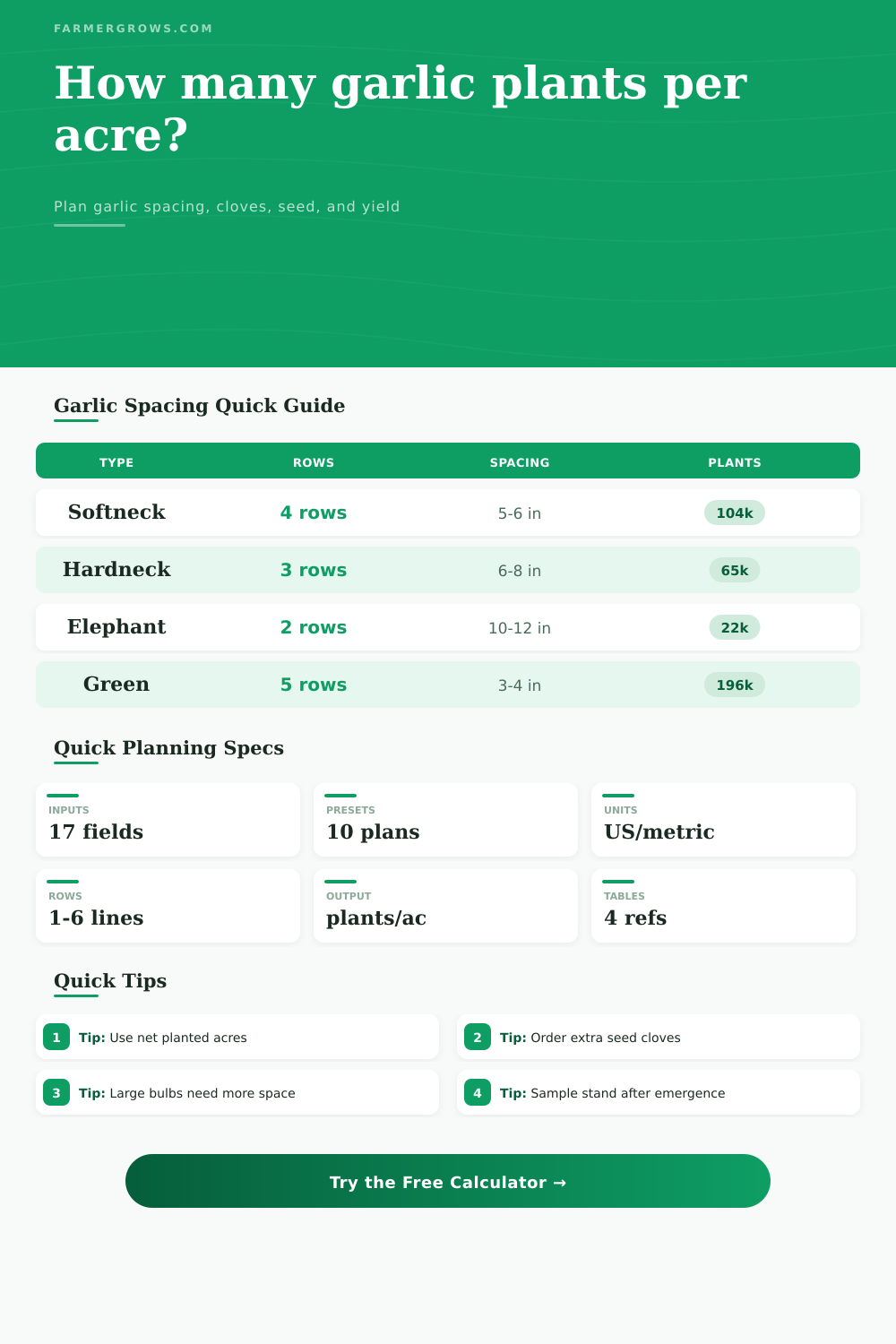
| Fresh softneck acre | 4 rows, 5 to 6 in | 87k to 105k | High-count fresh or cured bulbs. |
| Hardneck market bed | 3 rows, 6 to 8 in | 49k to 73k | Medium to large bulb production. |
| Porcelain seed crop | 3 rows, 8 in | 49k | Large cloves and seed garlic quality. |
| Green garlic | 5 rows, 3 to 4 in | 131k to 174k | Harvested before full bulbing. |
| Elephant garlic | 2 rows, 10 to 12 in | 17k to 21k | Large specialty bulbs. |
| Cultivated rows | 1 row, 30 to 36 in | 24k to 35k | Tractor cultivation and dry land. |
| Check | Formula | Example | Why it matters |
|---|---|---|---|
| Plants per 10 ft row | 10 ft / spacing | 20 plants at 6 in | Quick post-emergence stand count. |
| Seed bulbs | Cloves needed / cloves per bulb | 10,000 cloves / 8 | Converts planting count to bulbs. |
| Seed pounds | Seed bulbs / bulbs per lb | 1,250 bulbs / 6 | Estimates planting stock weight. |
| Harvest yield | Marketable bulbs x weight | 70k bulbs x 0.15 lb | Creates a field-level yield range. |
| Plants per hectare | Plants per acre x 2.471 | 80k/ac = 198k/ha | Useful for metric planning. |
Separate field population from seed order. Field population is based on planted stations. Seed order should also cover graded-out cloves, weak cloves, handling loss, and the grower's preferred buffer.
Match spacing to bulb size. Tight spacing increases plants per acre, but large hardneck and porcelain garlic often need more room for bulb size, airflow, and harvest quality.
In late October, you’re standing in a bare field with a bagful of expensive garlic bulbs; the temptation to stack ’em on top of each other is nearly real, since more plants per acre equals more bulb, right? Wrong. For most crops, yes, but garlic is a contrary beast that need some elbow room. Planting your hardnecks too close together won’t result in getting more yields; it’ll result in 100 little no-good bullets nobody wants to buy, all crammed in a single, sorry bulb. Learn the layout of your bed before you lift a trowel. This can make the difference between making a profit and wasting your time before you even start digging.
To begin, most growers estimate their density from neighborly advice (or maybe they just write it down somewhere). Then there is the issue that each type of garlic react differently to crowding. For instance, hardneck types is more sensitive to stress, and more likely to rot if not well-ventilated. Softneck types, such as those used for braiding, thrive in warmer weather and last for years in storage. So a density suitable for a braiding type would be too crowded for high-end market crop.
How to Plan Your Garlic Spacing
How do you go from feet-per-foot to projected yield, seed needed, and plant count? Doing the math in your head often lead to errors. With a formal calculator, you can account for variables that typicaly slip your mind on planting day; no more guessing. Then think about row spacing and bed centers. What’s the distance from the center of one bed to the next? That defines your main constraint (in terms of machinery and your root system). Wider spacing are needed if you’re operating a wide machine at mechanical cultivation time. That decreases the number of plant (duh), but it also decreases labor, and helps decrease disease pressure. Or maybe you have raised beds and will be hand-weeding them; you could put four rows closer together and get maximum square footage. Everything downstream depends on that decision.
Then there’s the matter of how far apart you’ll space the individual cloves in each row: How tight or loose should the in-row spacing be? That’s when the trade-off comes into view. More plants mean tighter spacing and smaller bulbs because there is less room for each plant to get nutrients. What doesn’t grow counts, too. In any planting nothing goes 100 percent right: Some cloves gets crushed en route, and don’t make it aboveground; others are culled (too small or diseased) to yield a good bulb. If you order by the theoretical number of plants desired, you’ll find yourself out of seed garlic before you can fill the field. Plan for emergence and culling losses; maybe assume that only nine out of every 10 cloves you plant will come up, and that one other in ten will need to be culled from total amount ordered. Losses to failure-to-emerge and culling aren’t something you should of ignore, since otherwise your harvest will be lopsided and your stands spotty.
The other thing to look at is the seed conversion. Softneck garlic tend to make more cloves per bulb than hardneck does. With some softnecks you can get up to 12 or even more, whereas with a hardneck like a porcelain type you’ll be lucky to get 4 or 5. That means you need to purchase many more pounds of seed to reach your target number of plants if you are growing a porcelain variety instead of a softneck. The converter will help you close this gap and convert the number of plants you want to see in a given space to the actual pounds of seed garlic required to fill out the rows.
And finally: Emergence leads to stand counts, which serve as the final reality check. With a measuring stick in hand, walk the field and count plants in a ten-foot section. Did you meet your plan? Was your actual stand lower, meaning you’ll need to reduce your yield projection, or higher, meaning you may have overestimated your spacing?
Planting garlic is one thing; planting a specific number of garlic plants that your market; and your soil. Can handle is another. Carefully planning the layout will transform chaos into a predictable system, where by the time those first green shoots poke through the surface, you already know precisely how many you’ve got and how much they’re each worth. Measuring twice means planting once; that gives you confidence.