
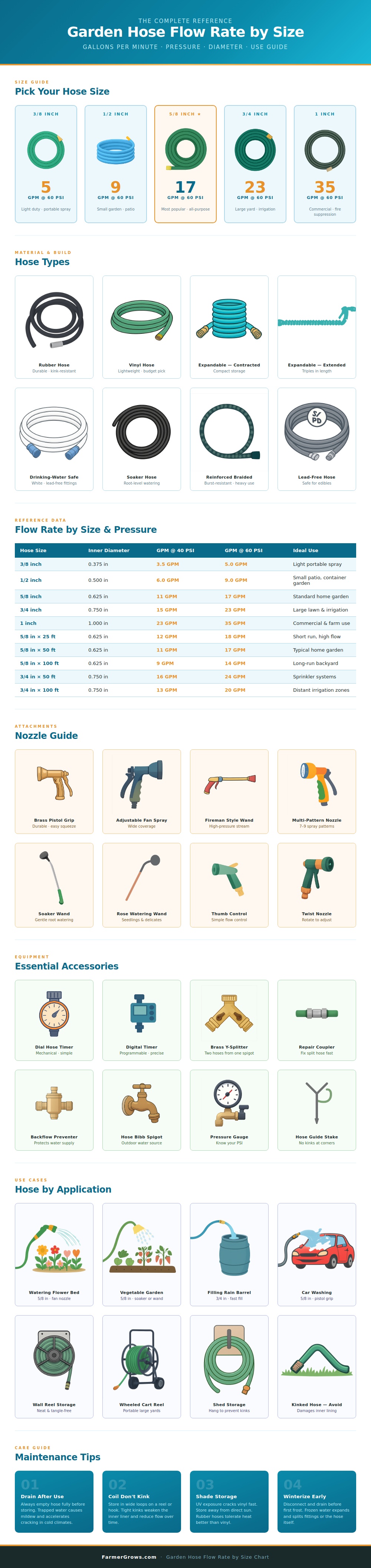
Low water pressure in a garden often occurs because a person have selected an improper hose, and low water pressure often occurs because the hose diameter are too small for the task. Many people assume that low water pressure is always a problem with the homes plumbing, but the specific characteristics of the hose being use often cause low water pressure. A hose function as a tunnel for water, and the diameter of the hose determines how much water can pass through the tunnel.
If a person use a hose with a narrow diameter, the water will experience friction against the inner wall of the hose, and this friction will cause the water pressure to decrease. Therefore, the diameter of the hose is the most importently specification for a person to consider when a person is selecting a hose. Different hose diameters is suitable for different tasks, and different hose diameters provide different level of water volume.
How to Choose the Right Garden Hose
A five-eighths inch hose is the standard choice for most residential yards because a five-eighth inch hose provide a balance between water flow and weight. A five-eighth inch hose is wide enough to water a lawn, but a five-eighth inch hose is also light enough for a person to move easy. If a person select a half-inch hose or a three-eighths inch hose, the water volume will be lower because the diameter is smaller.
A half-inch hose or a three-eighths inch hose are appropriate for small tasks, but a half-inch hose or a three-eighths inch hose isnt appropriate for large task. Conversely, a three-quarter inch hose move a large volume of water, and a three-quarter inch hose is appropriate for large irrigation zones, but a person will find a three-quarter inch hose heavier and more difficultly to maneuver. The length of a hose also affect the water pressure, and the length of a hose affects how much energy the water lose during travel.
As water travels through a hose, the water loses energy because of friction against the inner walls of the hose. A short hose, such as a twenty-five foot hose, will maintain more water pressure then a long hose, such as a hundred-foot hose, because a short hose provides less distance for friction to occur. Thus, a person must understand that a longer hose will result in lower water pressure than a shorter hose of the same diameter.
The material of the hose affect how long the hose will last, and the material of the hose affects how the hose perform in different weather condition. Vinyl is a common material for hoses, and vinyl hoses are often inexpensive, but vinyl hoses can become stiff and can crack when sunlight exposes vinyl hoses. Rubber is a durable material for hoses, and rubber hoses remains flexible in various temperatures.
Rubber hoses also resist kinking, and rubber hoses that resist kinking ensures that the water flow is not interrupted. If a person wants a hose that lasts for a long time, a person should of choose a reinforced rubber hose. The nozzle attached to the hose must match the specific task that a person is performing.
A multi-pattern nozzle allow a person to change the spray pattern, and a multi-pattern nozzle can provide a mist or a jet. A soaker wand or a rose watering head provide a gentle flow of water, and a soaker wand or a rose watering head is useful because a gentle flow of water prevent soil erosion. Additionally, a person must maintain the hose to ensure the hose remains functional.
A person should not leave a hose in the sun, because UV rays causes the hose material to become brittle. A person should also drain the water from the hose if the temperature drop, because water that freezes inside a hose will expand and split the hose. If a person drains the hose and stores the hose in the shade, the hose will last long.