Transplant Date Calculator
Plan indoor sowing, hardening, transplant, succession, and harvest windows from frost dates, crop type, soil temperature target, maturity days, and garden zone.
Enter your average last spring frost and first fall frost. The calculator counts backward for indoor sowing and hardening, then checks whether the crop has enough season left to mature before frost.
Transplant Calendar Results
Your transplant timing will appear here.
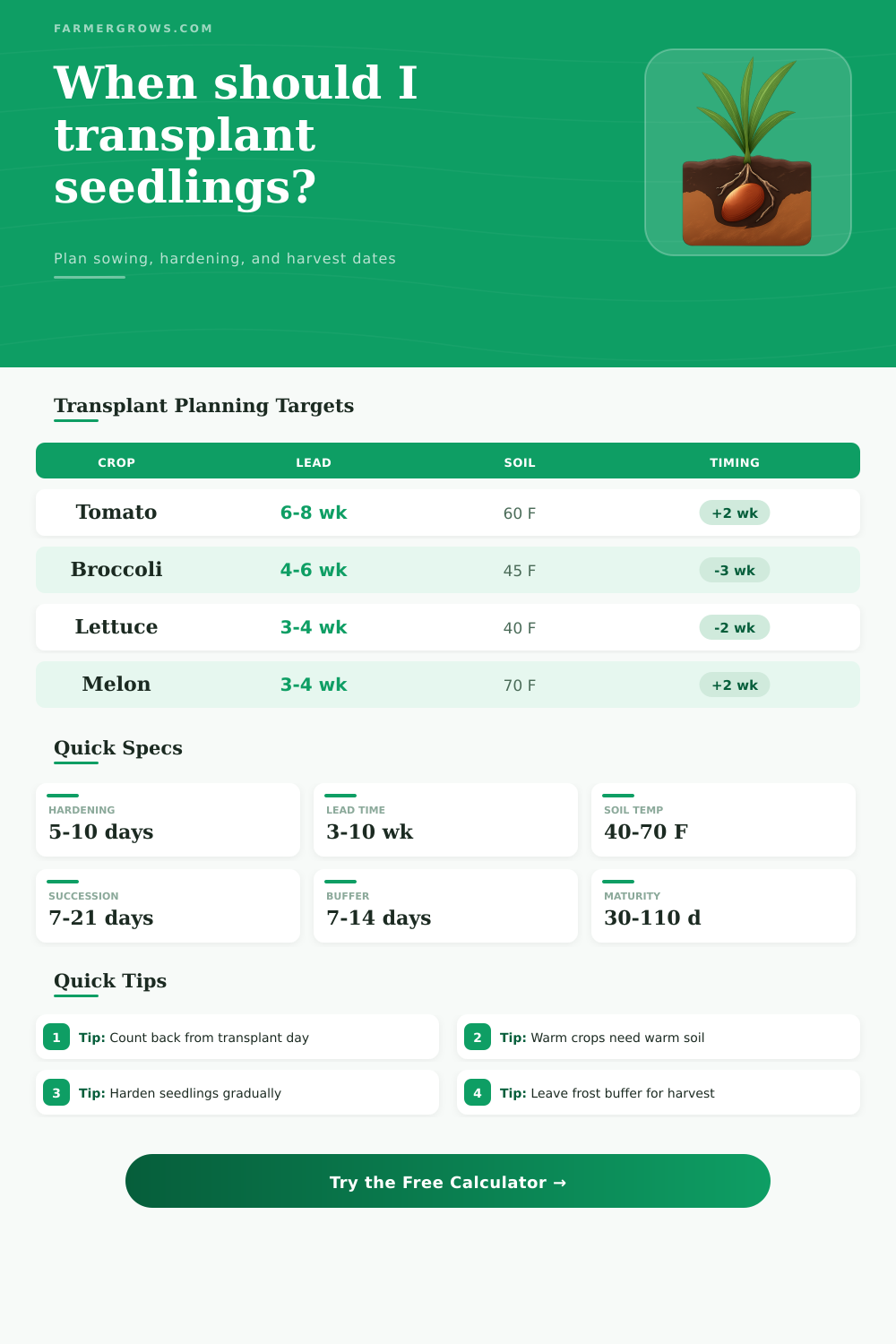
| Crop group | Indoor lead | Soil target | Typical transplant anchor |
|---|---|---|---|
| Tomato | 6 to 8 weeks | 60 F or warmer | About 2 weeks after last frost |
| Pepper and eggplant | 8 to 10 weeks | 65 F or warmer | 2 to 3 weeks after last frost |
| Broccoli and cabbage | 4 to 6 weeks | 45 F or warmer | 2 to 4 weeks before last frost |
| Lettuce and tender greens | 3 to 4 weeks | 40 F or warmer | 1 to 3 weeks before last frost |
| Melon, squash, cucumber | 3 to 4 weeks | 65 F to 70 F | 1 to 2 weeks after last frost |
| Onion starts | 10 to 12 weeks | 40 F or warmer | 3 to 5 weeks before last frost |
| USDA zone band | Common season length | Planning focus | Transplant caution |
|---|---|---|---|
| 3 to 4 | Very short | Use indoor starts for long crops | Protect warm crops after planting |
| 5 to 6 | Moderate | Balance spring starts and fall brassicas | Watch late cold snaps and early fall frost |
| 7 to 8 | Long | Plan spring and fall cool crop waves | Heat can close lettuce windows early |
| 9 to 10 | Very long | Shift many crops into cool months | Summer heat may matter more than frost |
| Succession style | Interval | Best crop fits | When to stop |
|---|---|---|---|
| Fast salad wave | 7 days | Lettuce, arugula, spinach starts | When heat or frost risk is high |
| Steady harvest wave | 10 to 14 days | Broccoli, basil, greens, scallions | When latest transplant date passes |
| Large planting wave | 21 days | Tomato, cucumber, squash, cabbage | When maturity no longer fits season |
| Single long crop | 0 days | Melon, pepper, onion, main crop tomato | After the first planned transplant |
| Soil temperature target | Crop examples | Transplant reading | Planning note |
|---|---|---|---|
| 40 F to 45 F | Onion, kale, lettuce, cabbage | Cool crop capable | Hardening still matters before wind and sun |
| 50 F to 55 F | Broccoli, chard, parsley | Shoulder season range | Root growth improves as soil warms |
| 60 F to 65 F | Tomato, basil, pepper | Warm crop minimum | Delay if nights remain cold or soil is wet |
| 70 F or warmer | Melon, squash, cucumber | Heat-loving range | Black mulch or tunnel cover can help warm beds |
Before sowing a tray: Confirm the transplant date first, then count backward by indoor lead weeks. This avoids root-bound plants when cold weather lingers.
Before setting plants outside: Check both air frost risk and soil temperature. Warm crops can stall badly when planted into cold, wet soil.
A transplant date calculator are a tool that help a person to determine when to move they plants from indoors to outdoors. Such a calculator use specific datas points to create a schedule for moving the plants because using a schedule will help to avoid any mistake that may occur as a result of the changes in the weather. For instance, people may desire to begin to plant their seeds following the experience of a particulary warmly day during the spring, but that warm day dont necessarily indicate that the soil will be warm enough to allow the plants to germinate and grow.
Additionally, if the crops is planted too early in the spring, they may die from exposure to frost during those early month. To create the schedule that indicate when to begin to transplant the plants from indoors to outdoors, the transplant date calculator must obtain several data point from the individual who utilizes the calculator. For instance, the calculator must ask for the date of the last spring frost and the date of the first fall frost.
How to Use a Transplant Date Calculator
Additionally, the calculator also requires information regarding the type of crop that are to be planted. For instance, some crops requires warm soil to germinate, while other crops can germinate and grow in soil that is less warmer than soil that is required of crops like tomatoes. Finally, the calculator also requires information regarding the soil temperature, since soil temperature has a similar effect upon the germination of the seeds as soil moisture.
Using the data entered by the individual who plans to utilize the calculator, the tool can calculate the window during which the plants should be transplanted into the ground outdoors. After calculating that window, the tool can calculate how many day must pass prior to beginning to start the seeds that will be transplanted into the ground. Starting the seeds at too late of a time will results in the seedlings having insufficient time to develop prior to being transplanted into the ground.
Starting the seeds too early, however, may result in the seedlings becoming root bound within the containers in which they are beginning to grow. In addition to calculating the date when the plants should be transplanted into the ground, the transplant date calculator may also be used to calculate how many different crop can be planted in succession within a season prior to the first fall frost date. For instance, if the setting for the succession interval of the calculator is set to two week, the calculator may calculate that crops can be planted every two weeks to ensure that there is a continual harvest of vegetables throughout that season.
Additionally, the calculator will also calculate the date of the last crop that can be planted within that season prior to the first fall frost date. If the maturity period for the crops is too long for the season, the calculator will indicate that the crops will not be mature prior to the fall frost will occur. In addition to determining the dates when crops should be transplanted outside, the transplant date calculator can also determine a schedule for the process of hardening the plants.
Hardening is the process of exposing the young plants to the element outside of the greenhouse or indoors to allow the plants to become accustomed to such an environment. If the plants are not hardened prior to exposure to these outdoor element, the plants may cease their growth. Thus, the transplant date calculator will provide the schedule to the individual to allow the plants to become accustomed to the outside environment, and will allow the plants to avoid spending to much time recovering from the shock of being transplanted outside.
Finally, there are a few thing that the individual should remember regarding the transplant date calculator. First, the calculator does not account for any microclimates in which the individual’s garden might exist. Second, the calculator does not account for any change in the weather that may occur during the season.
Thus, it is always a good idea to utilize a soil thermometer to determine the actual temperature of the soil in which the plants will be transplanted into the ground. This transplant date calculator can be of use in both spring and fall planning. During the spring, the calculator may help the individual to determine when to move from winter crop into the soil to spring crops.
During the fall, the calculator can determine when to begin to plant fall crops into the ground so that they mature prior to the first fall frost. Additionally, if the fall crops are planted too late in the fall they will not reach the desired size prior to the ground freezes. Conversely, if they are planted too early in the fall, the summer heat may cause those crops to bolt.
By using the transplant date calculator to determine the various timelines for beginning to start seeds indoors, warming the soil, and harvesting the produce, the individual can begin to understand any potential conflict in the timeline. Thus, by using such a calculator and understanding each of these timelines, an individual will have more organization in their management of the growing season.