Garage Exhaust Fan CFM Calculator
Estimate garage fan airflow from room volume, target air changes, engine fume factor, heat load, door relief, duct losses, fan staging, and local climate mode.
This calculator sizes general garage exhaust ventilation. It is not a substitute for code-required combustion air, carbon monoxide alarms, sealed vehicle exhaust extraction, or hazardous-area ventilation where fuels, solvents, or charging gases are present.
Garage Exhaust Fan Result
The recommended fan size uses the larger of volume/fume airflow and heat-removal airflow, then adjusts for doors, climate, duct loss, and reserve.
| Garage use | Typical ACH | Fume factor | Door relief | Fan note |
|---|---|---|---|---|
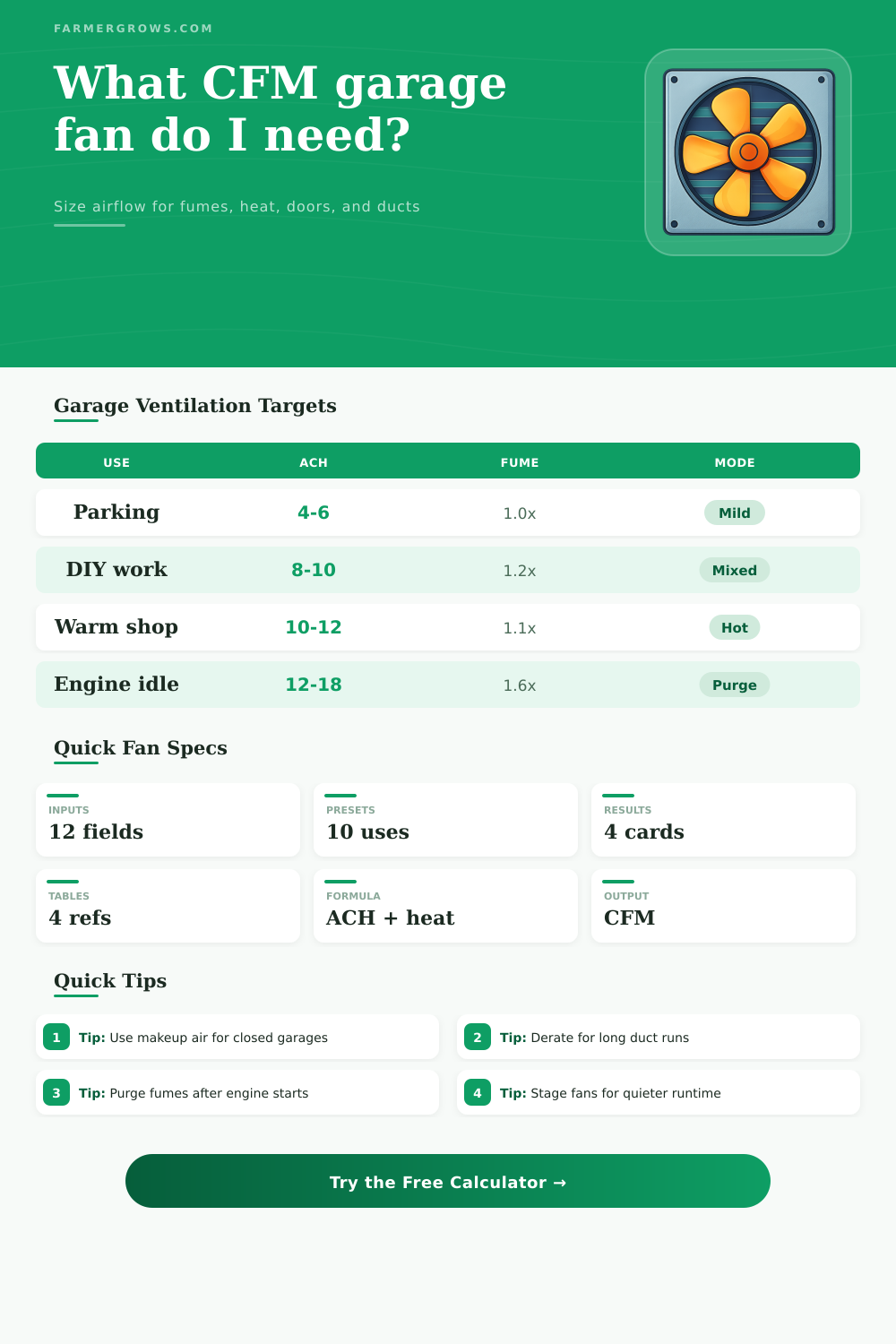
| Attached parking only | 4 to 6 | 1.00 to 1.10 | Closed or cracked door | Continuous low stage or timer purge |
| Two car family garage | 6 to 8 | 1.10 to 1.25 | Service door or wall intake | Good match for staged wall fans |
| DIY and tool work | 8 to 12 | 1.10 to 1.35 | Louvered intake preferred | Heat and odor often drive sizing |
| Small engine warmup | 10 to 14 | 1.35 to 1.60 | Door cracked or overhead open | Run purge cycle after shutdown |
| Short vehicle idle purge | 12 to 18 | 1.60 to 2.00 | Open overhead door best | Use local tailpipe capture when needed |
| Garage volume | 6 ACH | 10 ACH | 14 ACH | 18 ACH |
|---|---|---|---|---|
| 2,000 cu ft | 200 CFM | 333 CFM | 467 CFM | 600 CFM |
| 3,000 cu ft | 300 CFM | 500 CFM | 700 CFM | 900 CFM |
| 4,500 cu ft | 450 CFM | 750 CFM | 1,050 CFM | 1,350 CFM |
| 6,000 cu ft | 600 CFM | 1,000 CFM | 1,400 CFM | 1,800 CFM |
| 8,000 cu ft | 800 CFM | 1,333 CFM | 1,867 CFM | 2,400 CFM |
| Heat load | CFM at 8°F rise | CFM at 12°F rise | CFM at 18°F rise | Typical source |
|---|---|---|---|---|
| 2,000 BTU/hr | 231 CFM | 154 CFM | 103 CFM | Battery chargers and small tools |
| 5,000 BTU/hr | 579 CFM | 386 CFM | 257 CFM | Warm vehicle and sun gain |
| 10,000 BTU/hr | 1,157 CFM | 772 CFM | 514 CFM | Hot attached garage afternoon |
| 15,000 BTU/hr | 1,736 CFM | 1,157 CFM | 772 CFM | Large shop, tools, and roof gain |
| 25,000 BTU/hr | 2,894 CFM | 1,929 CFM | 1,286 CFM | High heat purge condition |
| System item | Common derate | What it represents | Design check |
|---|---|---|---|
| Wall fan with short hood | 5% to 12% | Backdraft damper and exterior hood loss | Keep discharge path short and clear |
| One filter or bug screen | 8% to 18% | Resistance as the screen loads with dust | Make it easy to clean or replace |
| Two elbows and duct | 15% to 30% | Friction and turn loss before discharge | Use smooth duct and generous radius bends |
| Louvered intake too small | 20% to 40% | Fan starves for makeup air | Provide intake free area near the door |
| Long duct plus filter | 30% to 50% | Multiple losses added together | Consider larger fan or simpler routing |
Makeup air matters: A closed garage can make a rated fan move far less air. Add a louver, crack a door, or size an intake path with enough free area.
Use purge timing: Run the fan before and after vehicle starts or small engine work. For serious exhaust, use direct tailpipe capture and verified CO protection.
Proper airflow in a garage are important for the ability of the garage to manage the heat and fumes that it creates. When a car is driven into a garage, the car introduces heat and fumes into the space. That heat and fumes will remain in the space if the garage door is closed.
A garage that is used only to park cars will have different airflow requirement then a garage that is used in conjunction with various workshop tools. The volume of the garage and the rate of airflow that is provided to the space must be balanced to provide sufficient airflow for the space according to its use. The volume of the garage is a start to calculating the necessary airflow for the space, but does not account for all of the variables.
How to Calculate Garage Airflow
For instance, a very large garage that does not experience much activity will require a different amount of airflow than a large garage that is filled with workshop tool and engines. The workshop tools and engines introduce more heat and fumes than a parking space alone. Thus, the air change calculator allow for the input of these different variables to ensure that the user makes an accurate guess of the amount of airflow that is required.
One of the main variables in the estimation of the required airflow in a garage is the rate of air change per hour. A basic garage that is used for parking cars may require four to six air changes per hour. A garage that is used as a workshop area for engine and tool changes may require eight to twelve air changes per hour.
If an engine is started in the garage, the space will require more air changes per hour to clear the fumes created by the engine. Thus, the user can adjust air changes per hour to ensure that the calculated airflow accurately reflect the intended use of the space. Heat can be another main driving factor for the required airflow in a garage.
For instance, if the roof of the garage is exposed to the sun, and if the cars that are parked in the garage contain heat, the heat will raise the temperature within the garage. The formula for calculating airflow includes dividing the total amount of heat that is loaded into the garage by a value representing the desired temperature rise of the air that the garage exhausts. A small temperature rise will require the fan to move more air through the garage to permit the temperature to remain low.
Thus, the user will calculate airflow calculations for the removal of heat from the garage alongside the calculation of the airflow according to the volume of the garage. The higher of the two calculations will become the baseline airflow value for the garage. The position of the door of the garage and the presence or lack of makeup air will impact the ability of the fan to move air through the space.
Fans require air to be introduced into a space in order to effectively move air through that space. In a very tight garage that does not possess an intake path for air, the fan will essentially be pulling against itself and will fail to perform according to the specifications of the fan. Introducing intake air through the opening of a service door, the addition of a louver, or the leaving of an overhead door open will provide the air that the fan requires.
The air change calculator allow these factors to be accounted for through the use of a multiplier. Fans that are installed in a garage will have ducts, elbows, screens, or filters that will create resistance against the movement of the air. Air will move through these components, but the air will be at a lower rate than that which is provided by the fan.
Commonly, these components create resistance that derates twenty percent of the airflow. The calculator derates the airflow according to these components after accounting for the door and climate variables. The climate in which the garage is established will impact the requirements for airflow in the space.
In hot climates, fans will have to be running for longer periods of time to clear the heat from the space. In cold climates, however, fans will require lower speeds to avoid the pulling of cold air into the space. The fan has a climate mode that the air change calculator use to account for these different climates.
The use of a fan that has multiple stage of airflow will provide the user with more flexibility with airflow management than a fan that has only a single stage of airflow. For instance, a fan with lower stages of airflow may be used to provide continuous movement of air to the space, but a fan with high stages of airflow will aid in the rapid clearing of fumes from the garage after an engine starts. Thus, the user can divide the calculated airflow by the number of stages that the fan has to account for the airflow requirements in the space.
The user will determine the intake area in the space once they calculate the required size of the fan. A guideline for intake area is that there should be between seven-tenths and one square foot of intake area for every thousand cubic feet of airflow per minute. If the intake area is too small for the volume of air that is to be exhausted, the fan will create negative air pressure within the garage.
Negative air pressures will cause air to be pulled into the garage through any cracks in the structure, which may pull odors from areas outside of the garage into the space. In addition to the cars that are stored in the garage, there are other heat sources for the space. For instance, fuel cans may be stored in the garage.
Battery charger may be located in the space. The roof of the garage may have a large portion that faces south and is exposed to the sun. Each of these variables will increase the amount of heat that is loaded into the space.
Each of these variables should be entered into the air change calculator. Otherwise, the calculated airflow requirement will be too low to effectively clear the amount of heat that will be loaded into the space. If there is too low of an airflow rate, the fan will not be able to handle the heat that is created in the garage on hot afternoons.
Once the user calculates the airflow in the air change calculator, a fan model with the appropriate amount of airflow must be purchased. The specifications for fans are provided free air ratings. Fans will move less air when they are installed in the garage than the free air rating due to the resistance against the air movement.
Thus, a fan model that is slightly larger than the calculated airflow will allow for the required airflow, with some extra head room for the loading of filters and seasonal changes. The last step in the calculation is to verify that the fan model will deliver the calculated airflow. An anemometer can be used to measure the airflow that is created by the fan.
An alternative would be to use the time that it takes for fumes to leave the garage. If the garage still feels stuffy, the issue is with the intake path for the air rather than the fan model. Thus, the exhaust system for a garage will work best if the user create it to match the specific requirements of that garage.
The air change calculator will provide a number for the required airflow that considers both the steady and rapid movement of air within the space.