💧 Gallon Per Acre Calculator
Calculate exact liquid application rates for any field or garden area — imperial & metric
⚡Quick Presets
🔧Calculator Settings
✅ Calculation Results
📊Typical Application Rates by Product Type
📏Area Conversion Reference
| Area (acres) | Sq Ft | Hectares | Sq Meters |
|---|---|---|---|
| 0.1 acre | 4,356 sq ft | 0.0405 ha | 404.7 m² |
| 0.25 acre | 10,890 sq ft | 0.1012 ha | 1,011.7 m² |
| 0.5 acre | 21,780 sq ft | 0.2023 ha | 2,023.4 m² |
| 1 acre | 43,560 sq ft | 0.4047 ha | 4,046.9 m² |
| 2 acres | 87,120 sq ft | 0.8094 ha | 8,093.7 m² |
| 5 acres | 217,800 sq ft | 2.0234 ha | 20,234.3 m² |
| 10 acres | 435,600 sq ft | 4.0469 ha | 40,468.6 m² |
| 40 acres | 1,742,400 sq ft | 16.187 ha | 161,874 m² |
🧪Gallons Per Acre vs. Liters Per Hectare
| Rate (gal/ac) | Liters/ha | Gallons per 1,000 sq ft | Gallons per 1,000 m² |
|---|---|---|---|
| 5 gal/ac | 46.8 L/ha | 0.115 gal | 0.124 gal |
| 10 gal/ac | 93.5 L/ha | 0.230 gal | 0.247 gal |
| 15 gal/ac | 140.3 L/ha | 0.344 gal | 0.371 gal |
| 20 gal/ac | 187.1 L/ha | 0.459 gal | 0.494 gal |
| 25 gal/ac | 233.9 L/ha | 0.574 gal | 0.618 gal |
| 30 gal/ac | 280.6 L/ha | 0.689 gal | 0.741 gal |
| 40 gal/ac | 374.2 L/ha | 0.918 gal | 0.988 gal |
| 50 gal/ac | 467.7 L/ha | 1.148 gal | 1.235 gal |
| 100 gal/ac | 935.4 L/ha | 2.296 gal | 2.471 gal |
| 200 gal/ac | 1870.8 L/ha | 4.592 gal | 4.942 gal |
🚜Tank Load Reference — Tanks Needed by Area
| Area (acres) | At 20 gal/ac | At 30 gal/ac | At 50 gal/ac | Tanks (100-gal) |
|---|---|---|---|---|
| 1 acre | 20 gal | 30 gal | 50 gal | 0.5 tank |
| 2 acres | 40 gal | 60 gal | 100 gal | 1 tank |
| 5 acres | 100 gal | 150 gal | 250 gal | 2.5 tanks |
| 10 acres | 200 gal | 300 gal | 500 gal | 5 tanks |
| 25 acres | 500 gal | 750 gal | 1,250 gal | 12.5 tanks |
| 40 acres | 800 gal | 1,200 gal | 2,000 gal | 20 tanks |
📋Common Project Reference — Total Gallons Needed
| Project | Area | Rate | Total Gallons |
|---|---|---|---|
| Home lawn | 0.25 ac | 10 gal/ac | 2.5 gal |
| Market garden | 0.5 ac | 20 gal/ac | 10 gal |
| Small farm field | 1 ac | 25 gal/ac | 25 gal |
| Mid-size crop field | 5 ac | 20 gal/ac | 100 gal |
| Large field block | 10 ac | 30 gal/ac | 300 gal |
| Commercial farm | 40 ac | 20 gal/ac | 800 gal |
| Orchard block | 5 ac | 50 gal/ac | 250 gal |
| Greenhouse beds | 0.1 ac | 15 gal/ac | 1.5 gal |
Liquid application rates is measured in gallons per acre. Gallons per acre tell you how many gallons of liquid will be spread over 43,560 square feet of ground. Since one acre are equal to 43,560 square feet, this unit of measurement will allow you to apply the product to small plots of garden ground to large farm.
Accurate application rates of liquid product need to be used. Using inaccurate application rates can cause weeds to not be adequate treated or the crops can be damaged by using too much of the liquid product. The application rates for each product are listed on the product label because the sprayer that is use to apply the product may output different amounts of the liquid.
How to Measure and Apply Liquids by the Acre
If the application rate is not calculated for the product to be applied, then the rates is guessed, which can lead to liquid runoff and ineffective treatment of the area with the chemical product. The rates for each type of product are not the same. Depending on the type of product that is to be used, the rates will differ.
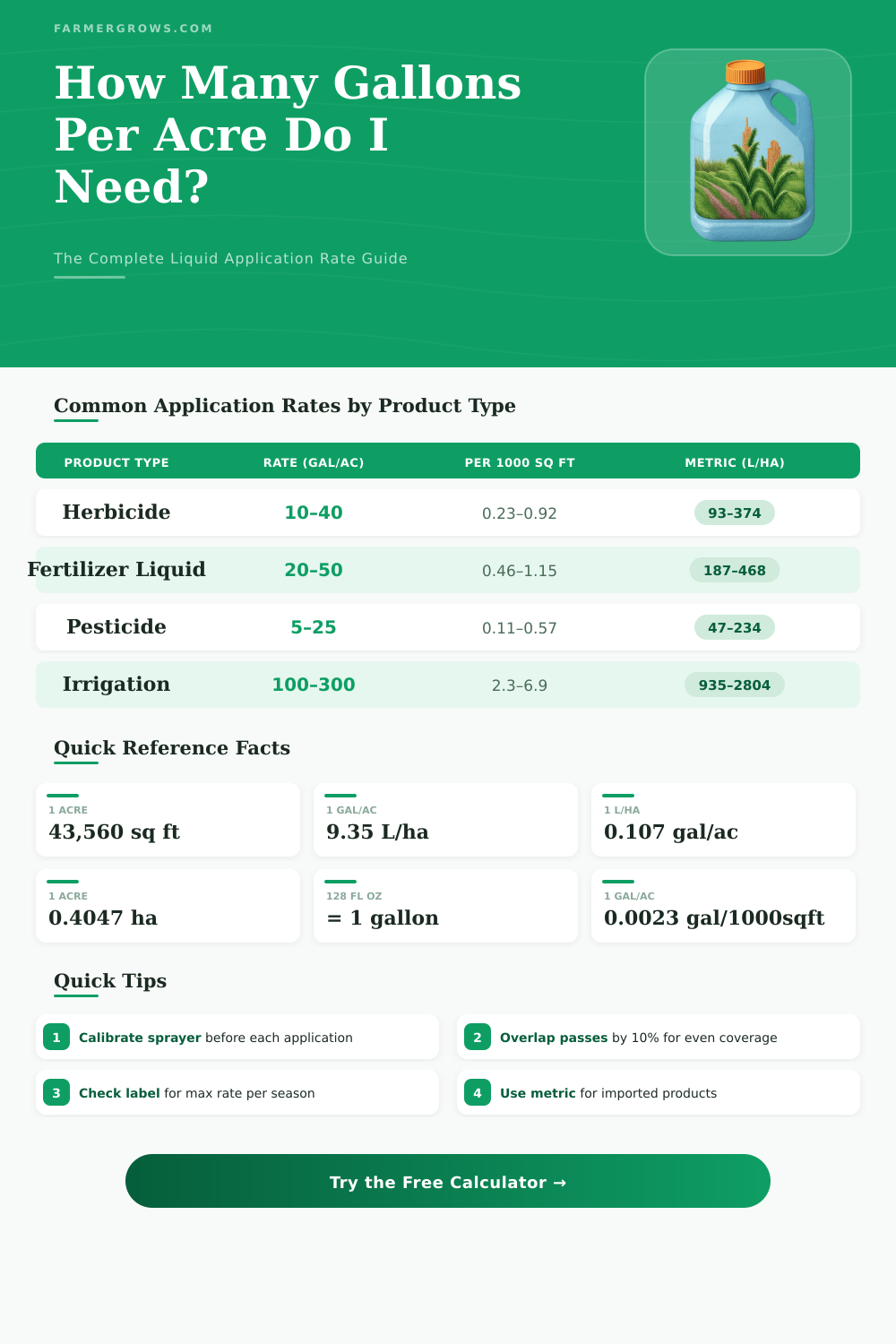
For instance, herbicides are a type of product that tend to have low application rates between 10 and 40 gallon per acre. Liquid fertilizers has higher gallons per acre rates ranging from 20 to 50 gallons per acre. Pesticides tend to have lower rates again between 5 and 25 gallons per acre.
For irrigation, much higher rates is required, ranging from 100 to 300 gallons per acre. Lastly, rates for soil amendments are between 30 and 80 gallons per acre for the product to penetrate the soil as necessary. In order for the sprayer to effective apply the liquid products at the rates that are required, the sprayer must be calibrated properly.
One way to calibrate the sprayer is to use a catch test. To perform a catch test, the sprayer should be drive at normal speeds for a distance of 100 feet, during which the nozzles will release the liquid into jars to catch the liquid output from the sprayer. To determine the rate at which the liquid is being apply to the field, divide the total volume of the liquid that was collected by the distance that the sprayer traveled multiplied by the width of the swath that was treated.
If the sprayer is not calibrated before performing the treatment of the field, the nozzles of the sprayer may become clogged with the applied liquid. If the nozzles of the sprayer become clogged, the application rate will be less than the target application rate for the field. A buffer should be accounted for in the calibration of the sprayer for the field.
A 10 percent buffer is one commonly used amount for the buffer to account for any overlap of the field that may be treated by the sprayer’s passes and any drift of the spray liquid from the sprayer’s nozzles. A 10 percent buffer ensures that there is enough liquid to complete the spraying of the field. The shape of the field may impact how much liquid is required to treat the field.
The shape of the field determine the acreage of the field. If the sprayer treats a rectangular shape field, it is relatively easy to calculate the acreage of the field. If the field to be treated have a circular or triangular shape, more complex mathematical equations are required to calculate the total acreage of the field to be treated.
Various tools are available online to convert the measurements of a field in feet to acres, especially for fields of irregular shape. These tools can also convert the application rate of liquid to the field from gallons per acre to metric unit. One gallon per acre is approximately 9.35 liters per hectare.
These metric units can be especially helpful for farmers who purchase agricultural products whose recommended application rates are in liter per hectare. Any calculations of the amount of liquid needed for application to the field should always be rounded up. Rounding the amount of liquid up that is calculated ensures that there is enough liquid to treat the field.
In addition to the factors related to the field itself, there are also some environmental and soil-related factors that can impact how the liquid behave within the field. Fields with sandy soil percolate liquids faster than fields with different soil types. Because of this, fields with sandy soil may require higher application rates for liquids than fields with other soil types.
Clay soil often resist the penetration of liquids into the soil. For this reason, fields with heavy clay soil may require lower application rates for liquids applied to the land. Another environmental factor to consider is the impact that wind may have on the field.
Wind can cause drift in the liquid that is being spray onto the field. Drift can lead to the loss of 5 to 15 percent of the liquid that was dispensed from the sprayer’s nozzles. It is necessary to check the wind and the moisture content of the soil within the field that is to be treated by the sprayer.
The wind and soil moisture can impact the amount of liquid that land on the field. Finally, precision in the application of the liquid to the field is important for minimize the amount of liquid that runs off of the field and enters the nearby waterways.