Greenhouse Heat Loss Calculator
Estimate winter greenhouse heat demand from glazing U-values, surface area, indoor-outdoor temperature difference, infiltration ACH, and night curtain savings.
Use the calculator for quick design checks, heater sizing conversations, and comparing glazing or insulation curtain upgrades. It estimates steady-state heat loss, not boiler efficiency, fuel use, or operating cost.
Estimated Heating Load
Enter greenhouse details to see conduction, infiltration, and curtain impacts.
| Glazing or envelope type | Typical U-value | Relative heat loss | Best use |
|---|---|---|---|
| Single polyethylene film | 1.20 BTU/hr-ft²-°F | Very high | Season extension where supplemental heat is limited |
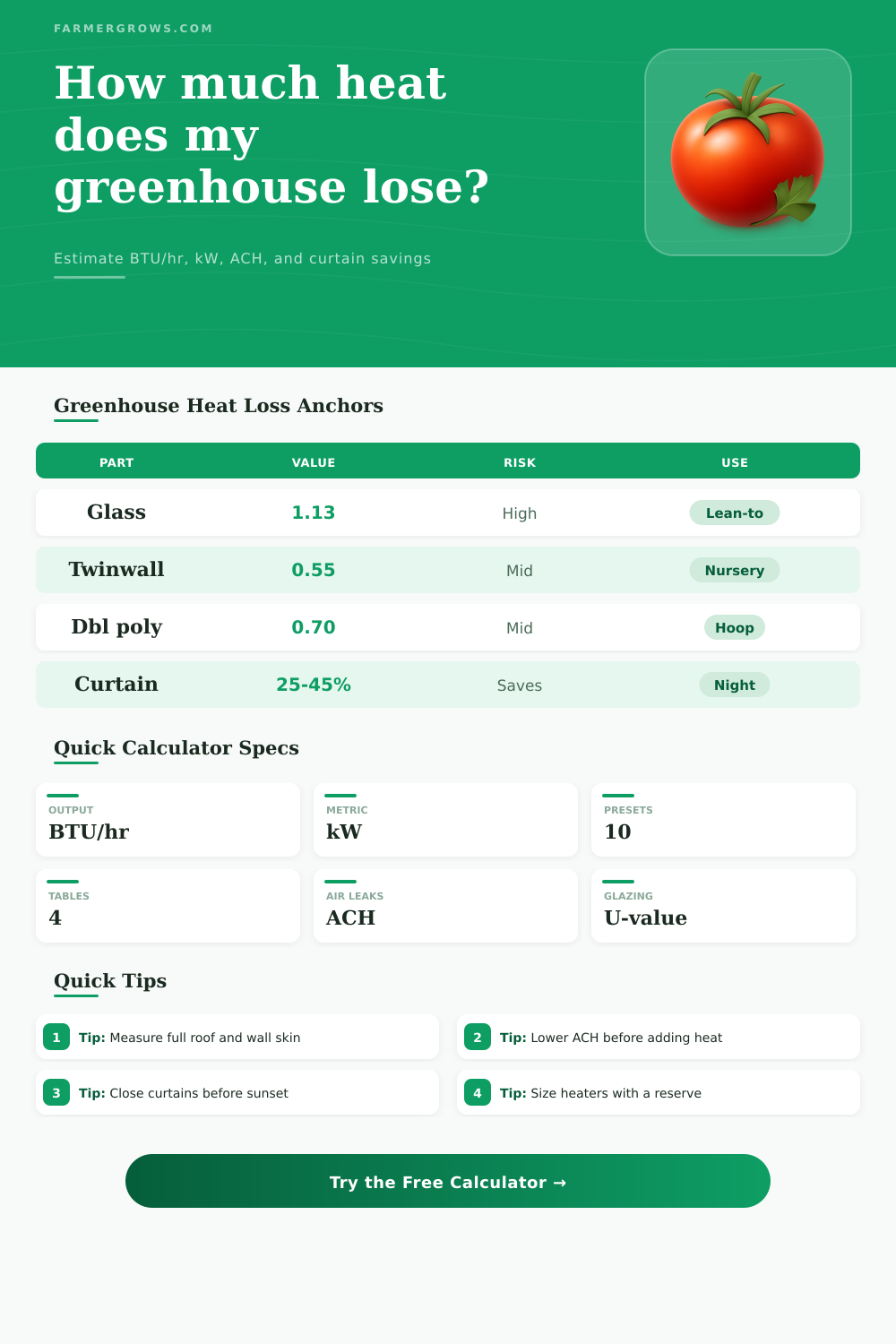
| Single glass | 1.13 BTU/hr-ft²-°F | High | Older glasshouses and lean-to structures |
| Inflated double polyethylene | 0.70 BTU/hr-ft²-°F | Medium | Hoop houses and production bays |
| Double glass | 0.65 BTU/hr-ft²-°F | Medium | Permanent structures with better sealing |
| 8 mm twin-wall polycarbonate | 0.55 BTU/hr-ft²-°F | Lower | Nursery houses and wind-exposed sidewalls |
| 16 mm triple-wall polycarbonate | 0.42 BTU/hr-ft²-°F | Low | Propagation and overwintering compartments |
| Greenhouse tightness | ACH range | What it means | Calculation effect |
|---|---|---|---|
| Very tight modern bay | 0.3 to 0.5 | Good seals, doors, and fan shutters | Infiltration is a small load share |
| Average production house | 0.8 to 1.2 | Normal cracks, vents, and doors | Use 1.0 ACH for early planning |
| Older glass or poly house | 1.5 to 2.0 | Noticeable leakage at laps and openings | Air sealing may beat bigger heaters |
| Windy or damaged envelope | 2.5 plus | Loose doors, tears, gaps, or open louvers | Heat loss can jump quickly |
| Curtain setup | Reduction to covered loss | Typical coverage | Notes |
|---|---|---|---|
| No curtain | 0% | 0% | Use this for daytime heating or uncovered tunnels |
| Light shade/thermal fabric | 15% to 25% | 50% to 70% | Works best when side gaps are controlled |
| Standard energy curtain | 25% to 35% | 65% to 85% | Common night energy strategy |
| High-performance curtain | 35% to 45% | 75% to 90% | Useful over large roof areas |
| Double curtain strategy | 45% to 55% | 80% to 95% | Best for warm crops in cold regions |
| Formula component | Imperial equation | Metric equivalent | Use in this calculator |
|---|---|---|---|
| Conduction | Area × U × ΔT | Watts = m² × W/m²K × K | Glazing and envelope skin loss |
| Infiltration | 0.018 × volume × ACH × ΔT | Converted from air heat capacity | Cold outside air replacing warm air |
| kW conversion | BTU/hr ÷ 3412.142 | kW direct heater output | Metric heater capacity result |
| Reserve capacity | Load × (1 + reserve %) | Same multiplier | Recommended heater size buffer |
Surface area tip: Measure the actual skin when possible, especially on gothic hoops, inflated double-poly houses, and structures with attached headhouses. Small roof-area errors become large BTU/hr errors during a 50°F temperature difference.
Air sealing tip: A curtain cannot fix a drafty envelope. Check door sweeps, fan shutters, baseboards, roll-up sides, and torn film before increasing heater capacity for a high ACH result.
To understand greenhouse heating, it is first important to understand how heat escape from a greenhouse structure. Many believes that purchasing a larger heater for a greenhouse is the best solution to heat the greenhouse during the winter months of growing vegetable. However, it is possible that a larger heater isnt the most efficient solution for heating a greenhouse structure.
Heat loss from a greenhouse structure occurs primarily through the processes of conduction and infiltration. Conduction is the process through which heat escape from the greenhouse structure due to the materials used to construct the greenhouse. The material that is used to glaze the greenhouse have a major impact upon the rate of heat loss from the greenhouse through conduction.
How Heat Escapes a Greenhouse and How to Keep It Warm
For instance, if single-wall polyethylene is used as the glazing for the greenhouse, heat will easily escape from the greenhouse structure due to the fact that single-wall polyethylene has a high U-value; the more higher the U-value of a material, the less effective that material is at insulating against heat loss. Similarly, single-wall polyethylene is a thin material; thin materials permit heat to easy escape from the greenhouse. For these reasons, it is better to use materials with low U-values (such as twin-wall polycarbonate or inflated double-poly) to insulate against heat loss through conduction.
Infiltration is the process of heat loss that occurs as warm air from within the greenhouse escape through gaps in the greenhouse structure. Infiltration occurs through door frames, roll-up sides of the greenhouse, and even through greenhouse vents. Infiltration is measured in air changes per hour (ACH).
High infiltration rates result in cold air from outside the greenhouse replacing warm air from within the greenhouse. You can reduce infiltration by the use of weatherstripping and silicone sealant to cover the gaps in the greenhouse structure. Reducing infiltration rates will reduce the amount of heat that must be replaced within the greenhouse structure.
A second strategy for reducing heat loss from greenhouses is the use of a thermal curtain. A thermal curtain is a fabric that is dropped over the vegetable crop that are growing within the greenhouse at the time of sunset. A thermal curtain creates a “pocket” of dead air between the curtain and the greenhouse roof; this layer of air reduces the amount of heat that escapes from the greenhouse through the roof.
It is important that the thermal curtain is placed such that it covers the entire greenhouse roof; if the thermal curtain does not cover the greenhouse roof, heat will escape through that gap. The heating load for a greenhouse is calculated to determine the amount of heat that is required to maintain a greenhouse with a steady internal temperature. Heating load is often expressed in units of BTU per hour or kilowatts.
It is important to understand that you should not size the heater for a greenhouse according to the heating load of that greenhouse. In addition to the fact that the weather within a greenhouse is not likely to remain steady, other factors such as wind chill and temperature drops can drastically reduce the internal temperature of a greenhouse. Therefore, a “cushion” of 15% to 20% should of been added to the heating load to ensure that the greenhouse heater will not be required to run at 100% capacity during periods of record low temperatures.
In sizing the heating system that will be utilized within the greenhouse structure, there are a variety of options. For instance, the greenhouse structure may be constructed with high-performance materials (like triple-wall polycarbonate) to reduce the amount of fuel that is required to heat the greenhouse; or, the greenhouse may be constructed with cheaper materials, which will lead to higher fuel costs. For instance, an individual may opt for purchasing a large heater for a simple hoop-house greenhouse structure, as opposed to constructing a greenhouse that is sealed against infiltration.
Thus, once an individual calculates the heating load of the greenhouse, determines the rate of heat loss through conduction and infiltration, they can plan the heating system for the greenhouse with precision.