
plant a fruit tree and water it. Wait for spring, when colors appears like a promise of fruit. It is easy to assume that a bloom are a promise of a harvest. Lots of orchard problems stem from this assumption.
Bloom isn’t a one-and-done. Instead, it’s a timeline governed by the trees own genetics, along with winter chill and spring warmth. Knowing the timeline transform your management of the season. Anxiety becomes a plan.
Why Timing Is Important for Fruit Trees
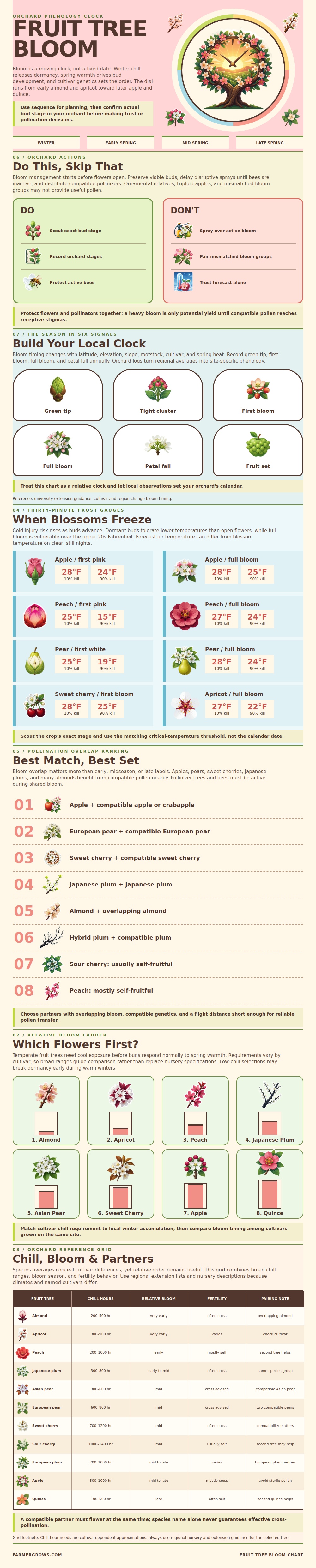
This is how the ladder of events plays out in visuals (see image above). Apricots and almonds kick things off; then come peaches and plums shortly thereafter. Warmer days await apples and quinces.
Why does this matter? It illustrates timing. When the weather turns cold, you want to look for frost. Understanding which fruit will flower next help you decide where to target your defense, even though we can’t cover everything. Can’t protect all those flowers! Knowing that your peaches are three weeks away from blossoms but your apples just about ready will help you know what’s at risk first.
That’s the order in the chart, what comes first, second, third, etc.; and what comes next. It’s a tight line. Cold that kills an open blossom does no harm to a dormant bud. According to data, temperatures just below twenty-eight degrees F will have killed apple flowers at full bloom. Ninety percent loss might occur at twenty-four degrees. Peachy-keen: Even more vulnerable some points of their life cycle, peaches begin being killed by higher numbers in the twenties.
Don’t rely solely on what you think the weatherman will say; check your buds to see where you’re at. A clear, calm night will make it colder in the flower cluster than your porch thermometer says. Don’t just look up; look out. Scout the trees.
The other half of the equation are pollination. And that means accurate timing, too. Many fruit tree are not good self-pollinators. They require a compatible blooming partner. The infographic reminds us that sweet cherries require a partner of their own species. Apples also need a partner, but they can use a crabapple or another apple instead. It’s not just having another fruit tree; it has to be the right type, and it has to bloom at the same time.
There’s no such thing as cross-pollination if your late plum isn’t open when your early one closes. Without overlap, there is no fruit set. Bees have to be around then, because the window is small. There’s no avoiding overlap; meaning you have to make decisions early, before any of the flowers even start opening.
Know who will be pollinating what by knowing your partners ahead of time. Use charts that rank how well various species’ blooms overlap (are they compatible?). Don’t spray when bees are on duty. Wait until pollinators is not active, according to the guidelines, and don’t use any chemicals while they are foraging. It’s a minor change in how you operate, but it saves the ones who actualy fertilize things.
MAKE A notebook of your orchard. Mark down each year’s blooms: when its green tips emerge, the day of first bloom, then the date of petal drop. Local observation trumps any regionwide average any day. Those are the variables of your own microclimate, your slope, your elevation. Log the data for several years and you’ll have a better-than-general-calendar, specific to you. Use the generic one just as a guideline.
Follow the cues given by your own eyes. And make yourself the last word on the timing of things. The closer we listen to the clock, the clearer we hear it tick. The more we observe, the less we guess. Then the harvest follows.