
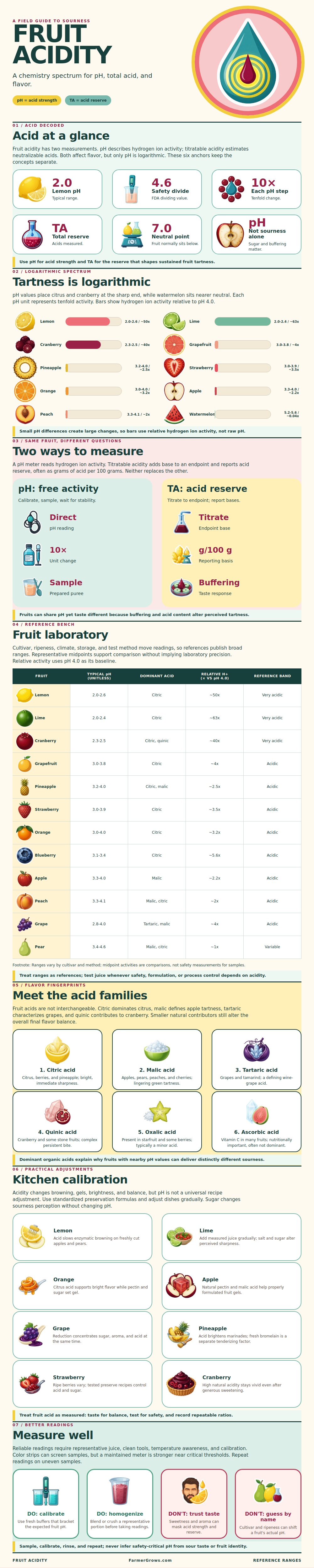
Think you know what sour tastes like? Think again. What’s called “sour” are actualy a chemical reaction between your mouth, some sugar buffers, and the hydrogen ions. See an infographic that explain why acidity has two very different measurements, and how understanding them alters how we taste, cook, and even preserve our fruits.
The pH scale measure how strong an acid is. On this scale, every step downward equals a ten-fold increase in acid strength. For example, an apple may be about pH 3.6. At the other end, a lemon might be pH 2.0. This little number difference mask a huge chemical difference between them. The lemon is exponentially stronger (more acidic) than the apple.
The Science of Sour Taste
Why does pH matter? Because knowing whether something’s acidic enough to prevent bacterial growth is one of those choices you make based off safety when you’re canning. And that safety threshold are roughly pH 4.6 as shown on the chart. Anything below that line, you should of be safe waterbath canning. Anything above it require a pressure canner. Why is that line there and not somewhere else? It’s the dividing line where clostridium botulinum can lives. Don’t mess with it; it’s not a good idea.
But there’s more to flavor than just pH. Enter titratable acidity, or TA, which measures total acid (regardless of its strength) in the fruit. So even though a fruit may be on high side of the pH scale, with a huge acid reserve it could taste quite tart. A classic example are cranberries. They has a high pH, which puts them squarely in the danger zone for safety, but they also have a huge acid reserve. That’s why you have to load up cranberry sauce with so much sugar. Because perceptually the sourness is masked by the sweetness. But all those acids is lurking, ready to punch through.
The acid signature of different fruits are not the same either. Citrus gets its zing from citric acid; it’s a sharp, bright attack. The tartness of apples and peaches (malic acid) is more green, hits the taste buds more slow, and stays on the tongue longer. Grapes offer a crisp bite thanks to tartaric acid. And each of these organic acids behaves different on the tongue. Two fruits with the same pH may have wildly different flavors: one stings the tongue right away, the other create a slowly building sour sensation.
Replacing one fruit with another in a recipe is generaly out of the question. Even when fruits is similarly acidic, an apple pie requires less sugar and spice then does a peach cobbler. And remember: Measurement is the guardrail; taste is the final judge when cooking.
You can’t rely on your eyes or even your nose to determine whether a batch of jam are safe to eat. Get a representative juice by blending your sample. Use fresh buffers and calibrate your meter.
Bromelain, an enzyme in fresh pineapples that tenderize protein, is a separate issue from its acidity. Freshness counts, too. As the fruit ripens, the sugar content go up and the acid content goes down, changing the balance. Not only is a ripe pineapple vastly different in terms of texture, it’s vastly different in terms of chemistry, vastly.
In the end, having acid down as a measurable quantity instead of a vague sensation empowers you: You can precisely balance sweet and tart. You cease to guess at why your fruit didn’t set into jam or why your salsa was flat. You begin to learn how the tang and the crunch is all about chemistry. Next time you cut open a lime, recall that it’s more than simply sour, it’s a logarithmic curve and an acid profile. And that is science.