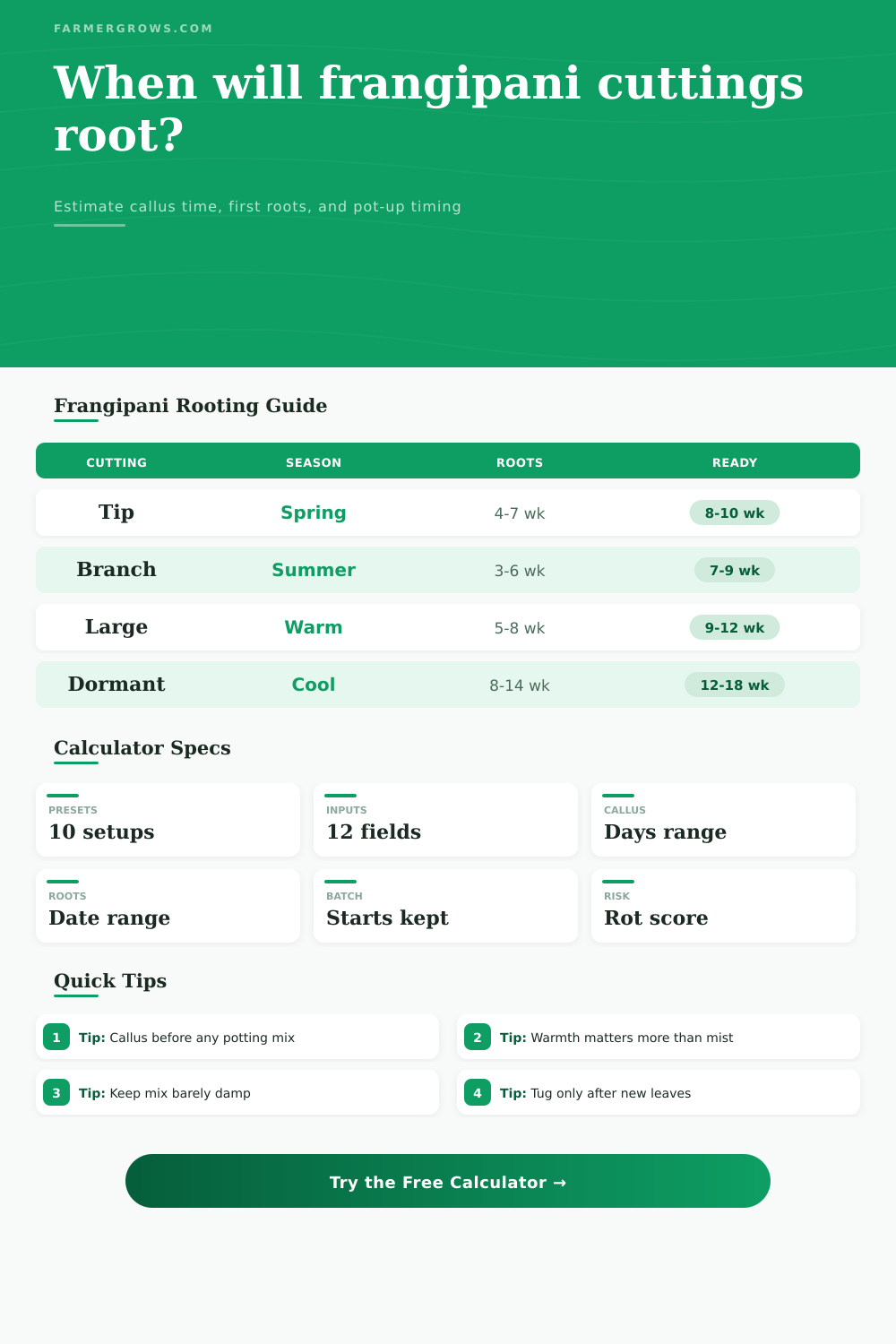
Frangipani Cutting Root Time Calculator
Estimate frangipani cutting callus time, first root window, transplant-ready timing, likely rooted count, and rot risk from cutting size, season, warmth, medium, and moisture.
Start with a real Plumeria cutting setup, then tune the cutting diameter, drying time, temperature, rooting medium, watering approach, and batch count.
Rooting Timeline Estimate
Adjust the inputs to estimate your cutting window.
Callus upright in shade, pot into airy mix, then water lightly only after the cutting has settled and warmth is steady.
Bottom warmth can shorten the root window when air stays bright and ventilated, especially for spring starts.
High humidity slows drying at the base. Use extra perlite, avoid deep pots, and keep rain off unrooted cuttings.
Low root-zone warmth can stretch rooting for many weeks. Bright light and restrained watering matter more indoors.
| Frangipani cutting type | Typical callus time | First root window | Pot-up ready window |
|---|---|---|---|
| Green tip with firm base | 5–10 days | 4–7 weeks | 8–10 weeks |
| Semi-woody branch cutting | 7–14 days | 4–8 weeks | 8–12 weeks |
| Large woody cane section | 10–21 days | 5–9 weeks | 9–14 weeks |
| Dormant leafless hardwood | 10–21 days | 8–14 weeks | 12–18 weeks |
| Soft fresh tender tip | 4–8 days | 5–9 weeks | 9–13 weeks |
| Root-zone temperature | Rooting effect | Moisture adjustment | Expected behavior |
|---|---|---|---|
| Below 65°F / 18°C | Very slow | Keep almost dry | Callus may hold without rooting until warmth returns |
| 65–74°F / 18–23°C | Slow to moderate | Light sips only | Roots can form, but timelines often stretch |
| 75–85°F / 24–29°C | Optimal | Barely damp airy mix | Best balance of callus activity and low rot pressure |
| 86–92°F / 30–33°C | Fast if ventilated | Check dryness more often | Good rooting, but full sun can dehydrate tops |
| Above 92°F / 33°C | Stress risk | Shade and airflow | Heat can shrivel cuttings before roots support water uptake |
| Medium choice | Drainage level | Rooting speed effect | Rot-risk note |
|---|---|---|---|
| Cactus mix plus perlite or pumice | High | Baseline | Reliable for most home growers |
| Mostly perlite or pumice | Very high | Slightly faster | Excellent oxygen, but needs careful anchoring |
| Coarse sand and grit | High | Neutral | Heavy pots can stay cool in winter |
| Regular potting mix | Moderate to low | Slower | Can hold too much water around the callus |
| Coir blend with perlite | Moderate | Neutral to slow | Use extra mineral aggregate in humid climates |
| Outdoor ground or nursery bed | Variable | Season dependent | Only works well when soil is warm and free draining |
| Readiness sign | What to look for | Timing clue | Action |
|---|---|---|---|
| Firm tug resistance | Cutting resists a gentle lift | Usually after first roots branch | Stop checking often and var roots extend |
| New leaf growth | Leaves expand without wilting | Often follows root initiation | Increase light gradually |
| Roots at drainage holes | White roots visible near pot edge | Ready stage, not first-root stage | Pot up without breaking new roots |
| Wrinkled stem | Stored water is being used | Common before roots form | Keep warm, avoid soaking to compensate |
| Soft dark base | Base collapses or smells sour | Rot warning at any stage | Cut back to clean tissue and re-callus |
Let the base seal before potting. Frangipani cuttings are succulent stems. A dry, firm callus is the main defense against basal rot when the cutting first meets potting mix.
Use warmth without wetness. Root-zone warmth speeds root initiation, but unrooted frangipani cannot drink much. Keep the mix airy and barely damp until resistance develops.
There it is: a fresh frangipani cutting (maybe even with a little spray bottle in hand, ready to coax roots from that woody stem) that you carry home with high hopes. It seems such an easy deal. Stick the thing in ground, water it, and wait for that green miracle to happen.
And then…weeks go by. The woody stem shrivels up. The bottom end near the ground turns all mushy. It dies, and you end up convinced you have a black thumb.
How to Root Frangipani Cuttings
It is rarely about your ability, it is far more about patience. Yes, frangipanis are succulents at heart; their thick stems hold water, and don’t respond well to instant availability before they’ve got the machinery to drink it up. Once you know how the calculations work, you will realy save your cuttings. Then, you just feed your unique conditions into the calculator above and presto! the math is done for you.
And yes, people get hung up on “more water means faster growing.” Wrong. First, a frangipani cutting has to heal itself before it can absorbs anything from the soil. That’s why it goes through what we call a callus stage; it’s non-negotiable. If not, an open wound invites rot organisms to take up the stem and kill the cutting from bottom up.
The tool helps you track mental waiting time and accounts for ambient humidity, as well as the thickness of the stem being cut. You stop wondering whether your cutting’s dead or just resting.
The second invisible force at work is temperature. The best range for the root-zone is from seventy-five to eighty-five degrees F., which are prime for forming roots. Cool soil is your starting point in early spring, and it’s going to be quite a wait. The calculator figures that in… And you should also expect it to take longer to get those first roots if the heat conditions are poor.
And no, it’s not ambient air temp alone. It’s what’s happening down there in the dirt. A heat mat underneath the pot can mean the difference between a rooted cutting in six weeks versus a dormant stick that has waited idly by for two months.
Airy: That’s more important than what medium you use (as long as it drains). Coarse sand, perlite, cactus mix are all fine. Avoid standard potting soil, which retains moisture. A swamp forms in the soil around the cutting’s base. Even when the cutting’s stem is callused well (which I’ll get back to), the higher the medium weight, the greater chance of rot. That’s clear from the reference table on the page.
Oxygen needs to gets to the cut site. And the medium needs to go bone-dry between waterings. If it doesn’t, why would the cutting want to make roots and seek water? It just sits there, safe but stagnant, till the dampness gives way to decay.
Light is a balancing act. Too little (deep shade) doesn’t stimulate the right hormonal changes to get rooting going; too much (full sun) will pull water out of what’s left of the leafy part of the plant faster than any root can grow, starving the stem before it makes roots. Bright indirect light is good, as it keeps the plant healthy enough that it doesn’t have to struggle, while still using its stored energy to grow more tissue. Growers tend to err on the side of caution with this one, but some brightness does help the callus firm up. And it conditions the plant to living in its starter pot, then beyond.
Not all are winners, far from it. Even on a perfectly good day, some cuttings just aren’t as strong. Maybe they were cut wrong… Or stored wrong. Don’t expect a 100-percent success rate from each stem. That’s a set-up for disappointment. The tool will tell you what stems it believes will root, so adjust your expectations accordingly. If you begin with six cuttings, expect to lose one or two. That’s normal. It’s par for the course. You’re trying to get enough plants to use in filling your own garden, or sharing with friends, not producing a perfect specimen.
In the end: Rooting frangipanis is a study of self-control. Do less than your heart says; do less than you feel you should. Water less. Move it to a sunnier spot less often. Check for progress less often each day. Trust the biology. Let the ground go dry at the base. Water it only if it’s barely moist. Wait until you feel firm resistance; until you know there’s a root system gripping on.
Then it all makes sense: When you cease to treat the cutting as a needy houseplant and begin to think of it more like a sleeping bulb, you can see that sometimes when things shrivel, they are not dead. Sometimes, they’re putting work into their own foundation…