
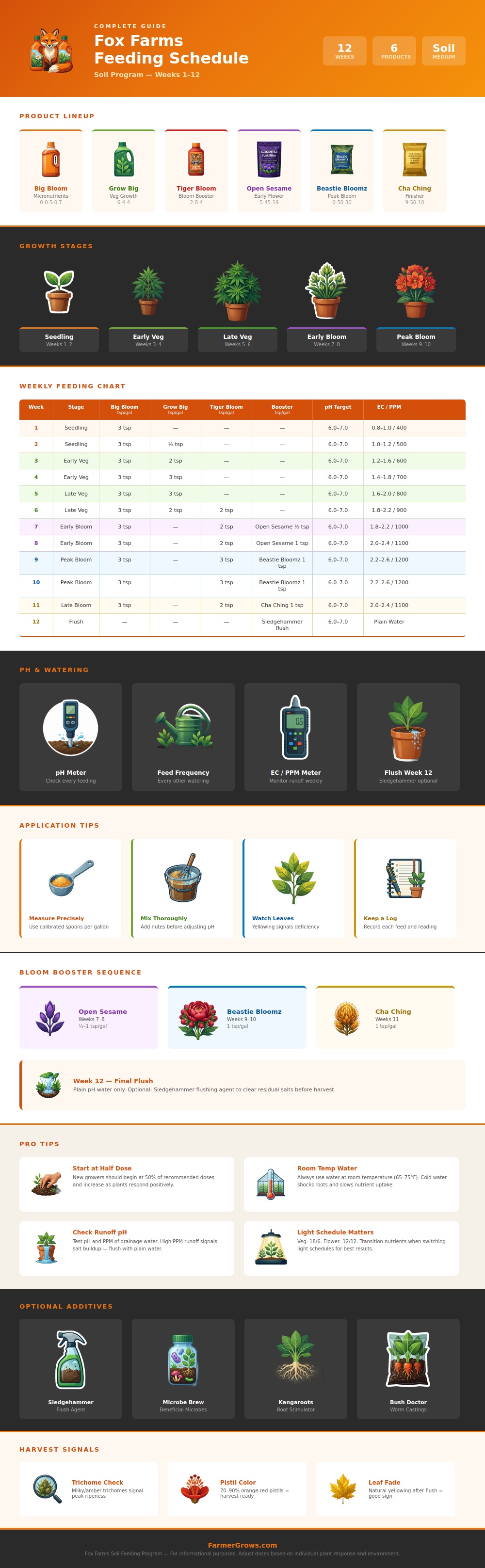
First of all, you have this really delicat seedling. If you mess around with it wrong, you’ll kill it. Then you get into that fragile first week where so many people freak out because they think they need to feed a lot. That’s when you stop. Stop right there and don’t add anything else. Less is more, remember?
So how do you feed a plant gently from the beginning? You want a gentle root system that grows without excessive salts that burn your roots. And that’s why we use Big Bloom on the early stage. Enzymes, micronutrients. Those things helps break apart organic material in the soil and the plants is able to grab the nutrients naturaly. It starts gently to build solid foundation.
How to Feed Your Plant Step by Step
Weeks go by, and the plant becomes established. Then it’s time for vegetative growth. Now you feed with Grow Big. Follow chart above. This shows that you should of increase this solution during an earlier stage of veg. By week 3, you want two tsp/gallon. Yes, you’re feeding nitrogen here. Nitrogen promotes strong stems and lots of leaves.
But be observant with those leaf. Are there too many nutrients? They’ll turn pale or curl. How do you tell nutrient burn versus a nutrient deficiency? That’s tricky. That’s something beginner mistake all the time. To know what your plants like, you’ve got to observe what they do. Don’t take the bottle label as gospel.
The plant then flips to flower. Now its requirements change, meaning soil needs something different. It needs less nitrogen and more potassium and phosphorus. Typicaly this shift occur during weeks six or seven of the 12-week cycle. At this point, Tiger Bloom becomes your primary nutrient source for high phosphorus during bud development. It has high phosphorus for bud development.
But you don’t throw it on there willy-nilly. You follow the dose based off the stage. Use a light hand during early bloom time and feed more heavily during peak bloom time. The visual guide illustrates that nicely. And it also shows how the booster products such as Beastie Bloomz and Open Sesame adds on to the base nutrients.
A lot of people get these boosters wrong. Rather than thinking of them as supplements to their regimen, they think it’s a magic potion. Use Open Sesame for early flowering. Promotes bud sites and roots. Beastie Bloomz is for peak swelling. High phosphorus to encourage. Finisher: Cha Ching in late. Improves aroma and color.
The trick is knowing what to add and when to add it. Adding too much potassium too early will block other nutrients. Each item has a particular role at that time, so you do them in order. Not haphazardly but purposefully.
The other factor. Equally important (is water quality). For a soil grow, aim to maintain a pH between six and seven. The roots can’t take up nutrients when your water’s off. It doesn’t matter whether the nutrients is pricey. To prevent buildup of salts in the medium, periodically check your runoff. Just a quick check of the drainage water will tell you what to do: Should you adjust? Should you flush?
Cleanup time: Last week was all about stopping. Stop feeding completely. Flush with pure water. Optional: If you want, try a sledgehammer agent to knock down any leftover salt. It tastes better then is smoother. Keep an eye out for natural foliage color change when the plants begin to tap their own reserves.
Don’t panic when leaves starts going yellow! That’s not wrong. In fact, that’s good, it means you did something right.
It starts with gentle beginnings, builds up strength, fuels the bloom, and cleans up afterward. It all came from waiting patiently with the seedling. Trust the cycle. Harvest will do the rest.