
You’re in the garden center, holding a packet in your hand, expecting a show of color. You bring it home, plant it…but nothing happens. What’s up?
Often what’s up: you’ve bought a plant without knowing its shape. The trouble doesn’t come from sun or water, but from botany. It is a simple fact that most gardeners overlooks. They see a flower and see only the colored petals, and nothing more.
Know Your Flower Type to Grow Better Plants
Here are some of the engineering below the surface. Know which kind of flower you have and suddenly the way you treat that flower make sense. You’re no longer just guessing.
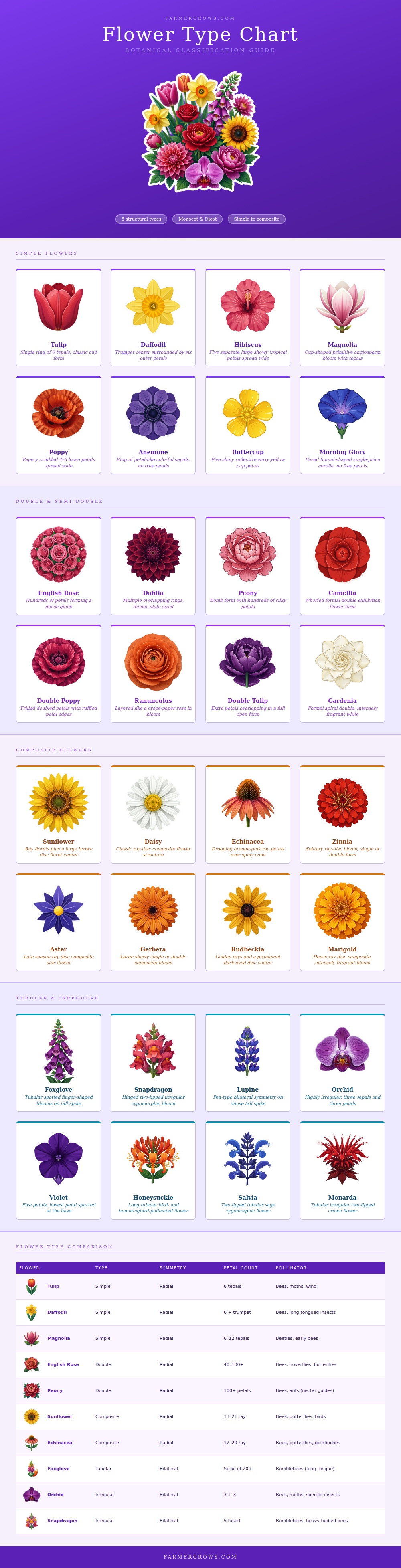
A flower can be broken down into one of these five categories in the chart above. This will help you know how to care for a plant before you buy it or plant it.
Go easy on the flower power Keep it simple: Tulips are simple. Magnolias are simple. The flowers has one ring around them. With a tulip, you’re looking at six tepals that make a cup shape. There is nothing secret going on there. Often they’re forgiving. Why? They tell you exactly what they need: light, space, and to be left alone. If you’re just getting your feet wet in gardening, this design give you a better chance of success. This isn’t nature versus selective breeding that twisted the plant into some unrecognizable shape. It’s just following its biology.
Semidoubles and doubles need extra care. A semidouble or double flower isn’t what nature intended; somebody intervened. (A peony, an English rose.) They’ve stacked on the petals till they form a tight ball of a thing. Beautiful! But there is a price. Those flowers may have hundreds of petals, as the chart indicates. All that tightness holds in moisture. This encourages mold. It blocks air flow. Want a ruffle-ruffled ranunculus or a double camellia? Better give them plenty of air circulation. This is because what you’re growing here are a fragile shape. It costs the plant energy to sustain itself so…make sure it’s well ventilated and lit.
People are often confused about what a composite flower is. That means it’s a bunch of little ones banded together. A daisy is one example. A sunflower is another example. You see the big outer florets, the ones we call rays, but inside those is another set of even smaller ones, called disc florets. Those do the actual work of reproduction; those outer ones gets all the glory. It is smart design. One plant gets to feed lots of pollinators with just a single stalk. This is good if you’re trying to help out the butterflies and bees. Good for them to have someplace to land. Echinacea, for instance, is on list in the chart (as are zinnias). Other easy garden plants will keep right on going, with each one opening up a bit differently so that they is in flower week after week.
They’re specialists in tubular and irregular flowers. These include snapdragons and foxgloves. Each flower has been selected by nature to fit its visitor, the beak of a hummingbird, the tongue of a bee. They are irregular and usually bilateral (with a right and left side). It is a kind of lock-and-key arrangement. Plant them, and you’ve created a habitat. You might not be attracting all insects. You’ll attract those who it’s made for. And that helps you make a garden that supports life. It’s about building an ecosystem, one shaped petal at a time.
It is all about seeing forms, such as tubular ones. Some are composite, which means they have flowerheads with many small flowers packed tightly together. Simple? Knowing this eliminates guesswork, and you read the garden like a series of relationships. Need to diagnose a sick plant? Look at its form. The solution to your problem might be right there in its shape. You should of looked at the biology first.