
TAKING A walk into the garden center on A saturday morning, you’ll see lots of pots in all kinds of shades and shapes. Most of us selects the one whose flowers first catch our eyes. Big mistake.
A small group of baby’s breath and a big tall sunflower are great plants to have, but they requires varying amounts of space, which means you’ll end up with one taking up most of the space while the other goes missing. Bloom size isn’t about memorizing facts; it’s about making a design that doesn’t look like it was thrown together at random.
Why Plant Size Matters in Your Garden
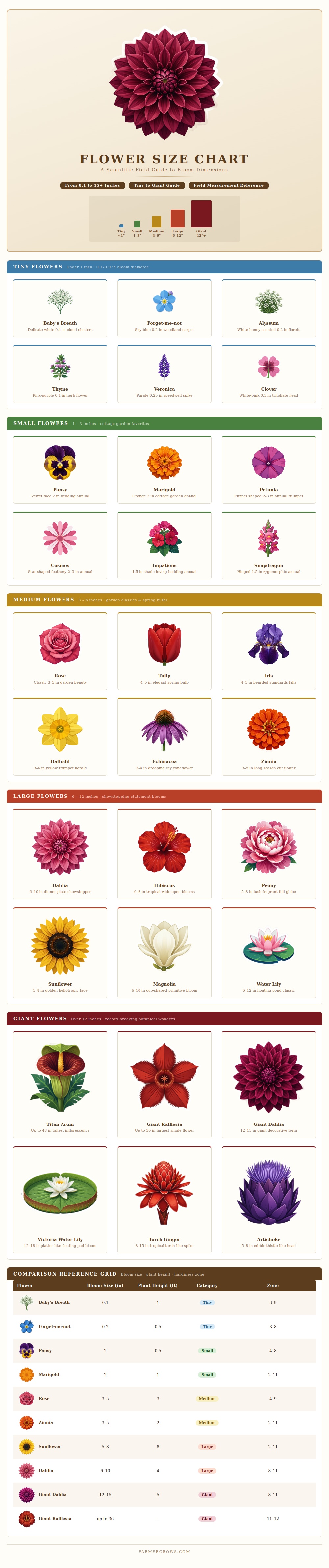
Above are five sizes, which I have grouped into categories in a chart (see top). These help you lay out your garden. They range from smaller than an inch to more than four feet across (forty-eight inches). Why? Because these different sizes has a different impact on the eye when moving around the garden.
When all the flowers seems to weigh visually equally, the garden feels cluttered. It is a little thing that makes all the difference.
Some tiny ones are forget-me-nots. Thyme. Individual flower are so small we tend not to notice them. But massed like this they form a carpet effect, which is good. This is what makes baby’s breath so useful in arrangements. It fills space but doesn’t cover up other blooms. Scatter it amid big flowers and it dissapears. Mass it, and it knits all the other pieces together into a single unit.
The middle range: From small blooms to roses that might be three to five inches wide, this is where most of the garden action take place. We grow pansies and marigolds; we grow roses. They provide structure and good color, which is why most gardeners choose them as workhorse plants. At that size you get the big-picture effect (you can spot a 3- to 5-inch-wide rose from afar), yet it’s not so large that it dominates its border companion. Middle ground equals flex space. Zinnias pair well with daffodils; irises goes nicely with echinacea, since neither overwhelms the other.
Giant bloom: Statements Dinner-plate dahlias, hibiscus flowers…they want to be seen. Use them as statements, not filler for the background. A giant flower in a little border won’t work. Give these guys some room. On their own, against a solid backdrop (such as a wall) they’re best. Some giants, according to the infographic, measure more than a foot across. They can easily dwarfs everything else nearby if you aren’t careful. It’s not the plant’s fault. It’s a design mistake.
And then there’s the question of hardiness zones. You might have a great place for a sunflower, but what about one that gets eight feet high? That thing goes in a moveable pot or out to the back of the bed. Failure to factor bloom size into the equation makes all those bigger things cast shadows on smaller things. These are the basics of light and space.
Make it A CONVERSATION: Imagine the garden as a dialogue. Some things shout; some whisper; others are in between. Too much shouting is too noisy. Too much whispering’s too quiet. It’s all about balance. Begin with the biggest plants, put some of the mediums in there to backstop them, and then add some tiny stuff to round out the edges. That’s the beauty of this formula, respecting visual weight. The idea is for the eye to be able to settle comfortabley on what we see. Think in terms of scale; that’s how you make a collection of plants cohere.
Sometimes a little thing is more interesting then a big thing…if used right. You should of started with the biggest plants first. It could of been easier if you planed it out. The furnitures is also important.