
When you buy flowers for a reason that matters, there’s a particular sort of panic that follows. It is not like the one when you buy the wrong shade of paint. This is sharper: Should it be fifteen stems? Does that mean I love you? Or will this do as a polite nod to your existence? Volume can make all the difference between making a meaningful statement and offering up only a token gesture. But most of us has no instinct for how volume converts into impact. Choosing size of a bouquet is less about gardening and more about calculating how much emotion you want to show.
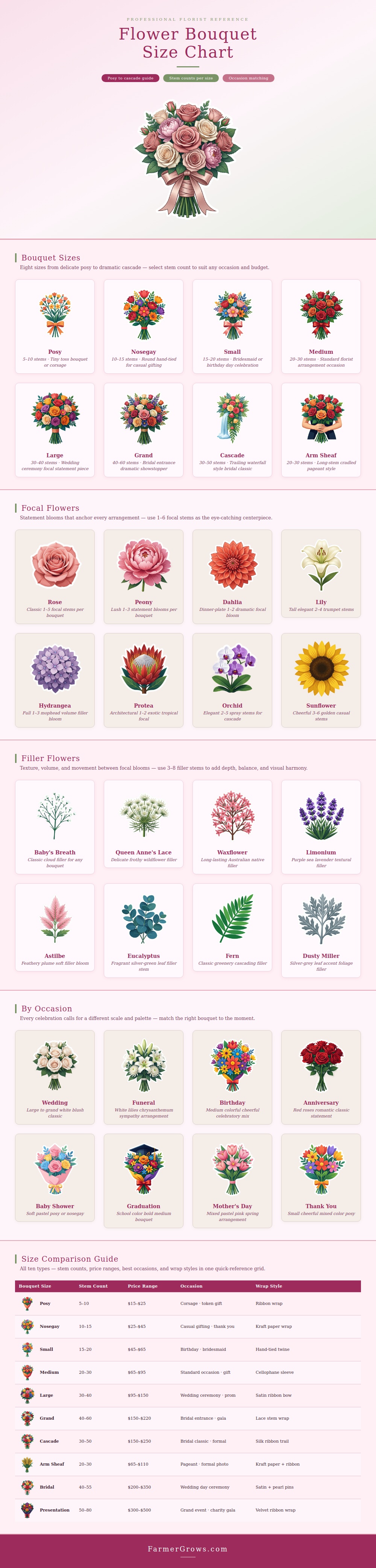
This is where visual above comes in: it maps stem count directy to occasion weight. No guessing required. It tells you that a posy, with its demure five to ten stems, is meant for intimate occasions (like a tiny toss bouquet, or maybe a corsage). Its very form say, I’m going to be intimate with you. But then try using this tender architecture for a wedding altar, uh-oh. There’s something about that, too, that looks unfinished.
How to Choose the Right Flower Bouquet
See the chart? As the occasion get larger, so does the need for more stems. When a bride want her floral arrangements to make an impressive statement on her grand entrance, she’ll need at least forty to sixty stems to do it justice. Otherwise, they’ll get lost amid the scale of the venue and weight of the moment. Proportion matters. A large bouquet in a small space feels aggressive. A small bouquet in a large space feel lost. Match the energy of the event with the energy of the flower.
How many? Absolutely critical. But also: how? How are they arranged? No, you can’t simply toss in a few roses and call it good. As infographic points out, there’s more to it than that. There’s something called the focal flower. This is the single stem (or perhaps two) on which the whole thing rests, the statement bloom. Proteas provide architectural drama, and peonies provides luscious fullness. Those are the stars.
And here’s the catch: It’s all psychological. Because the eye goes straight to that focal point, those other stems falls into place. You get that and maybe another strong one, and the rest becomes an arrangement rather than just a bunch of things. On the other hand, stars need support. And this brings us to the unsung heroines (and heroes) of the floral world: the fillers. Waxflower, eucalyptus, baby’s breath. They may feel like an afterthought, but without them, a bouquet is just a bunch of random stems stuck together.
Where would we be without that filler for texture? What about volume? Those little guys gives dimension; they fill in the negative spaces. Twenty to thirty stems is a medium-sized bouquet, but if it’s all focal blooms, it can look sparse. Plus, if you throw in a few stems of silver-green eucalyptus or maybe feathery astilbe, then it suddenly has body. Three to eight stems of filler will help balance the arrangement, the chart says. That’s what people gets wrong. They see the pretty flowers and don’t think about the greenery that holds it all together.
It’s all relative: Budget is also a factor. You’ll find the truth of that in the reference grid. For example, a basic nosegay will run you approximately twenty-five bucks, while a presentation bouquet of fifty- or even eighty-stems can go up to five hundred. Why? Because you’re not just paying for petals, you’re paying for labor. It takes skill and it takes time and it takes a steady hand to arrange sixty stems. On a tight budget? Follow the chart and go for the smallish (tighter) arrangement instead of the largeish (sparsely filled) one. A good small bouquet, when arranged well and balanced, is always prettier than a huge airy mess.
So at the end of the day, what’s the best size for your bouquet? Read the room. At a graduation, go big with a medium-sized hand-tied bouquet in school colors. For a funeral, go tall and formal with a large arrangement of the quiet beauty of white lilies and chrysanthemum. You should of considered the setting.
This isn’t plant shopping. This is a visual language. Once you realize that a posy is intended to be held close and tight, or that a cascade will trail and flow, you won’t guess anymore. Now, you’re communicating. Next time you stand before the floral aisle, don’t think in terms of dollars, but stems. Let the bouquet’s weight speak to the weight of the moment. It’s a simple shift in perspective, but it changes everything.