Flax Seeding Rate Calculator
Estimate flax seed needed from target plants per square foot, thousand seed weight, germination, purity, seedbed loss, row spacing, variety use, and acres.
Use the tag values from the exact flax lot when you have them. The calculator adjusts the planted seed count for germination, purity, and expected seedbed loss, then converts the final seeding rate into field totals.
Your flax seeding plan
Results update from the field and seed lot values above.
Calculation breakdown
Best fit for typical grain production where uniform emergence and harvestability matter more than stem length.
Target: 35-45 plants/sq ft
balancedOften managed like oilseed flax, but seed quality and clean harvest samples carry extra weight.
Target: 36-46 plants/sq ft
food gradeUse a steady stand and avoid thin areas that leave room for weeds or uneven maturity.
Target: 38-48 plants/sq ft
premium lotHigher stand targets encourage finer stems, less branching, and more uniform fiber length.
Target: 45-60 plants/sq ft
dense standMiddle target ranges keep seed yield practical while still supporting a more upright canopy.
Target: 40-52 plants/sq ft
middle rateOften benefits from a stronger stand to close rows faster, especially in fields with weed pressure.
Target: 40-55 plants/sq ft
weed pressureFlax stand targets by use
Use these as starting ranges, then adjust for local variety guidance, seedbed condition, planting date, and harvest goals.
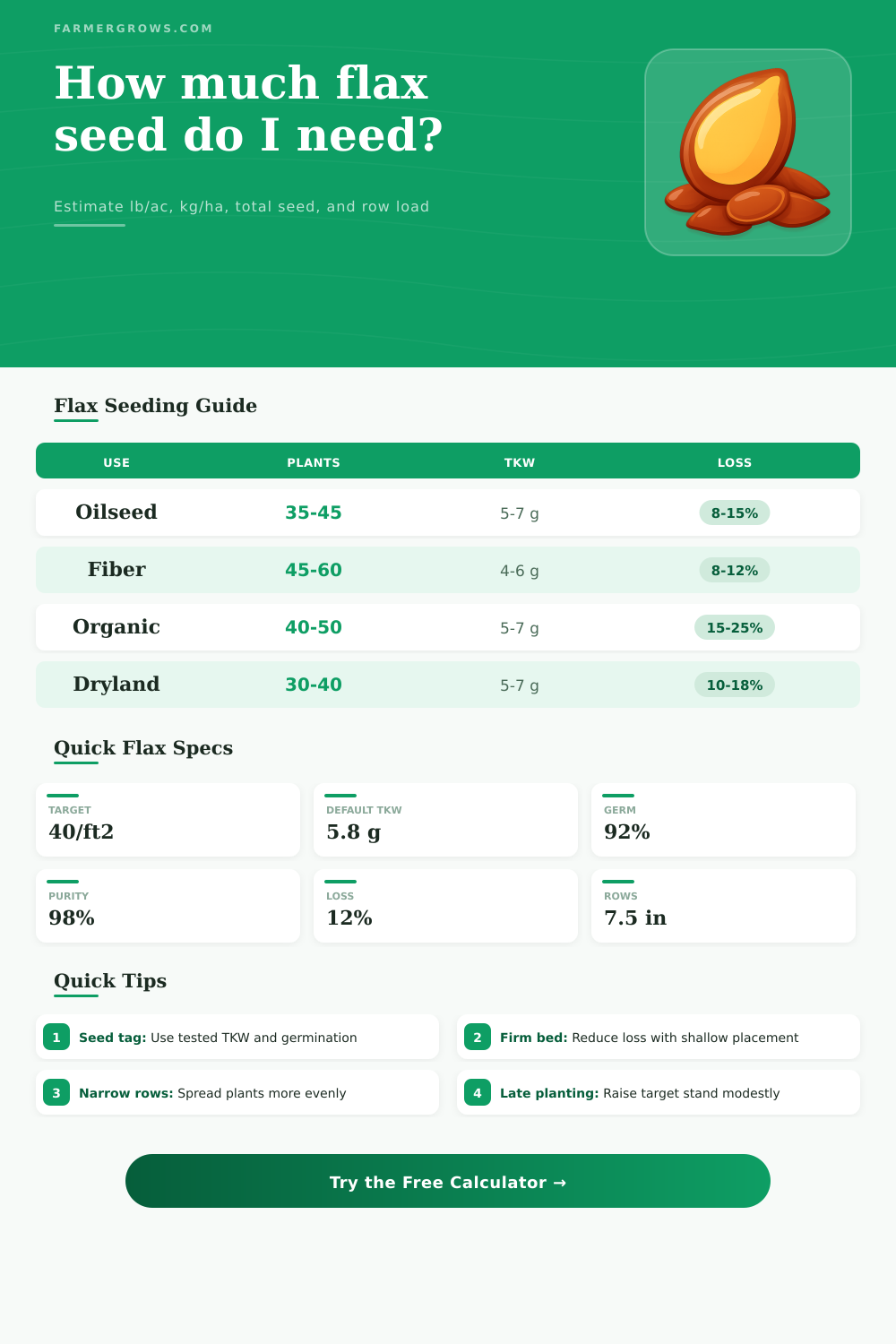
| Flax use | Target plants/sq ft | Typical row spacing | Field note |
|---|---|---|---|
| Oilseed grain | 35-45 | 6-10 in | Good default for most clean, firm seedbeds. |
| Brown food flax | 36-46 | 6-10 in | Keep stand even to support clean sample quality. |
| Golden food flax | 38-48 | 6-10 in | Useful where a more uniform canopy helps weed suppression. |
| Fiber flax | 45-60 | 4-7.5 in | Dense stands favor longer, less-branched stems. |
| Organic flax | 40-55 | 5-7.5 in | Higher stands can help the crop compete sooner. |
Thousand seed weight conversion
A heavier seed lot has fewer seeds per pound, so the same planted seed count needs more pounds per acre.
| TKW | Seeds/lb | Seeds/kg | What it means |
|---|---|---|---|
| 4.5 g | 100,798 | 222,222 | Small seed lot; fewer pounds for the same seed count. |
| 5.5 g | 82,471 | 181,818 | Common seed size for many flax lots. |
| 6.5 g | 69,783 | 153,846 | Heavier seed; rate in lb/ac rises. |
| 7.5 g | 60,479 | 133,333 | Large seed; confirm drill calibration carefully. |
Seed quality correction guide
The calculator multiplies germination, purity, and surviving seedbed establishment before it decides how many seeds to plant.
| Germination | Purity | Seedbed loss | Planting response |
|---|---|---|---|
| 94-98% | 98-99% | 5-10% | Excellent lot and seedbed; small correction needed. |
| 90-94% | 97-99% | 10-15% | Normal planning range for many flax fields. |
| 85-90% | 96-98% | 15-22% | Increase seed and check drill placement closely. |
| Below 85% | Below 96% | 20% plus | Consider retesting or sourcing a cleaner, stronger lot. |
Row spacing and row load
This table uses a final planted rate of 45 seeds/sq ft after quality adjustments.
| Row spacing | Seeds/ft of row | In-row gap | Comment |
|---|---|---|---|
| 6 in | 22.5 | 0.53 in | Very even distribution for thin flax stems. |
| 7.5 in | 28.1 | 0.43 in | Common cereal drill spacing. |
| 10 in | 37.5 | 0.32 in | Still workable with careful depth control. |
| 12 in | 45.0 | 0.27 in | Watch row crowding and weed gaps between rows. |
This planning tool estimates seed quantity only. Follow local agronomy guidance for variety selection, planting date, depth, herbicide program, disease risk, and certified seed requirements.
To determine the correct seeding rate for flax, a person must consider various factors that can influence the final calculated rate. The seeding rate will impact the yield and quality of the flax fibers that is grown in that specific field. If the seeding rate is too low, there will be enough space for the weeds to grow in that field.
However, if the seeding rate is too high, the flax stems will crowd each other, which will negatively impact the quality of both the flax seed that is produced and the fiber from that flax. Because the seed for flax is so small, the plants will not compensate for a poor stand of flax plants. Therefore, a person must consider the target number of flax plants per square foot.
How to Calculate the Right Flax Seeding Rate
Depending on the use of the flax, that target will change. For oilseed flax, the target will be thirty to forty-five plants per square foot. However, for fiber flax, a higher target will be necessary so that the stems of the flax plants can grow longer and remain straight as required to produce the flax fiber that others purchase.
For food-grade flax, the requirement for plants per acre will be slightly higher than that for oilseed flax because a higher density will enable the plants to remain clean in there flax samples. The weight of the flax seed will also impact the seeding rate for flax. The size of the flax seed will vary in weight when measured by a thousand seed weight.
For flax seed, the thousand seed weight will commonly be five to six grams. However, that weight can range from four and a half grams to seven and a half grams depending on the specific variety of flax that is to be grown along with the growing conditions of that flax. If the weight of the flax seed is heavier than the standard measurements, then more pounds of that seed will be required per acre to ensure the proper stand of flax plants is grown.
A person can use a calculator to make the calculations for the weight of the flax seed. Furthermore, using the actual thousand seed weight for the variety of flax that will be grown will eliminate guesswork in the calculation. Another factor that will impact the seeding rate is the germination rate and purity of the flax seed.
The tag of the flax seed will show the percentage of germination and purity. However, that percentage will only indicate the germination potential of the seeds in ideal environment. In the field where the flax will be grown, losses of flax seeds will occur due to soil crusting, cold soil, and poor contact between the seeds and the soil.
A percentage loss of the seedbed will need to be accounted for. For example, if the initial percentage is ten percent and it is increased to twenty percent loss of the seedbed, the seeding rate will change noticeable. This final rate will be the total number of seeds that will need to be planted into the ground to achieve the target number of flax plants per acre after losses of seeds.
Another factor that will influence the seeding rate is the row spacing in which the flax will be planted. If there are fewer rows of flax plants in the acre, then each row will have more flax plants per foot of row. Fewer rows will also create fewer opportunities for lodging of the flax plants.
However, fewer rows will allow for more weeds to grow between rows. Row spacing can be calculated from the number of seeds per square foot. Variety of flax will also affect the seeding rate of the flax.
For instance, dual-purpose flax and organic flax will require a stronger stand of flax plants to compete with the weeds in the planting area. Calculations for the seeding rate should of been performed twice. The initial calculation will use the values given on the tag of the flax seed.
However, a second calculation will factor in a higher percentage loss of the seedbed for fields with heavy residue from previous crops or fields with soil that is too cold for germination of the flax seeds. The second calculation will also reveal the row load of the flax plants. The gap between each flax seed should be at least one-third of an inch.
If not, the stand of flax plants may compete for nutrients and water in the soil. Flax seeds should not be planted deeply into the ground. Because the seeds are small and have limited reserves of nutrients, they will not germinate if planted too deeply into the soil.
If the soil is firm and level, the percentage of loss of the seedbed will be lower. Therefore, the total amount of flax seed that will be required will also be lower. The calculator will provide the total amount of flax seed that will be required to grow the acre of flax as the final output.
This value can aid in ordering the flax seed and determining the capacity of the drill that will be used to plant the flax. If the total amount of flax seed seems too high or too low, it is recommended that the person calculates the rate with the target stand, thousand seed weight, and loss of seedbed. The goal of calculating the seeding rate is to ensure that the stand of flax plants is as close to the target stand as possible so that there are no interventions in the growth of the flax crops.