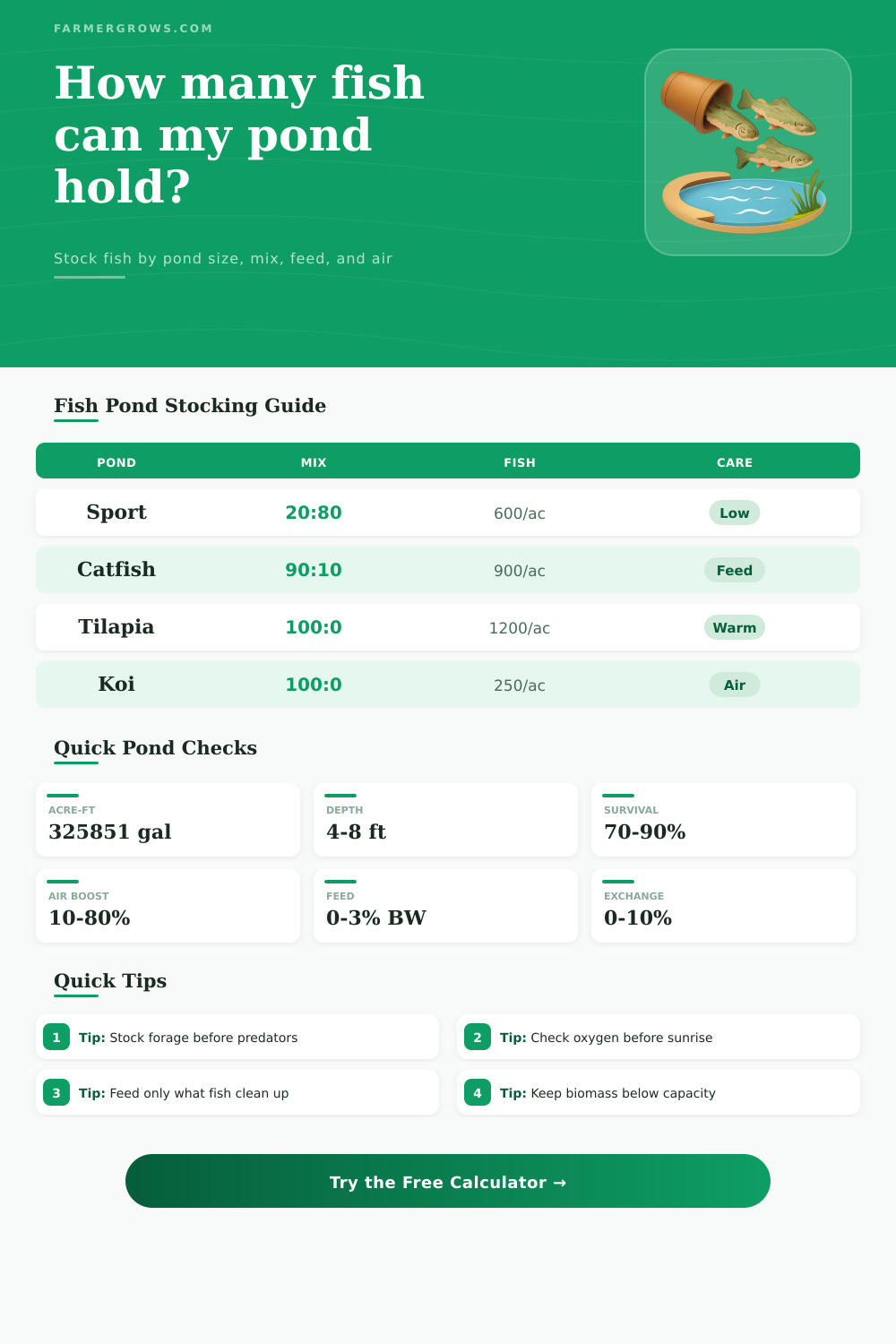
Fish Pond Stocking Calculator
Estimate stocking counts from pond acres or gallons, average depth, species mix, target fish size, aeration, feed plan, survival, water exchange, and carrying capacity.
Stocking Estimate
Results are planning numbers. Confirm final rates with local water quality, dissolved oxygen, legal species rules, and hatchery advice.
Pick a starting scenario, then adjust the inputs for your actual pond, water quality, feed practice, and harvest goal.
| Mix | Primary fish | Companion fish | Planning note |
|---|---|---|---|
| Bass-bluegill sport pond | 15% to 25% predators | 75% to 85% bluegill or forage | Forage should be established before or with predators. |
| Channel catfish harvest | 85% to 100% catfish | Optional forage or minnows | Feed and aeration control carrying capacity. |
| Tilapia growout | 90% to 100% tilapia | Usually none in simple growout | Works best in warm water with steady feed. |
| Trout seasonal pond | 90% to 100% trout | Usually none | Cold water and high dissolved oxygen are critical. |
| Koi or ornamental pond | 100% display fish | Avoid overmixing sizes | Filters and oxygen often limit stocking before volume. |
| Management level | Typical capacity | Key requirement | Risk flag |
|---|---|---|---|
| Unfed natural pond | 100 to 250 lb/acre | Balanced fertility and harvest | Low forage limits growth. |
| Light supplemental feed | 200 to 400 lb/acre | Feed cleanup and basic oxygen checks | Uneaten feed reduces water quality. |
| Aerated fed pond | 400 to 800 lb/acre | Reliable aeration and water quality testing | Power outages can cause oxygen crashes. |
| Intensive growout | 800+ lb/acre | Dedicated aeration, exchange, and monitoring | Needs experienced management. |
| Condition | Exchange guide | Aeration guide | Best use |
|---|---|---|---|
| Static sport pond | 0% routine exchange | Emergency or light aeration | Bass, bluegill, low feed rates. |
| Fed farm pond | 0% to 2% per day | Nightly diffused or surface units | Catfish and mixed harvest systems. |
| Warm tilapia pond | 1% to 5% per day | Continuous during heat or high feed | Summer growout and higher feed loads. |
| Intensive holding pond | 5% to 15% per day | Redundant aeration | Short-term holding or high density. |
| Feed plan | Peak ration | Typical target size | Calculator use |
|---|---|---|---|
| Natural food only | 0% body weight | Bluegill 0.25 to 0.5 lb | Keep base capacity conservative. |
| Light supplemental feed | 0.5% to 1.0% body weight | Mixed fish 0.5 to 1.0 lb | Good for small farm ponds. |
| Regular floating feed | 1.0% to 2.0% body weight | Catfish 1.0 to 1.5 lb | Watch cleanup time and oxygen. |
| Managed growout feed | 2.0% to 3.0% body weight | Tilapia 0.75 to 1.5 lb | Needs warm water and aeration. |
| Intensive plan | 3.0%+ body weight | Species dependent | Use only with monitoring and backup air. |
For new ponds, use the calculator as an upper planning number, then stock below it until oxygen, feeding response, and water clarity prove the pond can carry more fish.
Feed plans raise carrying capacity only when fish consume feed quickly and aeration keeps oxygen stable, especially near sunrise during warm weather.
When you are thinking about stocking a pond with fish, you must consider how many fish the pond can supports. Factors that will impact the ability of the pond to support the fish include the composition of the pond’s water, the type of feed that are added to the pond, and the weather conditions within which the pond will exist. Many individuals attempt to determine the carrying capacity of their pond based off the number of fish that they can purchase, but many of those who attempt to stock their pond with this many fish finds that their pond is not able to support the fish that they purchased.
The carrying capacity of a pond is the maximum number of fish that can live within the pond based upon its available resource. The first factor that you must calculate for the fish that are to be stocked into the pond is the volume of the pond. The volume of the pond can be expressed in either gallons or acre feet.
How Many Fish Can a Pond Hold
You must also consider the depth of the pond in the stocking calculation of the pond. Deeper ponds tend to hold more oxygen within the water than ponds that are shallowly in relation to their surface area. Because shallow ponds tend to experience rapid changes in temperature in the environment and rapid changes in the dissolved oxygen levels in the water, these rapid changes in water conditions can become stressed by the fish in shallow ponds.
A pond stocking calculator can calculate the carrying capacity of the pond by entering the surface acres of the pond, the total number of gallons of water in the pond, and the average depth of the pond. Beyond pond volume, depth, and area, the type of fish that are to be stocked into the pond will impact the carrying capacity of that pond. For instance, if the species of fish that are to be stocked in the pond include species like bass and bluegill, it is necessary to ensure that there is an ample supply of forage fish for the predator fish to consume.
If there is not enough forage fish in the pond, the bass will begin to consume the bluegill fish. Similarly, you can stock fish species like catfish into the pond in greater number than other fish species in the pond because catfish will consume supplemental fish feed. However, supplemental feed increase both the oxygen requirements of the pond and the amount of waste that is expelled by the fish in the pond.
Species like tilapia grow rapidly in warm water but require aeration of the water in the pond once the amount of tilapia in the pond increases beyond a certain biomass level. Trout require cold water in which the water contains a high level of dissolved oxygen, factors that prevent trout from existing in the same conditions as the bass or catfish species. These stocking factor can be entered into the pond stocking calculator to determine the carrying capacity of the pond and to ensure that the survival rates and sizes of the fish in the pond match with the species that are to be stocked into the pond.
The management of the pond will also impact the carrying capacity of the pond. For instance, ponds that contain no supplemental fish feed will have a low carrying capacity because the food supply in those ponds is limited. Adding supplemental fish feed will increase the carrying capacity of the pond but only if the fish in the pond will eat the supplemental feed that is added and if the pond fish do not eat the supplemental feed that is not eaten and it does not rot on the bottom of the pond.
Aeration of the pond will also increase the carrying capacity of the pond because the aeration will help to maintain the oxygen levels in the pond, especially during warm months. Water exchange is another management practice that will increase the carrying capacity of the pond but only in relation to the management of a flowing system rather than a static system. The stocking calculator will use multipliers for aeration, supplemental feed, and water exchange to determine the carrying capacity of the pond in relation to the management practice that are to be applied to the pond.
Additionally, the survival rates of the fish that are to live in the pond will impact the stocking level. Because many of the fingerling fish do not survive the transport to the pond, the acclimation of the fish to the water in the pond, or the first season in the pond, the stocking calculator will calculate a higher number of fish to be stocked in the pond. The stocking calculator will calculate the number of fish of each species that will live in the pond, including the primary harvest fish and the forage fish in the pond that will maintain the carrying capacity of the fish species.
While each pond will have a carrying capacity based upon the factors described above, that carrying capacity can change. Factors that will affect the carrying capacity of a pond include changes to the temperature of the pond, changes to the rate at which feed is added to the pond, and changes to the reliability of the aeration system in the pond. In order to account for these potential changes, it is recommended to implement a safety buffer into the stocking calculations for the pond.
Using a safety buffer will help the fish farmer to avoid the situation in which either a heat wave or a power outage that prevents the aeration systems in the pond from functioning kills the fish in the pond. The feed plan that is established for the pond will also impact the carrying capacity of that pond. For instance, ponds whose fish rely upon natural fertility will have a supplemental feed rate of zero and a low carrying capacity for the pond.
By establishing a managed growout plan for the fish that live in the pond, the rate at which supplemental feed is added to the pond can be increased. However, increasing the supplemental feed rate for the pond will only be possible if the aeration and water quality of the pond are able to support that increased supplemental feed rate. The stocking calculator will use the feed rate and the conversion ratio to determine the amount of feed that the fish in the pond will consume.
While the stocking calculator will provide recommendations for stocking a pond based upon the factors described above, the actual conditions of the pond may vary from those calculations. Factors such as shade in the pond, wind in the area in which the pond is located, algae blooms within the pond, and seasonal turnover of the ponds water may alter the amount of oxygen that is contained in the water and the temperature of the pond. Therefore, stocking calculations and stocking levels should be established based upon the stocking calculator recommendations and the actual water quality tests that are performed in the pond.
The stocking levels should not be established to the maximum carrying capacity of the pond as determined by the stocking calculator. Instead, stocking levels should be created to ensure that the pond can handle unexpected change to the pond and stocking levels based upon the response of the pond to the fish that have been stocked into the pond.