Log to Firewood Calculator
Convert round logs into split stacked firewood volume, cords, weight, and usable yield.
Tapered log volume: top diameter = base diameter x (1 - taper). Solid volume per log = pi x length / 12 x (D1² + D1 x D2 + D2²), using diameters in feet.
Usable solid wood: total solid log volume x (1 - kerf loss). This accounts for sawdust, trimming, crotch waste, and short offcuts.
Seasoned stacked volume: usable solid wood x split stack factor x (1 - shrinkage). The stack factor converts solid wood to split stacked firewood with air space.
Cord count: seasoned stacked volume divided by the selected cord volume. Dry weight = usable solid wood x species dry density x (1 - shrinkage x 0.25).
Same pile, tighter stack
A tight 1.35 stack factor lowers visible stacked volume but usually signals better cord density and less air.
Same pile, higher taper
A 20% taper can reduce yield sharply compared with straight stems because log volume follows diameter squared.
Same pile, wetter wood
Higher shrinkage reduces final stack volume after seasoning, especially on fresh-cut hardwood rounds.
| Diameter | 8 ft log | 10 ft log | 12 ft log |
|---|---|---|---|
| 8 in straight | 2.79 solid ft³ | 3.49 solid ft³ | 4.19 solid ft³ |
| 12 in straight | 6.28 solid ft³ | 7.85 solid ft³ | 9.42 solid ft³ |
| 16 in straight | 11.17 solid ft³ | 13.96 solid ft³ | 16.76 solid ft³ |
| 20 in straight | 17.45 solid ft³ | 21.82 solid ft³ | 26.18 solid ft³ |
| 24 in straight | 25.13 solid ft³ | 31.42 solid ft³ | 37.70 solid ft³ |
| Cord type | Stack size | Stacked ft³ | Stacked m³ |
|---|---|---|---|
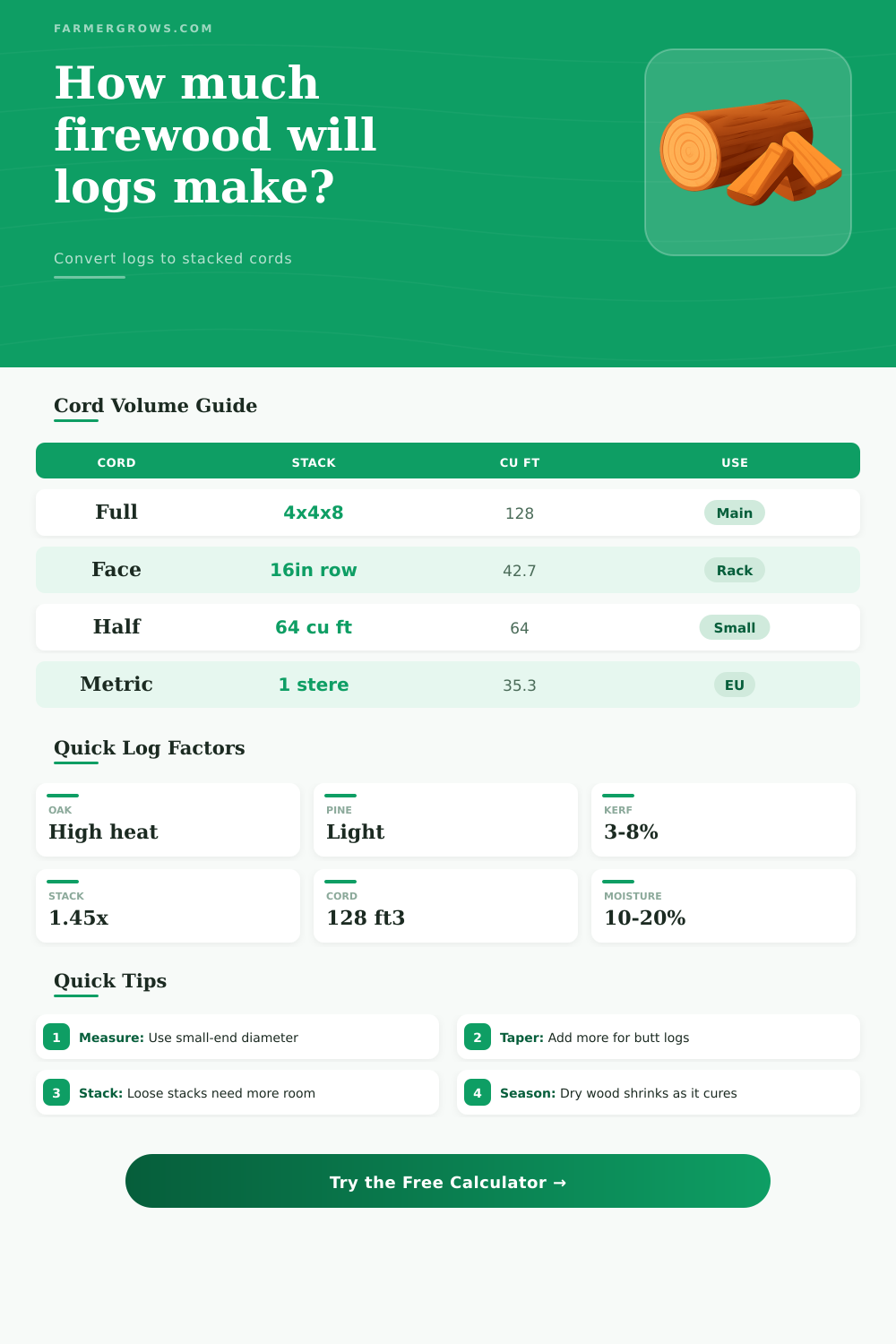
| Full cord | 4 ft x 4 ft x 8 ft | 128.0 | 3.62 |
| Half cord | 64 stacked ft³ | 64.0 | 1.81 |
| Face cord, 16 in | 16 in x 4 ft x 8 ft | 42.7 | 1.21 |
| Face cord, 18 in | 18 in x 4 ft x 8 ft | 48.0 | 1.36 |
| Stere | 1 stacked m³ | 35.3 | 1.00 |
| Species | Dry density | Relative heat | Splitting note |
|---|---|---|---|
| White oak | 47 lb/solid ft³ | Very high | Dense, slow drying |
| Hickory | 44 lb/solid ft³ | Very high | Stringy, heavy rounds |
| Sugar maple | 38 lb/solid ft³ | High | Clean splits |
| Ash | 35 lb/solid ft³ | Medium high | Splits easily |
| Southern pine | 32 lb/solid ft³ | Medium | Resin and lighter stacks |
| Poplar | 26 lb/solid ft³ | Low | Light shoulder wood |
| Stack style | Factor | Air space | Best use |
|---|---|---|---|
| Very tight split stack | 1.35 | Low | Straight, uniform splits |
| Neat hand stack | 1.45 | Moderate | Most cord racks |
| Average split stack | 1.55 | Moderate high | Mixed sizes |
| Loose or crooked stack | 1.70 | High | Knots and odd splits |
| Thrown pile estimate | 1.90 | Very high | Temporary pile volume |
A cord of firewood are a specific measurement of volume. A cord of firewood is defined as a stack of firewood that is four feet wide, four feet high, and eight feet long. The measurement of a cord of firewood include all of the air that exists between the individual piece of wood within that cord.
A round log is a solid piece of wood that dont include the air spaces between the pieces of wood in a cord of firewood. Because a cord of firewood includes air and a round log is solid wood, the two items do not contain the same amount of volumes. In order to calculate how many cord of firewood can be created from a set number of round logs, there are several different variables that must be account for.
How to Calculate Cords of Firewood from Round Logs
One of the main variable is the diameter of each log. The more greater the diameter of each log, the more firewood it will contain. To calculate the volume of each log, you must measure the diameter of the log at its small end.
Another variable that can change the amount of firewood contained within each log is the taper of the log. A log that tapers quick from its butt end to its top end will contain less firewood than a log that does not taper quick. The species of each log are another variable that must be accounted for in the calculation of the total volume of firewood that may be created.
The density of the wood can range from high to low within each species of wood. A species of wood that is high in density will have a more greater amount of weight within a specific volume compared to a species of wood that is low in density. Additionally, each species of wood will shrink at a different rate when it dry out.
Another variable that will change the total volume of cords of firewood that may be created is the way in which the logs are stack when creating the cords of firewood. If logs are split into pieces, there will be air space between each individual piece of firewood. The more air space within cords of firewood, the less actual wood is contain within that cord.
You can control this variable by either creating tight stacks or loose stacks of firewood. The variable of tight versus loose stacks will change the total amount of firewood that is contained within each cord of firewood. Other variables to consider are the loss of firewood due to saw kerf and trimming.
Saw kerf is the amount of wood that is sawdust when saws split logs. Trimming logs to remove any rotten or crooked ends of the logs will also result in the loss of some of the total volume of logs. Moisture content is another variable to consider when estimating the volume of firewood that can be created from logs.
Freshly cut logs will contain more water than dry logs. Seasoning logs allow the water within the logs to evaporate. During the seasoning process, logs will shrink in size.
This shrinking of the logs will result in the volume of logs decrease from the volume of logs when they were freshly cut (green logs). When measuring logs, it is important to consider that the logs will eventually dry out, and the volume will decrease. The difference between a full cord of firewood and a face cord is important to consider.
A full cord of firewood contains the same dimension as described previously: four feet wide, four feet high, and eight feet long. A face cord is a stack of logs that is only one row deep. Because of the difference in dimensions, a face cord will take up less space then a full cord.
For these reasons, a face cord is not considered a full cord of firewood. In order to accurately calculate the number of cords of firewood that may be created from a set number of round logs, you must measure the small end diameter of each log and identify the species of the logs. The stacking of cords of firewood can be controlled, as, to alter the amount of firewood that is contained within each cord.
Additionally, you can account for the loss of wood due to saw kerf and trimming in the estimation of cords of firewood. If these variables are understood, it is possible to create a better estimation of the number of cords of firewood that can be created from the existing logs.