🌲 Cord Firewood Calculator
Estimate how many cords of firewood you need per heating season
Quick Presets:
| Species | BTU / Cord (millions) | Dry Weight / Cord (lbs) | Burn Quality | Seasoning Time |
|---|---|---|---|---|
| Hickory | 28–30M | 4,327 | Excellent – long, hot burn | 12–18 months |
| Oak (White / Red) | 24–28M | 4,200–4,600 | Excellent – dense, steady heat | 12–24 months |
| Maple (Hard) | 24–26M | 3,680 | Very Good – clean, even burn | 12–18 months |
| Birch | 20–23M | 3,000 | Good – burns well when dry | 12 months |
| Douglas Fir | 17–20M | 2,970 | Good – denser softwood | 6–12 months |
| Pine (Eastern White) | 14–16M | 2,236 | Fair – good kindling, more resin | 6–12 months |
| Poplar / Aspen | 13–15M | 2,106 | Fair – burns fast, low heat | 6 months |
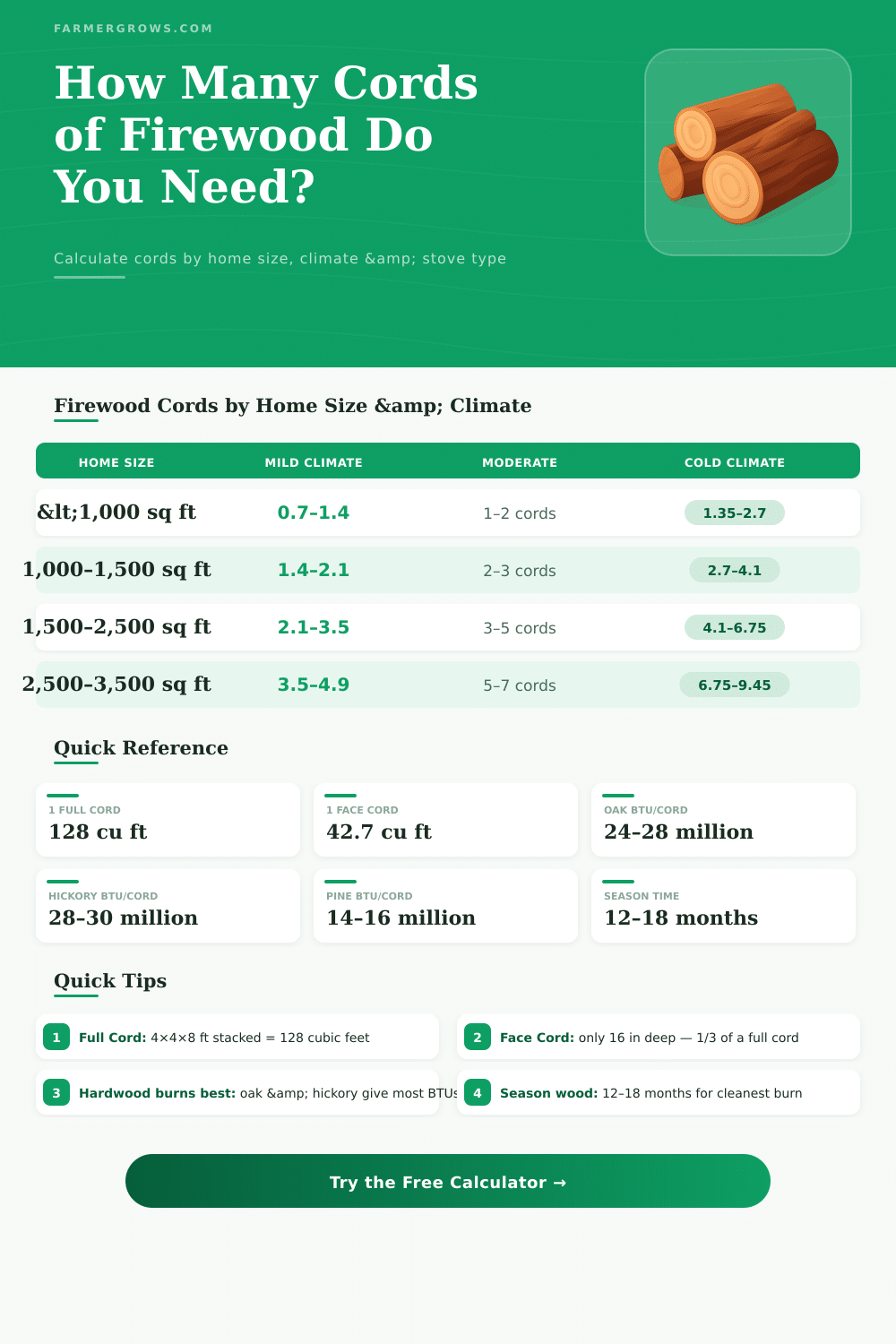
| Home Size | Mild Climate (Zone 7–9) | Moderate (Zone 5–6) | Cold (Zone 3–4) | Very Cold (Zone 1–2) |
|---|---|---|---|---|
| <1,000 sq ft | 0.7–1.4 cords | 1–2 cords | 1.4–2.7 cords | 1.7–3.4 cords |
| 1,000–1,500 sq ft | 1.4–2.1 cords | 2–3 cords | 2.7–4.1 cords | 3.4–5.1 cords |
| 1,500–2,500 sq ft | 2.1–3.5 cords | 3–5 cords | 4.1–6.8 cords | 5.1–8.5 cords |
| 2,500–3,500 sq ft | 3.5–4.9 cords | 5–7 cords | 6.8–9.5 cords | 8.5–11.9 cords |
| 3,500+ sq ft | 4.9+ cords | 7–10+ cords | 9.5–13.5+ cords | 11.9–17+ cords |
| Type | Dimensions | Cubic Feet | Equiv. Full Cords | Notes |
|---|---|---|---|---|
| Full Cord | 4 ft × 4 ft × 8 ft | 128 cu ft | 1.0 | Standard measurement, tightly stacked |
| Face Cord (Rick) | 4 ft × 8 ft × 16 in | ~42.7 cu ft | ~0.33 | Most common retail unit sold |
| Half Cord | 4 ft × 4 ft × 4 ft | 64 cu ft | 0.50 | Half of a full cord stacked |
| Thrown / Loose Cord | Varies | ~180 cu ft | ~0.71 | Unstack penalty; less dense than stacked |
| Stere (metric) | 1 m × 1 m × 1 m | 35.3 cu ft | ~0.276 | 1 cord = 3.625 steres |
At the base, firewood simply is wood that one burns for heat, nothing fancy, nothing ready used. It is made up of sticks or branches that was not done in pellets or other made stuff. One can throw it in the fire, on a campfire, in a home or in a wood-burning stove.
That is basic but one must avoid untreated wood because of safety.
How to Choose and Use Firewood
When talking about moisture, there exists a big difference between two kinds. Some firewood is dried by means of seasoning or heat treatment until they are fully dry. Others arrive fresh and wet, not dry, as one says.
The ideal sits around 20 percent of moisture or less. Kiln-dried firewood? It is wood that was slowly dried in a controlled kiln to remove all water.
The advantage is huge: it lights more quickly, burns more well and makes less smoke and creosote. It costs more, yes, but it deserves it.
Many kiln-dried wooden bits come in nice, compact boxes and do not need much space. Ideal for those that live in a small apartment. One can buy lasting supply of kiln-dried oak in bags, that quickly flraes and gives pure, smokeless burning when one wants.
When one chooses firewood, some main points. How much heat it truly gives? How much time lasts before one needs to add more?
And how easily one gets it? Hardwood timbers… Oak and hickory, for instance, are the best for heat making.
They also keep coals more long, what makes them good for cooking. Oak and pecan stand out because there cellulose structure has more hydrogen atoms than other trees, and hydrogen gives all heat. Various hardwood mixes can carry oak, ash, cherry, locust, hickory and mulberry.
So one has other choices like hickory, apple, pecan, walnut, mesquite and peach too.
Softwood timbers sometimes are ignored, but pine is everywhere available and a lot of it comes from dead trees in the woods. If that is what one has access to, it certainly does the task.
Now about walnut; that is hard to sell. The smoke smells awful, truly. If one plans to burn walnut somehow, do it outside in a wood burner and keep it to only a bit mixed with better wood.
Firewood bags come as split sticks that already are dry and ready to burn. Oak, eucalyptus, madrone and ash are all common choices, and all of them burn warm and steady. The usual measure is a cord, that is 128 cubic feet.
Think three rows stacked four feet high and eight feet long with sticks of 16 to 18 inches. Because trees grow again, firewood is considered renewable.
There is something truly nice about burning wood. Besides that it saves money for heating, it pulls you into theprocess in a way that only turning the thermostat can not.