Fingerling Potato Growth Time Calculator
Estimate fingerling potato emergence, seed piece spacing, elongated tuber set, hilling dates, new-potato digging, full-size harvest, row yield, skin set, and storage readiness.
Fingerlings reward different timing than round baking potatoes. Close seed spacing keeps tubers narrow, steady hilling protects shallow elongated sets, and storage harvest needs skin set after vines finish.
Fingerling Potato Growth Estimate
Enter your planting details to estimate emergence, hilling, harvest, yield, and storage windows.
| Fingerling variety | New harvest | Full-size harvest | Shape behavior | Storage note |
|---|---|---|---|---|
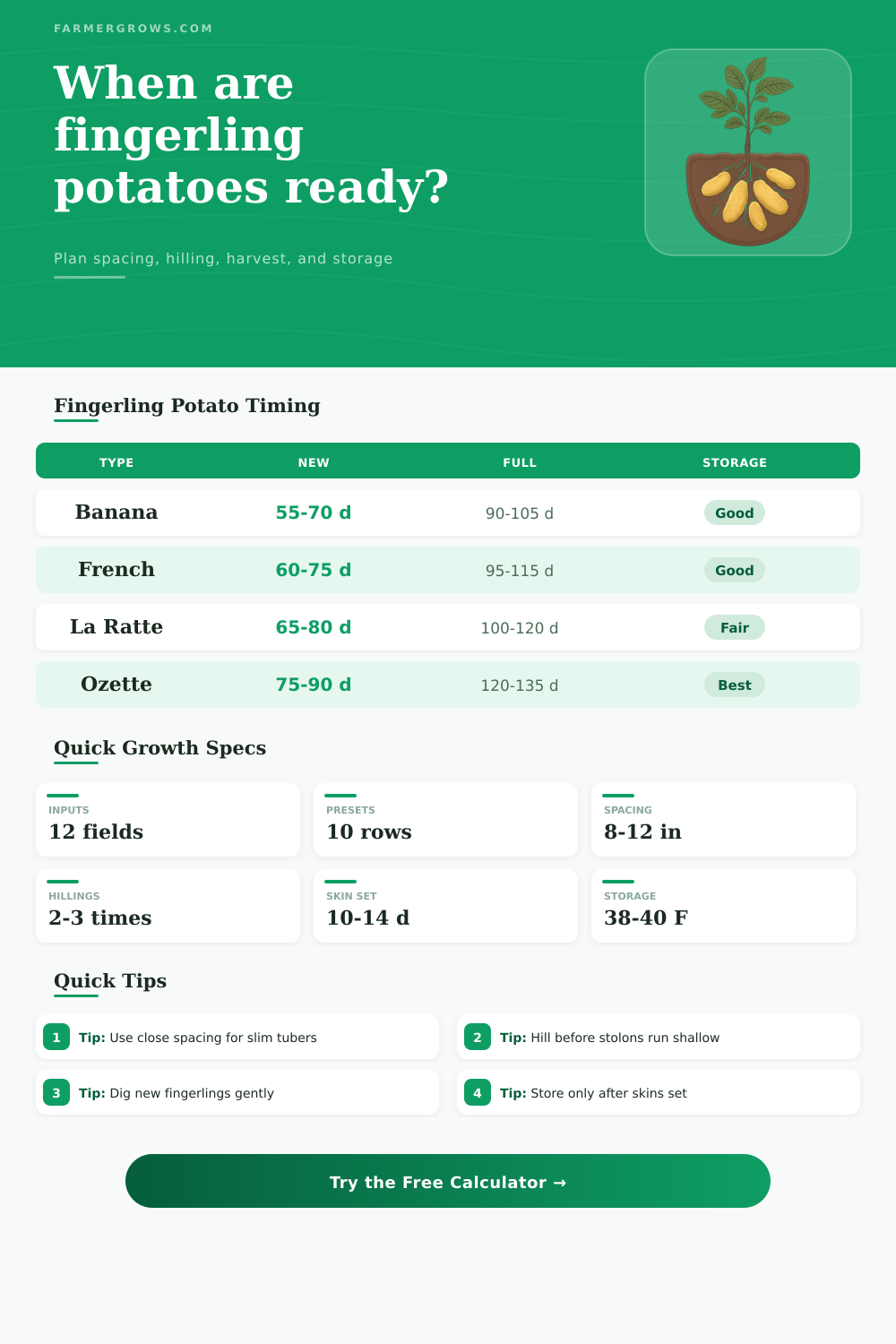
| Russian Banana | 55 to 70 days | 90 to 105 days | Long yellow tubers, usually uniform | Good keeper after firm skin set |
| French Fingerling | 60 to 75 days | 95 to 115 days | Rose skin, elongated oval fingers | Stores well when cured without cuts |
| La Ratte | 65 to 80 days | 100 to 120 days | Small gourmet tubers, slower bulk | Fair storage, use damaged tubers first |
| Rose Finn Apple | 58 to 72 days | 90 to 110 days | Waxy, sometimes curved or knobby | Moderate keeper with gentle handling |
| Ozette | 75 to 90 days | 120 to 135 days | Long heritage tubers, needs season | Best after complete vine maturity |
| Seed piece spacing | Plants per 100 ft | Tuber size effect | Yield tendency | Use case |
|---|---|---|---|---|
| 7 to 8 in | 150 to 171 | Many slim small fingers | Early count, lower average size | New fingerlings and small packs |
| 9 to 10 in | 120 to 133 | Balanced slender tubers | Good marketable row yield | Most garden and CSA rows |
| 11 to 12 in | 100 to 109 | Longer full-size fingers | Higher weight per plant | Full-size fresh harvest |
| 13 to 15 in | 80 to 92 | Larger, less uniform set | Can extend sizing time | Storage rows with long season |
| Container 8 to 10 in | Varies | Small to medium tubers | Depends on soil volume | Grow bags and patio bins |
| Hilling stage | Approximate timing | Fingerling purpose | Soil target | Risk if missed |
|---|---|---|---|---|
| First hill | Shoots 6 to 8 in tall | Cover seed shoulders and early stolons | Pull 3 to 4 in loose soil | Shallow tubers green quickly |
| Second hill | 14 to 18 days later | Protect elongating tuber set | Build a broad ridge, not a sharp peak | Long tubers bend into hard edges |
| Third light hill | Before row closure | Patch cracks and exposed fingers | Add soil or clean straw mulch | Sunlight causes green bitter skins |
| Container top-up | As stems stretch | Keep tubers covered in warm bags | Add mix in shallow layers | Overfilling at once can weaken vines |
| Storage dry-down | After vine yellowing | Cure skins before digging | Avoid wet soil harvest if possible | Scuffed skins reduce storage life |
| Storage step | Timing | Temperature | Humidity | Fingerling handling note |
|---|---|---|---|---|
| Skin set in soil | 10 to 14 days after vines die | Cool field soil | Not saturated | Check skin with thumb pressure before lifting |
| Cure | 7 to 14 days | 50 to 60°F | High, with airflow | Keep dark and avoid washing storage tubers |
| Sort | After curing | Room cool | Dry surface | Eat forked, cut, or greened tubers first |
| Hold | Winter storage | 38 to 40°F | 90 to 95% | Keep in ventilated crates, dark and frost-free |
| Warm before cooking | Several days | 50 to 60°F | Moderate | Improves flavor after cold storage |
Spacing controls shape: Tight seed spacing gives many slender fingerlings, while wider spacing can make heavier tubers that lose the classic small-finger look.
Harvest by skin, not just days: Dig new fingerlings early for the kitchen, but store only tubers with firm skins, no greening, and no fork cuts.
If you dig up your potatoes and find nothing but dirt, don’t be surprised. Fingerlings are unpredictable that way, unlike typical red or russet spuds. Since they’re thin tubers, they has different habits, growing shallow near the seed piece… And require precise timing that’s beyond what most guide explain. Plant them as you would any baking potato, and you’ll end up with shriveled, green tubers (not those creamy gems you crave).
How these varieties time out their growth, and how deep they root in the process, are typically the key. Gardening with potatoes is typicaly seen as a matter of adding soil and water, but spacing also determine the shape of the tubers. You can see this in the yield calculator above, which factor spacing into its calculations. The closer together you plant your seed pieces, the more tubers they’ll have (though they will be smaller) because their roots gets crowded. However, the farther apart you sow, the bigger individual tubers will be (but there will be fewer per plant). That tradeoff is rarely obvious until it is too late in the season.
How to Grow Fingerling Potatoes
Surprisingly, the closer you plant, seven or eight inches instead of the recommended minimum of eleven or twelve (the better for narrow-fingerling kind), which are what you want. Fingerlings form tubers close to the surface, sometimes right where they started at the shoulder of the seed potato. Because of this, the timing of when they set tubers is critical. Hilling them up is also critical. Letting that soil show in the sun turns skin green and bitter in a matter of days.
This page’s hilling tool takes into account whether you’re planning to hill early or not, then calculates when to build those shielding hills. Hilling too soon avoids greening, but don’t mound heavily at all later on, since tubers will gets bent around against the firm soil as they develop. It is better to use a thick layer of straw mulch or loose soil as vines reach height, and prop the crop up with gentle protection from light so you do not crush it under its own weight.
You should of know when to dig by observing the plants instead of watching the clock. Some varieties take a few weeks longer then others (such as the Ozette, La Ratte, or any Russian Banana type) to mature, so watch them all. If you harvest too soon, the potatoes will be delicate with thin skins that gets soft quickly; however, they taste good fresh or roasted right away. Wait until the vines die back to make sure they lasts through the winter. They won’t keep longer than a week or two. You want to wait till the vines go fully dead.
The calculator above includes an adjustment for skin set, because even after the tops turn brown, the tubers below continues to thicken up and harden off underground. Harvest too soon and your crop won’t last through the winter. Handling the potatoes is more important than temperature. Leave them in the ground for two weeks or so after the vines wither to allow skins to harden off, then cure them in a cool, humid location before putting them into cold storage. Many of us omit that step and are puzzled when our winter stock shrivels.
It is not a bug issue; it is physics. The skin thickens as potatoes heals from scrapes after being exposed to warm, moist air. Cold, dry air hastens water loss. Rushing from warm soil to cold cellar? Condensation invites rot.
With fingerlings, growing them means moving away from quantity and towards quality: how spacing affects their shape, how careful hilling will be about protecting shallow-growing roots, when digging will be ok without compromising the potato’s skin. The arithmetic can be hard but the concepts are simple. Get on board with the variety’s habits, and you won’t have to guess anymore at harvest time; you can expect predictability instead of gambling. This helps you get to know a variety instead of fighting it, and leaves you with a binful of similar-sized potatoes that last all season while keeping their taste and shape.