Fig Tree Lifespan Calculator
Estimate realistic fig tree life, productive years remaining, age stage, cold dieback pressure, pruning renewal benefit, root restriction, variety vigor, disease pressure, and replacement timing.
Choose a fig profile, then adjust current age, growing setting, root room, cold dieback, pruning renewal, variety vigor, disease pressure, drainage, sun, and yield trend.
Can fruit early, but heat, water swings, and root congestion shorten useful life.
Best patio balance when refreshed with root pruning, feeding, and winter storage.
Good drainage and moderate root run, but roots still hit bed edges over time.
Long-lived where roots stay healthy and trunks are periodically renewed.
Roots may persist for decades, but topwood and productivity reset after severe winters.
Fig Lifespan Estimate
Your fig tree estimate will appear here.
| Fig situation | Typical useful life | Prime productive window | Main limiter |
|---|---|---|---|
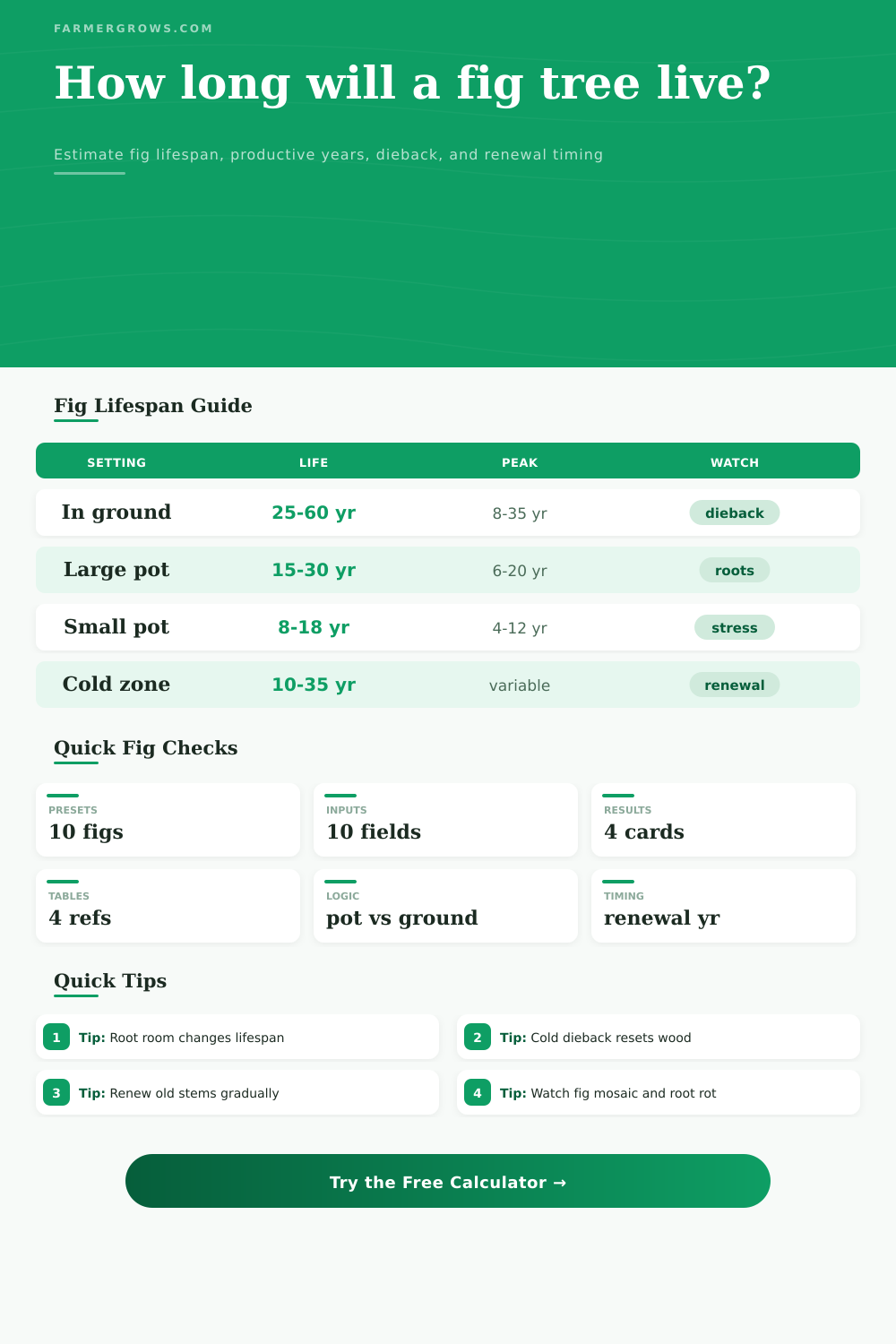
| In-ground fig in mild climate | 30 to 60 years, sometimes longer | Year 7 to 35 | Trunk age, root disease, storm damage, and canopy crowding |
| In-ground hardy fig with periodic dieback | 15 to 40 years for the crown | Variable after each winter | Topwood loss and short-season ripening |
| Large container fig | 15 to 30 years | Year 5 to 20 | Root congestion, watering swings, and nutrient depletion |
| Small container fig | 8 to 18 years | Year 3 to 12 | Heat stress, restricted roots, drought, and pot-bound decline |
| Greenhouse or protected fig | 18 to 35 years | Year 5 to 24 | Root refresh, pests, and salt buildup |
| Dieback pattern | Lifespan effect | Productive effect | Best response |
|---|---|---|---|
| Rare tip injury | Small reduction only | Breba and main crop can remain reliable | Remove dead tips after buds show life |
| Light twig dieback | Minor topwood aging reset | Some breba loss, main crop usually steady | Thin weak shoots and keep young canes |
| Moderate cane dieback | Shortens productive topwood cycle | Main crop delayed while new shoots rebuild | Select strong replacement canes each spring |
| Severe top-kill | Crown may live, but tree age resets above ground | Useful crop depends on season length and variety | Mulch crown, protect stems, and avoid excess nitrogen late |
| Annual crown dieback | Root system persists but productive lifespan is limited | Crop may be late or unreliable | Use earliest varieties or grow in a movable container |
| Management factor | Extends life when | Shortens life when | Timing cue |
|---|---|---|---|
| Renewal pruning | Old trunks are replaced gradually with young stems | All fruiting wood is removed at once every year | Remove one or two oldest stems each dormant season |
| Root pruning in containers | Root ball is refreshed before severe circling | Pot is left packed for many years | Refresh every 2 to 4 years in active pots |
| Pot size | Water and temperature stay steady | Small black pots overheat or dry daily | Move up when watering cannot keep leaves turgid |
| Soil drainage | Roots get oxygen after heavy rain | Wet roots stay sour or anaerobic | Improve mix or drainage before decline spreads |
| Variety vigor | Cultivar replaces wood quickly after stress | Weak growth fails to rebuild canopy | Track annual shoot length and leaf density |
| Scenario | Keep and renew | Propagate backup | Replace soon |
|---|---|---|---|
| Healthy in-ground fig | Strong shoots and clean crown | Age above 70% of adjusted life | Crown rot, borers, unsafe trunks, or severe decline |
| Container fig | Responds after root pruning and fresh mix | Root ball fills pot again within one season | Permanent wilt, sour mix, or repeated branch dieback |
| Cold dieback fig | New shoots ripen fruit before frost | Crop is late but variety is valuable | Annual dieback prevents useful crop in most years |
| Old stool or multi-trunk fig | Young replacement stems are already present | Main trunks are hollow but roots are healthy | Large dead crown, root disease, or falling productivity |
A fig crown can be old while the fruiting stems are young. Severe cold may reset topwood without killing the whole plant.
Long-lived potted figs need periodic root pruning, fresh mix, and steady water. Pot-bound roots are a lifespan issue, not just a yield issue.
Remove the oldest stems over several seasons where possible. This keeps replacement wood coming while preserving near-term crops.
Fig mosaic symptoms, rust, borers, nematodes, root rot, and poor drainage can matter more than the calendar age of the tree.
Fig trees may look dead when they don’t bear fruit again, but it’s not so simple. More likely what happens is that the roots lives on (often for years) and only grow out a new set of branches when things get better. Hard to guess how old your fig tree is; being able to start over from below makes it a tricky calculation. Consider its age and any winter damage. Also look at the space around the roots and disease pressure on the tree itself.
To do this, use the calculator on this page, which will take care of the math while you concentrate on figuring out a care strategy. It will give you an estimate based off historical data for your specific set up. I know many folks just guess depending on how big the trunk looks. That is not accurate, though; thickness do not mean the tree is healthy. You can have a thick looking trunk and still have root rot or some other structural weakness behind it that might come down in high wind. So the tool asks you to see beneath the outer layer of bark to check actualy health.
How Long Do Fig Trees Live?
How long will your fig last? That depends on where it lives. In a good location, the plant can reaches forty-plus years of age. This means soil is relatively dry but well-drained and comfortabley warm. Its roots will take in energy to stretch out as necessary and then tuck it away.
Plant the same type of fig in a tight space (think: pot), and it could shorten its life by half (to maybe fifteen years) because of root restriction. The smaller the container, the faster it’ll deteriorate (because there’s less oxygen exchange and water-storage capacity). In this situation, you’re daily increasing the pressure against a limited volume.
Cold weather adds complication. A lot of people don’t realize how complex this is. In colder areas, the top portion of the tree will die back heavily every year. That looks like death, but it isn’t. It is a reset of above-ground structure, where the roots lives and send up new shoots in spring.
The question is: Can the new shoots get to maturity and bear fruit before frost again? If your growing season is too short, then even though the fig may be biologically immortal, it is really impractical as a crop producer.
Regular pruning is one reason to extend the life of the tree. A lot of gardeners don’t do any (or hardly ever do) and what happens? Branches becomes crowded, light cannot get in, and disease sets in. Renewing branches regularly means having young wood actively producing fruits; it’s work, but an investment in fruit to come. Your pruning practices is included in the estimated life in the calculator. Neglect will shorten life; good maintenance will extend it.
The calendar age of your trees isn’t always as important than disease pressure. A 30-year-old tree that’s infested with borers may be dead in three seasons. Another aged specimen on poorly drained ground is long gone, while its healthier-looking younger sibling (ten years old) lives to a ripe old age. First look at the roots. Are they tight circles? Soggy? Big trouble, and no miracle fertilizer will help. How about some fresh soil, plus improved drainage? Then maybe something else…
REPLACING A dying fig tree may sound extreme, until you look at the numbers. When do you replace the tree, and when do you keep it? Use these reference tables on the page to weigh your options. Want another chance with the same variety, but with a fresh start (and a healthy root system)? Take cuttings for propagation…saving you heartache and labor in the long run.
Fig trees are rewarding of careful handling, not heroic last-minute efforts. If there’s a problem, they don’t take kindly to an emergency intervention; they want a little loving, steady as she goes. Be honest with yourself about what their environment can support. Establish expectations early (use the calculator). And look for clues to how the tree is doing. Examine the roots; they’ll tell all.