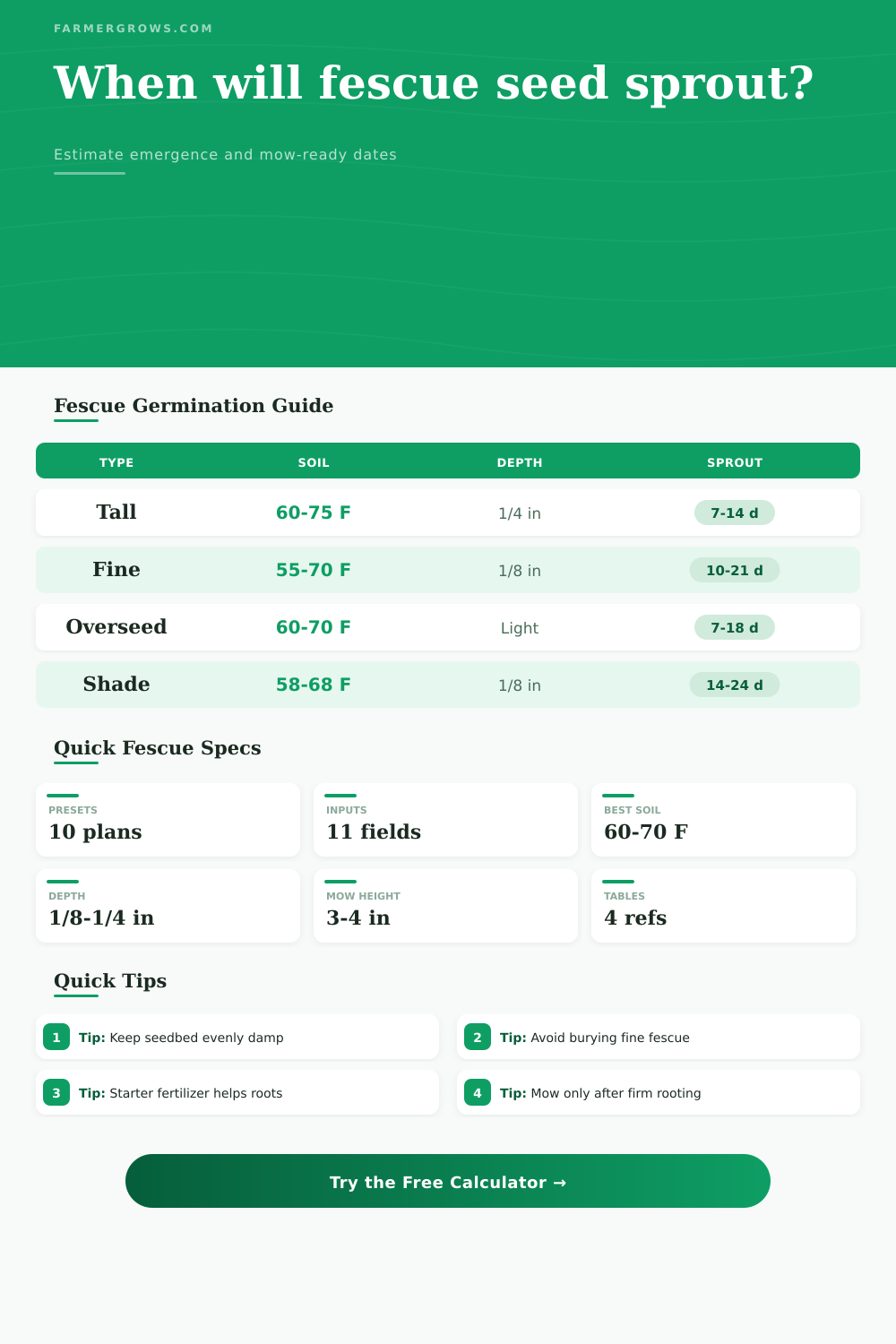
Fescue Seed Germination Time Calculator
Estimate tall or fine fescue emergence, first visible green-up, mow-ready date, and establishment confidence from soil temperature, seed depth, moisture, fertilizer, shade, and lawn type.
Use the presets for common fall and spring lawn projects, then tune the seed-zone conditions. The estimate assumes viable seed, good soil contact, and irrigation that prevents the seedbed from crusting or drying out.
1 Choose a fescue seeding preset
2 Compare fescue germination profiles
Fastest and most common for durable cool-season lawns when soil is near 60 to 70 F.
Useful in partial shade, but it reacts poorly to deep burial and seedbed drying.
Slower to fill, good for lean soil and lower fertility areas once established.
Works well in fine fescue blends and shaded slopes with light seed coverage.
3 Enter your seedbed conditions
Your fescue seed timeline
Estimate appears here after calculation.
4 Seedbed condition summary
5 Fescue reference tables
| Fescue type | Typical emergence | Best soil temperature | Depth target | Planning note |
|---|---|---|---|---|
| Tall fescue | 7 to 14 days | 60 to 75 F | 1/8 to 1/4 inch | Most forgiving for full-sun lawns and renovations. |
| Turf-type tall fescue blend | 7 to 16 days | 60 to 72 F | 1/8 to 1/4 inch | Blended lots may show staggered sprouting. |
| Creeping red fescue | 10 to 21 days | 55 to 70 F | Surface to 1/8 inch | Good shade tolerance, slower early density. |
| Chewings fescue | 10 to 20 days | 55 to 70 F | Surface to 1/8 inch | Fine texture, useful on slopes and shade mixes. |
| Hard fescue | 14 to 24 days | 55 to 68 F | Surface to 1/8 inch | Low-input sites need patience before mowing. |
| Sheep fescue | 14 to 28 days | 55 to 68 F | Surface to 1/8 inch | Best for naturalized or low-maintenance turf. |
| Soil temperature | Timing effect | Watering effect | Use this action |
|---|---|---|---|
| Below 50 F | Very slow or stalled | Seed can sit for weeks | Delay seeding or expect a long wait. |
| 50 to 55 F | Slow | Moisture must stay steady | Use for early spring only if weather is stable. |
| 56 to 60 F | Moderate | Good for fine fescues | Rake lightly and water gently. |
| 61 to 70 F | Best window | Fast and even germination | Ideal for fall tall fescue and blends. |
| 71 to 78 F | Fast but stressful | Seedbed dries quickly | Water more often and avoid heavy nitrogen. |
| Above 78 F | Heat risk | Drying and disease pressure rise | Delay if hot nights or drought are forecast. |
| Seed depth or cover | Tall fescue result | Fine fescue result | Correction |
|---|---|---|---|
| Surface, firmed | Good if kept damp | Good target | Roll or press seed for soil contact. |
| 1/8 inch | Very good | Best target | Light rake or compost dusting. |
| 1/4 inch | Best target | Often too deep | Use only for larger tall fescue seed. |
| 1/2 inch | Delayed and thinner | Poor emergence | Scratch surface and overseed lightly. |
| Over 1/2 inch | High failure risk | High failure risk | Do not bury more; reseed at the surface. |
| Project | Emergence planning | Mow-ready planning | Extra care |
|---|---|---|---|
| New lawn | More uniform if raked and rolled | Usually 28 to 45 days | Keep traffic off until rooted. |
| Overseeding | Can be uneven under existing canopy | Usually 30 to 50 days | Mow old grass high and bag clippings. |
| Bare patch | Fast if soil contact is clean | Usually 25 to 42 days | Feather seed into surrounding turf. |
| Renovation | Depends on debris removal | Usually 32 to 55 days | Topdress lightly and water often. |
| Shaded area | Slower and thinner | Usually 40 to 65 days | Use fine fescue and reduce traffic. |
6 Practical fescue seeding tips
Water lightly enough to keep the top quarter inch damp without washing seed into low spots. After emergence, switch gradually toward deeper, less frequent watering.
Tall fescue can handle a little more cover than fine fescue. Fine fescue usually needs surface contact, a dusting of compost, and gentle irrigation.
Starter fertilizer helps early rooting when applied at label rate. Avoid pushing tender seedlings with heavy nitrogen before the first mowing.
Make the first cut only when seedlings resist a light tug and reach the selected mowing height. Use a sharp blade and remove no more than one third.
Fescue is treated as a quick fix around here by most homeowners; They toss some seed around on Saturday and hope for a plush carpet by Monday morning. Unfortunatley, reality move at a snail’s pace and it will punish you if you don’t understand what’s going on beneath the surface before anything show up on top.
It’s all about patience and understanding germination. Germination is not one single event but a series of thing that take place over weeks. Soil temperature, moisture consistency and depth of burial matters with tiny seeds. Plugging in your local conditions into the calculator (above) do the math for you, and spares you a guess as to whether your soil temperature has warmed enough to awaken dormant seed.
Why Fescue Grass Needs Time to Grow
Remember: it’s not so much the air temperature that counts but rather the soil temperature (since roots is growing down there). Fescue, for example, won’t move until the soil temperature reaches around fifty near the seedbed even if it’s reading seventy at knee height on your thermometer. That’s why it makes sense to check what the real ground temp is at planting depth, and not just glance at the weather app.
And then there’s the thing about seed depth, which also gets people tripped up again and again. Seeds of tall fescue are pretty strong and big so they’ll poke their little heads up through a quarter-inch layer of soil without complaint. But those tiny seeds of fine fescue. Creeping red and chewings in particular, are delicate creature who lack the energy reserves to fight their way through the soil if buried too deep. Keep the fine fescue on top or lightly covered with compost.
It is not a preference but a requirement if they are going to survive at all. If you bury them an extra eighth-inch deeper then you intended, you’ll lose half your stand before watering it in.
How does this affect seed starting? Managing moisture during those first couple of weeks make all the difference. You shouldn’t have too much but you also shouldn’t let them get soaked or bone-dry. This determines whether you end up with patchy growth or a nice even stand of babies. To promote rooting after germination, water more deeply but less often; before that, frequent light watering is best.
It seems opposite for a lawncare regimen, but a flood will wash around tiny seeds and form a crust that won’t allow for exchanging air. The tool also asks about shade levels and whether you want to include starter fertilizer. These two things affects how much time the seedlings have to get established after breaking through soil.
Phosphorous-rich starter fertilizer is key to early rooting action and helps give your young plants a fighting chance to overcome drought stress or competition from older weed growth. Things happen slower in shade, from transpiration to photosynthesis. You will also need to be patient longer before you even think of mowing a shady area.
The biggest rookie error is mowing too early. You think you’ve won because you see little green sprouts; but they’re tender seedlings whose shallow roots can be easily uprooted by the wheels of a mower (or even from someone walking on them). Let the grass grow till it’s as tall as your desired cut and then pass the tug test. That means its root system should of been strong enough for stress.
If not, what happens? Bare spots must be filled in again, which ruins everything you’ve done so far. Knowing this timeline will give you more reasonable expectations. Remember: This is a living thing; you’re not laying carpet. Consult the reference table on this page to help you choose a mixture and understand what to expect.
Following fescue’s biological lead give superior results than pushing it to do anything else, whether you’re starting fresh or overseeding an existing lawn. The secret to establishing a successful lawn is that timing matter as much as doing things correctly in the end. Provide the seed with what it wants (and when) it wants it; temper your expectations in those first few quiet weeks and then stand back and let nature take over.
When you’re able to walk around on something that feels solid beneath your feet, not spongy and unsure… It’s worth all that waiting for.