Fertilizer Per Plant Calculator
Estimate fertilizer grams per plant, total product, N-P-K delivery, split applications, spacing load, and safe dose checks for vegetables, berries, herbs, ornamentals, and container plants.
Load a crop scenario, then adjust the plant count, spacing, target nitrogen, product grade, slow-release share, spoon density, and split plan.
Per-Plant Fertilizer Plan
Your fertilizer plan will appear here.
| Plant group | Typical N per plant | Common split | Spacing context | Use note |
|---|---|---|---|---|
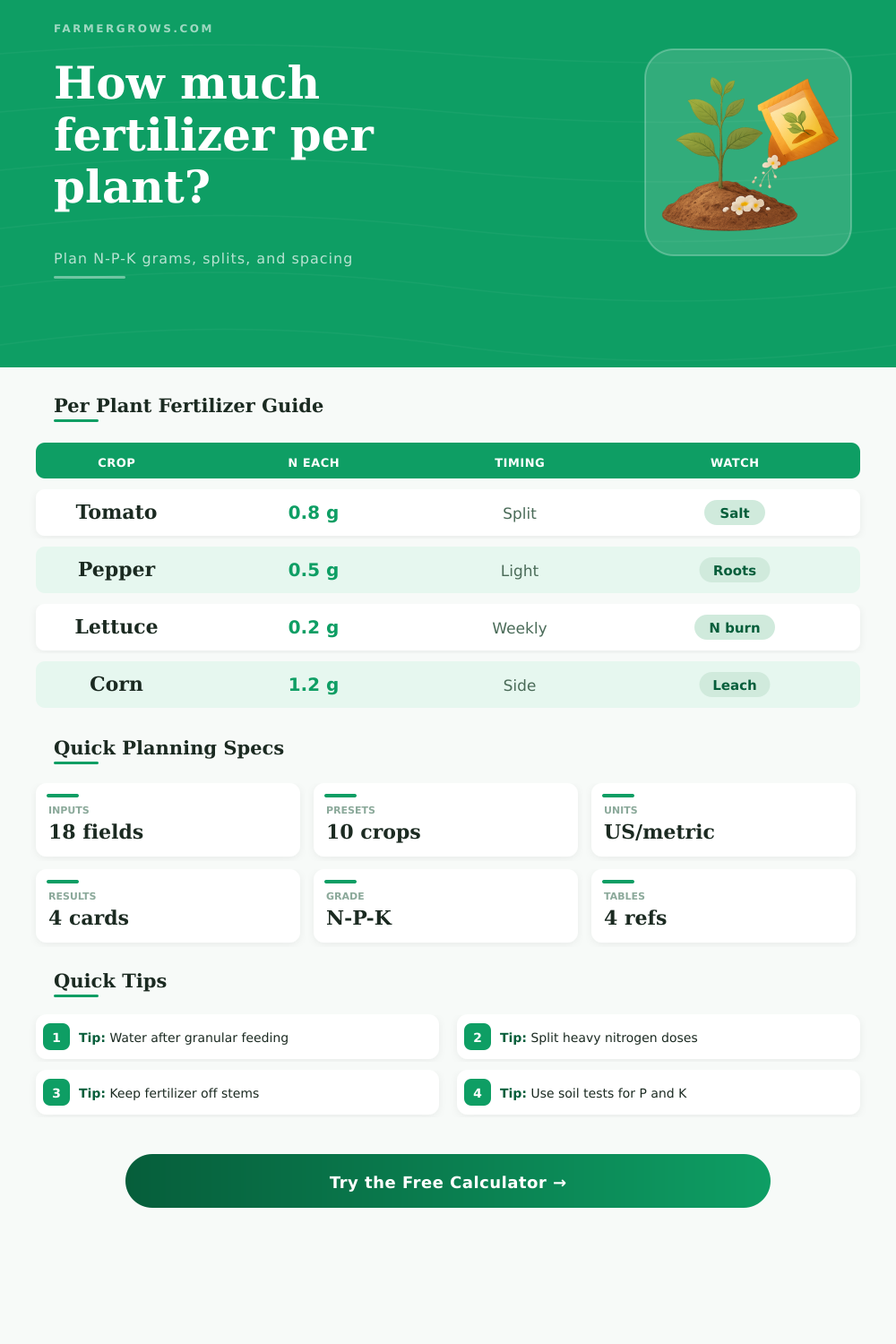
| Tomato or heavy fruiting vegetable | 0.6 to 1.2 g N | 3 to 4 doses | 18 to 36 in spacing | Keep granules outside the stem zone and water well. |
| Pepper or eggplant | 0.35 to 0.8 g N | 2 to 4 doses | 15 to 24 in spacing | Too much early N can delay fruiting. |
| Leafy greens | 0.08 to 0.3 g N | Light frequent doses | 4 to 12 in spacing | Use gentle rates to avoid leaf burn and nitrate spikes. |
| Sweet corn | 0.8 to 1.6 g N | Side-dress heavy | 8 to 12 in spacing | Most N demand arrives during fast vegetative growth. |
| Berry or ornamental shrub | 1.0 to 4.0 g N | 1 to 3 doses | Wide root zone | Broadcast around the drip line, not against stems. |
| Fertilizer grade | N percent | P₂O₅ percent | K₂O percent | Product for 1 g N |
|---|---|---|---|---|
| Balanced 10-10-10 | 10 | 10 | 10 | 10.0 g product |
| Vegetable 5-10-10 | 5 | 10 | 10 | 20.0 g product |
| Tomato 3-4-6 | 3 | 4 | 6 | 33.3 g product |
| Organic 4-4-4 | 4 | 4 | 4 | 25.0 g product |
| Urea 46-0-0 | 46 | 0 | 0 | 2.2 g product |
| Spoon estimate | Low-density organic | Typical granular | Dense mineral | How to verify |
|---|---|---|---|---|
| 1 teaspoon | 3.0 to 3.5 g | 4.0 to 5.0 g | 5.0 to 6.0 g | Weigh 10 level teaspoons, then divide by 10. |
| 1 tablespoon | 9 to 10.5 g | 12 to 15 g | 15 to 18 g | Tablespoon equals 3 teaspoons by volume. |
| 1 cup | 144 to 168 g | 192 to 240 g | 240 to 288 g | Use only for large batches, not single plants. |
| Pinch measure | 0.2 to 0.4 g | 0.3 to 0.6 g | 0.4 to 0.8 g | Better weighed for seedlings and small pots. |
| Situation | Per-app caution | Root-zone caution | Watering cue | Adjustment |
|---|---|---|---|---|
| Seedlings or herbs | Under 1 g product | Low salt tolerance | Water before and after | Use more splits or dilute feed. |
| Transplants | Keep off crown | Band 3 to 6 in away | Water after placing | Reduce dose in dry heat. |
| Heavy fruiting crops | Split above 8 g | Spread around drip line | Deep water after side-dress | Feed when fruit set begins. |
| Containers | Watch per liter | Limited soil buffer | Leach salts periodically | Use lower, frequent doses. |
| Sandy soil | Leaching risk | Small root reserve | Water lightly but often | Prefer split nitrogen. |
Placement note: Granular fertilizer should usually be scratched into moist soil beside the plant row or around the drip line, then watered in.
Soil test note: Use this calculator to size the product, but var a soil test decide whether phosphorus or potassium should be reduced or skipped.
Most of us fertilize using vague intuition instead of exact math. “It says here to grow something I’ll buy a big bag of stuff and spread around willy-nilly,” and voila, nothing much growing (or worse, all leaf and no fruit). Not your fault; just your math.
Fertilizer isn’t food the way plants eat it. They take up nutrients from a solution dissolved in water, and each species have its own limit for how much of each nutrient (nitrogen, phosphorus, or potassium) it can take in at once. You have to come to terms with that when you think in terms of nutrition per plant.
Stop Guessing: How to Feed Your Plants Correctly
The calculator above do the math for you: It takes the crop you plan to grow, its spacing and desired amount of nitrogen and transforms it into exact spoon measures and weights. It shifts the focus from vague abundance to specific availability.
If you choose something that’s a big eater, sweet corn, say, or tomatoes, the tool accounts for their huge appetite while they’re growing fast. But look at what occurs if you change the crop to something leafy. The necessary nitrogen plummet. Why? Because leafy greens get eaten fast. They don’t have time to stock up in woody stems or draw down nutrients from deeper soil levels. Feed them regularly and lightly. This avoids overfeeding greens, which is the quickest way to get too many nitrites in your salad bowl. High nitrite levels can taste unpleasant and may be harmful to your health.
Don’t get fixated on which bag has the most famous name; what really counts is the grade of the fertilizer. A “balanced” ten-ten-ten means it contains 10 percent each of N (nitrogen), P (phosphate) and K (potash), by weight. A specially formulated tomato blend may be labeled as three-four-six, meaning that the percentage of those elements will be 3%, 4%, and 6% (or so). Those are percentages, not volumes. That’s why a concentrated food such as urea can have twice the actual nitrogen per gram of material required then a less concentrated organic meal containing just one gram of nitrogen per maybe twenty-five grams of material.
So density is another variable that plays into this equation. A tablespoon holds about ten grams of lightweight organic meals like feather meal, but only about half that amount of dense mineral fertilizers. Not knowing the density and making guesses based on volume alone can lead to big mistakes when applying anything. I’ve included some table of spoon comparisons below, from both heavy stuff and airy stuff, showing how wide off-base our volume-only estimates can be.
To retain nutrients, splitting applications isn’t optional; it’s essential. Rain and runoff are always a threat to success, so don’t risk applying all the season’s quota of any element, especially nitrogen. At one time. As they say, nitrogen follows water, which means if a heavy storm hits the day after fertilizing, half of whatever amount you apply could wash off and into the ground- or surface-water system. To keep nutrients where they belong, in the root zone, where the plant can use them, it makes sense to divide the dose into multiple small ones. You can dial in those splits in the calculator, making sure every dose falls well below the maximum safe amount for the size of the plant at any given moment.
Remember, transplants have very small root system. When you smother them with concentrated salt-laden fertilizer at planting time, you inflict an osmotic shock on them that pulls water out of their roots instead of allowing water in. Better to feed little and do so carefully staying away from the stem, watering right after.
But it all depends off the texture of your soil. Does it drain fast? Then you have sandy soil, which doesn’t retain many nutrients and will wash those out more quickly. Or does it hold nutrients tightly but release them slowly? That’s clay. To account for such access factors, the tool assume that not 100 percent of the fertilizer described on the bag will become available immediately to the plant. Microbes break down organic materials first, so soil moisture and temperature affect how quickly they does their job. Nitrogen from an organic source like compost will take a long time to get broken down if the soil is cool early in the spring. Plants can starve while they wait for nitrogen (or any other nutrient) that hasn’t been delivered yet, especially if you just rely on blood meal or compost tea in cool weather. Knowing when there will be a delay could of made the difference between a crop that thrives and one that looks pale even though you provided everything it needed to stay healthy.
The bottom line: Feeding a garden isn’t so much about throwing things at it as it is getting them in sync with the plant’s own life processes. Metabolism has its rhythms, which we try to time our feeding to match. That’s true whether your garden is a big vegetable bed or a single potted herb. Measure carefully; divide the dosage into smaller amounts and observe the bounds of the root zone. A little precision goes a long way compared to a lot of guessing.