Fertilizer Per Acre for Sugarcane Calculator
Estimate sugarcane fertilizer rates from acres, cane yield goal, plant cane or ratoon stage, soil N-P-K credits, trash blanket nutrient credit, product analysis, split timing, water regime, pH, sulfur, and micronutrient needs.
Load a common cane fertility scenario, then adjust the analysis, yield target, soil-test credits, trash blanket credit, water setting, and split timing to match the field plan.
Usually needs a balanced base, moderate nitrogen, and good phosphate placement near early root growth.
Often receives more nitrogen and potash because the stubble crop starts fast after harvest.
May need higher N and K, but poor stands should be checked before chasing yield with fertilizer.
Higher yield goals can justify larger nutrient totals when water supply and split timing are reliable.
Sugarcane Fertilizer Application Plan
Results show product rate, N-P-K delivery, bag count, split timing, and field notes.
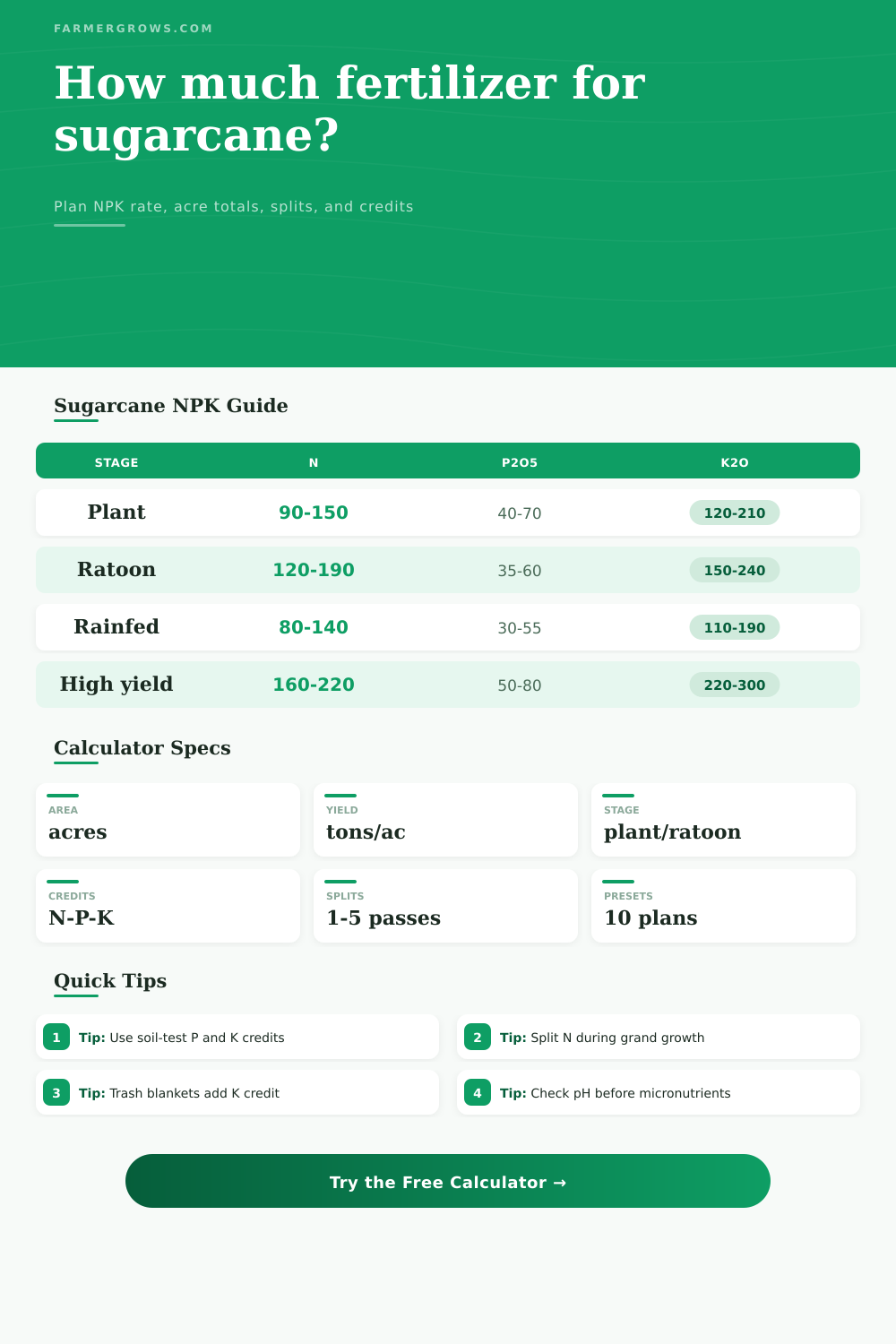
| Cane situation | Typical N target | Typical P2O5 target | Typical K2O target | Planning note |
|---|---|---|---|---|
| Plant cane, medium yield | 90 to 130 lb/ac | 40 to 65 lb/ac | 120 to 180 lb/ac | Use soil-test P and band placement where recommended. |
| First ratoon, good stand | 120 to 170 lb/ac | 35 to 55 lb/ac | 150 to 220 lb/ac | Apply early enough to support rapid canopy regrowth. |
| Older ratoon or weak stand | 110 to 190 lb/ac | 30 to 55 lb/ac | 150 to 240 lb/ac | Check stand count before adding aggressive rates. |
| Irrigated high-yield cane | 160 to 220 lb/ac | 50 to 80 lb/ac | 220 to 300 lb/ac | Best matched with split application and tissue monitoring. |
| Fertilizer analysis | 100 lb product supplies | Product for 100 lb N | Product for 100 lb K2O | Best use |
|---|---|---|---|---|
| 15-5-20 cane blend | 15 N, 5 P2O5, 20 K2O | 667 lb | 500 lb | Balanced cane program where K demand is strong. |
| 12-6-24 high potash | 12 N, 6 P2O5, 24 K2O | 833 lb | 417 lb | Ratoon cane or sandy soils needing more potassium. |
| 18-6-12 starter blend | 18 N, 6 P2O5, 12 K2O | 556 lb | 833 lb | Plant cane with moderate potash need. |
| 46-0-0 plus potash | 46 N, 0 P2O5, 0 K2O | 217 lb | needs K source | Use when N is separate from P and K decisions. |
| Split timing | Common share | Growth stage | Why it matters |
|---|---|---|---|
| One pass | 100% | Preplant or early ratoon | Simple, but single large doses carry more loss risk. |
| Two passes | 40% then 60% | Early growth and grand growth | Good default for many field cane programs. |
| Three passes | 25%, 45%, 30% | Planting, tillering, elongation | Better nutrient match on sandy or leaching-prone soils. |
| Four or five passes | staged shares | Irrigated or fertigated cane | Useful when equipment can apply smaller precise doses. |
| Soil or tissue signal | Likely concern | Calculator note | Field response |
|---|---|---|---|
| pH below 5.5 | Acidity and aluminum stress | Lime note becomes high priority | Use soil-lab lime rate before relying on fertilizer alone. |
| pH 6.0 to 7.0 | Normal cane range | Monitor with routine soil tests | Keep fertility plan tied to yield and tissue results. |
| pH above 7.5 | Iron, zinc, or manganese tie-up | Micronutrient note rises | Confirm with tissue test and choose compatible sources. |
| Low organic matter or sandy soil | Sulfur and boron risk | S and micronutrient watch increases | Apply only when tests or local history justify it. |
Credit the trash blanket carefully. Green cane residue can recycle useful K2O, but cool soil, dry weather, and slow decomposition can delay when that potassium is available.
Keep N near active uptake. Sugarcane usually uses nitrogen most efficiently when large N doses are split around tillering and grand-growth demand instead of sitting exposed early.
A sugarcane field takes plenty of nutrients out of ground. Nitrogen, Phosphorous, and Potassium (NPK) is used up heavily during growth, leaving many fields with poor soil tests by harvesting time. There’s much more to figuring out how much to fertilize your field than just grabbing X number of bags from the feed store. Timing, chemical interactions, existing residues and soil nutrients all matters. This calculator will tell you what to put down; it’s knowing the inputs that make the season successful…or a waste of money.
Know your crop stage. Even though both plant cane and ratoon cane has identical leaves, they are separate crops. The former relies on phosphate to establish its root system and needs only moderate amount of N for early shoot growth. The second one, which emerge quickly after harvest from stubble, requires high rates of immediate potash and also more N. Treating that third-ratoon crop as if it were a first planting is not going to yield fast results. Tell the tool what stage the crop is in; it’ll adjust its base demand accordingley.
Tips for Using Fertilizer on Sugarcane
Nutrient management is highly affected by water availability. Because irrigated cane is easier to process, there is less limit on nutrient load. On rainfed crops you need to be more conservative. Remember: The plant won’t take up nutrients that haven’t been washed into the root zone. Don’t put too much nitrogen on dryland. In these situations, leaching are the silent killer. The efficiency ceiling will be set in the input. When you have erratic rain or fast-draining soils and apply high rates, the fertilizer goes into the groundwater different than the crop.
Prior nutrients influence purchases. Too many growers thinks about adding, instead of subtracting. Soil test credits for nitrogen, phosphate, and potash reduce the amount you need to purchase. You don’t get any more yield by adding potassium where there’s plenty of it. It just sits in soil until another rain event or crop uses it. Otherwise, the excess will stay there for next crop. The same applies to the trash blanket credits. Green cane left on the surface as a trash blanket is a slow release source of potassium and holds moisture. These credits save you money while preventing one nutrient from building up and blocking the uptake of others.
Nutrient uptake is better when split. Putting everything down at planting have its perils. Sugarcane takes up nutrients according to an S-shaped curve, the grand growth phase being their peak period of uptake. By splitting we match nutrient availability to plant demand. Nutrients stays in the root zone (where they are needed) and there’s less volatility loss as stalks really take off. The calculator provides a total, and then you decide based off the labor, literature, and equipment schedule. Less risky if more field passes is made; but this also adds time cost.
Think about the pH and soil micronutrients, as nutrients become available based on pH. Expensive phosphate is converted to unavailable iron phosphate in acidic soil. Alkaline soil tie up iron and zinc micronutrients. Your tool flags pH problems; soil samples confirm them. Micronutrients and sulfur are often overlooked till there are deficiency symptoms. Lacking them may show up as yellowing between the veins. Adding small amounts of sulfur can help with stalk strength and improve protein synthesis, especially if soil is sandier and more inclined to leach.
There are reference tables for common ranges for different situations. These should of be used as a sanity check, not a rulebook. Each field will have its quirks. The intent is to pair the inputs with what you can reasonably expect, and to avoid overdoing it. Don’t go into luxurius consumption mode; adding another round of nitrogen won’t make the cane get any bigger, just more leaves. You want to push that cane to its genetic limit.
Sugarcane is a changing balance between crop physiology and soil chemistry. To understand how it works you have to consider not just what’s in the fertilizer bag but also the rest of the system: the residue, the rain and the root system itself. The right ratio leads to better juice quality and thicker stalks. Applying nutrients from the right source, at the right time, in the right amount, that’s feeding the plant well. Doing so precisely makes for a good season become a great one.