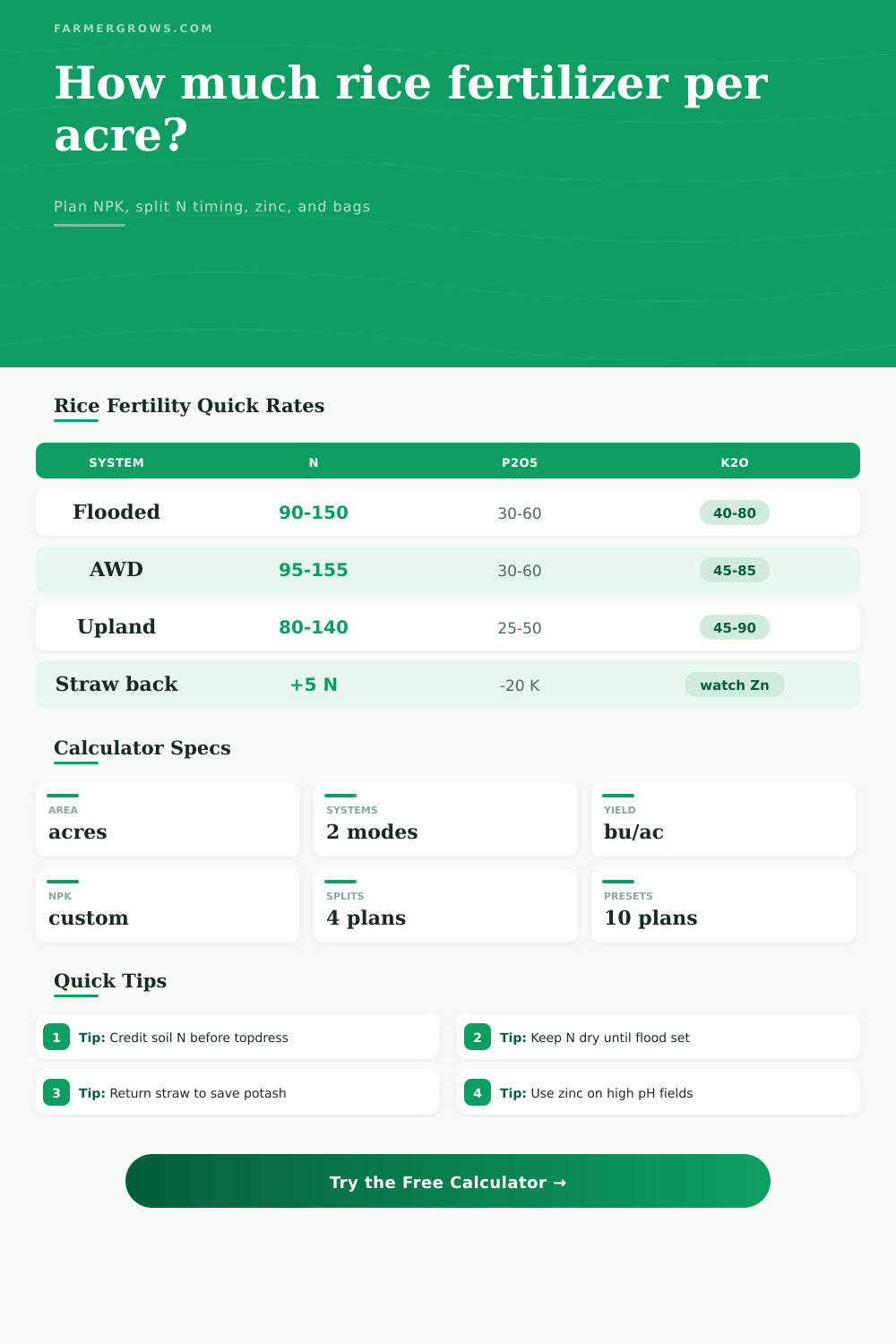
Fertilizer Per Acre for Rice Calculator
Estimate rice fertilizer per acre from acres, flooded or upland production, rough rice yield goal, soil N-P-K credits, fertilizer analysis, nitrogen split timing, straw return, water management, zinc need, and variety duration.
Choose a starting plan, then edit the field size, yield goal, soil credits, fertilizer grade, straw return, water timing, zinc status, and nitrogen split program.
Rice Fertilizer Plan
Your calculated fertilizer rate will appear here.
Best fit for urea or ammonium N placed before flood. Keep dry fertilizer off standing water until incorporation or flood timing is ready.
Alternate wetting and drying can work well, but N efficiency depends on applying before reflooding and avoiding exposed wet soil losses.
More leaching and dry-soil variability often means smaller split doses and more conservative yield goals than flooded basins.
Starter P and K matter early, while most N should wait until stand establishment and dependable water management.
| Rough rice yield goal | Flooded N target | Upland N target | P2O5 and K2O planning note |
|---|---|---|---|
| 110-130 bu/ac | 80-105 lb/ac | 85-115 lb/ac | Use soil test; P2O5 often 25-45 and K2O 35-60 lb/ac. |
| 140-170 bu/ac | 100-130 lb/ac | 105-135 lb/ac | Moderate yield zone; return straw to lower potash removal pressure. |
| 180-210 bu/ac | 125-155 lb/ac | 125-150 lb/ac | High yield rice needs strong midseason N timing and adequate K. |
| 220+ bu/ac | 145-175 lb/ac | 140-165 lb/ac | Confirm local recommendations before pushing N rates above normal ranges. |
| Source or blend | Analysis | Primary use | Calculator note |
|---|---|---|---|
| Urea | 46-0-0 | Main nitrogen | Enter 46 for N and zero for P2O5 and K2O. |
| Ammonium sulfate | 21-0-0 | N plus sulfur | Useful where sulfur is also needed; larger product pounds per acre. |
| DAP | 18-46-0 | Starter N and P | Often sized by P2O5, then N balance is finished separately. |
| MOP potash | 0-0-60 | K replacement | Use when straw removal or low soil K creates a potash deficit. |
| Rice blend | 16-20-0 | Preplant blend | Good for early N and P, but K may need a separate source. |
| Balanced blend | 13-13-13 | Mixed fertility | Auto sizing may oversupply one nutrient to meet another. |
| Split program | Typical shares | Best fit | Field caution |
|---|---|---|---|
| Basal plus tillering | 50% / 50% | Simple flooded fields | Works best when flood can be held soon after N. |
| Basal, tillering, panicle | 40% / 35% / 25% | Higher yield lowland rice | Keep panicle N modest to avoid lodging. |
| Tillering, panicle, boot | 45% / 35% / 20% | Dry-seeded or uncertain early water | Needs timely scouting and water control. |
| Four-way spoon feed | 30% / 30% / 25% / 15% | Long duration or sandy fields | Extra passes improve timing but add handling risk. |
| Factor | Low input setting | Higher input setting | Calculator adjustment |
|---|---|---|---|
| Straw return | Most straw returned | Straw removed | Returned straw lowers K2O need; removed straw keeps replacement higher. |
| Flood timing | Flood set after N | Delayed flood | Delayed or rainfed water lowers N efficiency and raises product rate. |
| Zinc status | No symptoms | Known low Zn or high pH | Zinc sulfate rises from zero to deficiency-level maintenance. |
| Variety duration | Short duration | Long duration | Long rice receives more seasonal N and spread-out timing. |
Split nitrogen by water control: Apply urea close to flood establishment or reflooding so nitrogen stays in ammonium form and plant uptake improves.
Do not ignore straw: Returned rice straw can recycle substantial potassium, while removed straw makes K2O replacement more important for the next crop.
When you sit down with paper and pencil, planning fertilizer application can be clean and easy: the math is straightforward and it looks like you have plenty of time to reach your yield goal. Reality isn’t so tidy; ground’s not all one texture, and Mother Nature doesn’t go by your schedule.
There’s always a gap between plan and reality that has to be bridged, you want to know how many containers or what amount of product in pounds per acre will be needed for rice. The calculator take the guesswork out of converting yield goals, system type, and field size into a set number of containers or pounds of a given product. It turns your general goals into specific plans.
How the Calculator Helps You Plan Fertilizer
The big decision is that water trumps nitrogen. An anaerobic environment holds onto nitrogen in a form (ammonium) that is soluble and available to be taken up by roots. Aerobic/upland systems leaks nutrients more quickly than flooded ones. The tool automatically accounts for soil drying out or water running off, which reduces efficiency. Simply describe how you manage water, and the system will recalculate nitrogen accordingly to prevent overapplying to make up for lost runoff.
Yield goals have their perils. It takes more potash for a two-hundred-bushel goal then it does for a one-hundred-fifty-bushel goal, for instance. And by scaling up (or down) phosphorus and potassium in tandem with nitrogen, the calculator will help you avoid common pitfall of applying only for nitrogen without considering other nutrients. To get more bushels, you don’t just feed the leaves; you feed the whole plant. The reference table show how your nutrient targets change based on expected bushels.
Farmers also guess wrong when managing straw, whether they leave rice straw in the field to recycle nutrients or take it away. The system reflects the value of straw’s role as a potassium bank. Choose to leave straw and the program reduces the recommended rate for potash, since some of the nutrient come from organic matter. When removing straw, make up for its lost potassium heavily; the tool spells out that trade-off in the final product rate.
It’s fancy math about when to time splits. If you apply it too early, like at planting, you risk applying all that N, which is dangerous. If you apply it too late, like after panicle initiation, its too late for tillering. The calculator lets you select either 3-way or 4-way split programs, or just basal + tiller. There is various efficiency factors associated with each split pattern.
Generally, the more times you make a pass across the field with your application equipment, the lower the loss from volatilization. However, making multiple trips cost more than making fewer trips, so balance the yield benefit of improved nutrient timing against the cost of additional applications. Cost of additional applications. The output will show exactly how many pounds of what goes where.
Zinc deficiency stunts rice: This essential trace mineral doesn’t show up on those familiar NPK labels, yet too little of it stunts crops. And when soil pH is high, zinc gets bound up and unavailable to plants. How do you test for zinc? The tool will ask you whether it’s an issue (and include a sulfate recommendation should it be). That simple step ensures a better harvest.
You enter the “soil credits” that your field already contains; those naturally occurring levels of, say, potassium or phosphorus, then the system subtracts those totals from overall fertilizer needs. This way, you do not overspray fields whose soils is already rich in one nutrient or another. At the end you get a bag count and total pounds of product applied.
What good does this do? Well, now you know exactly how many 2,000-pound totes (or 50-pound bags) to stage next to the field. You no longer have to guess; you just count.
Now you are matching what the plant needs with what was put out, taking into account your local soil and water conditions. Plan your acres, plan your yield and let the math take care of the rest. Keep the budget on track and keep the nitrogen in the root zone. When you come back to the field you’ll have a map that fits the territory.