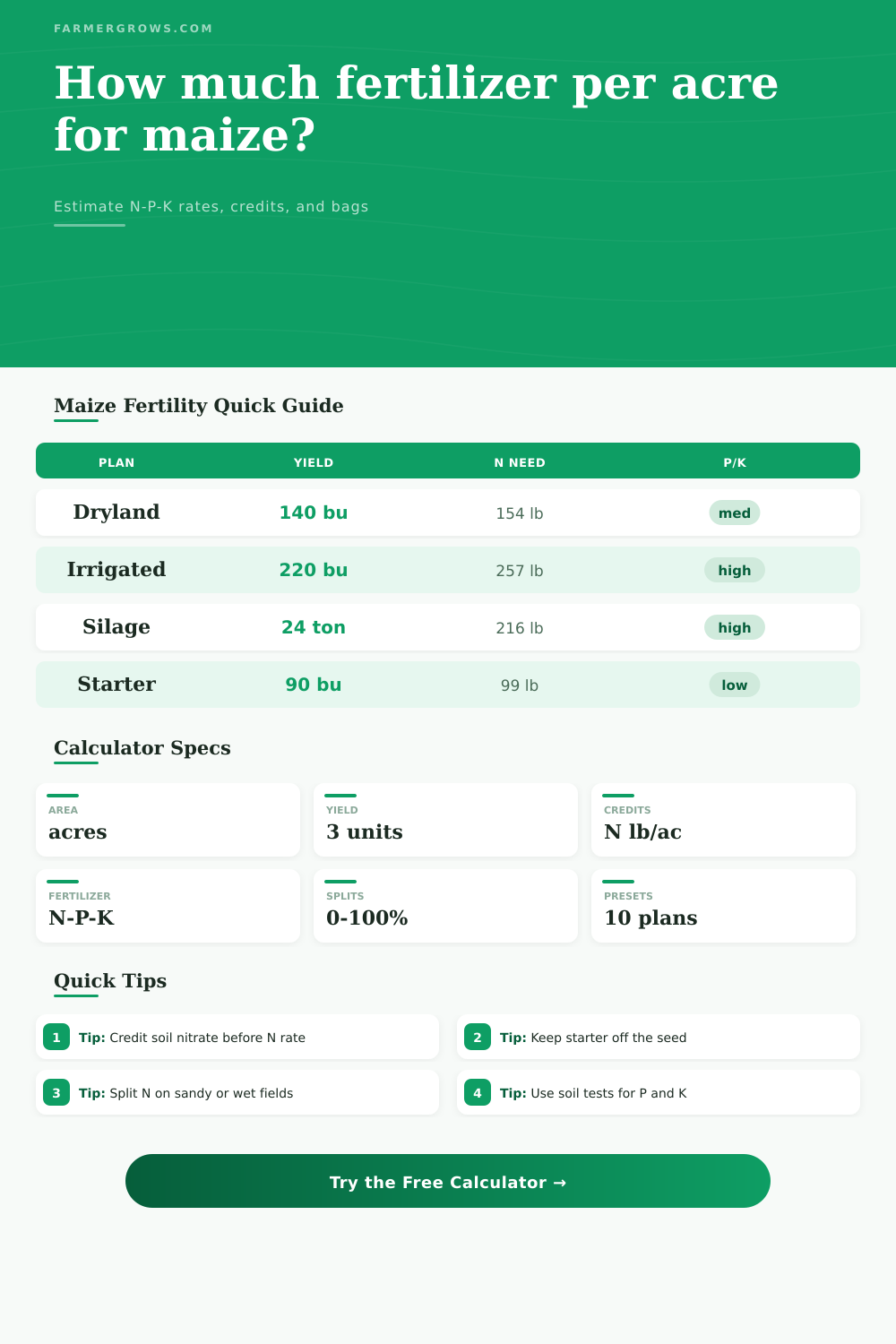
Fertilizer Per Acre for Maize Calculator
Estimate maize fertilizer product rate from acreage, yield goal, grain or silage unit, soil nitrate credit, previous crop credit, custom N-P-K analysis, P/K soil test, irrigation, split nitrogen, and plant population.
Choose a maize field plan, then edit the yield goal, credits, soil-test status, N-P-K analysis, split timing, irrigation, and plant stand.
Fertilizer N-P-K analysis (%)
Maize Fertilizer Plan
Results are planning estimates per acre and for the full field. Confirm final rates with local soil-test recommendations, nutrient regulations, and fertilizer placement limits.
Field Breakdown
About 1.1 lb N, 0.37 lb P2O5, and 0.27 lb K2O are planned per bushel before credits and soil-test adjustment.
Silage removes the stalk and leaf biomass, so potash demand is much higher than grain-only harvest.
Full irrigation adds an N support factor because long-season grain fill can carry a larger canopy and ear load.
Dense stands do not automatically require more fertilizer, but they raise the penalty for shortage during V6 to tassel.
| Expected maize yield | Converted basis | Typical N support | P2O5 removal | K2O removal |
|---|---|---|---|---|
| 120 bu/ac grain | 120 bu/ac | 132 lb N/ac before credits | 44 lb/ac | 32 lb/ac |
| 170 bu/ac grain | 170 bu/ac | 187 lb N/ac before credits | 63 lb/ac | 46 lb/ac |
| 220 bu/ac grain | 220 bu/ac | 242 lb N/ac before credits | 81 lb/ac | 59 lb/ac |
| 10 t/ha grain | 159 bu/ac | 175 lb N/ac before credits | 59 lb/ac | 43 lb/ac |
| 24 tons/ac silage | 24 tons/ac | 216 lb N/ac before credits | 86 lb/ac | 192 lb/ac |
| P/K soil test status | Phosphate adjustment | Potash adjustment | Planning meaning | Calculator action |
|---|---|---|---|---|
| Very low | Add 50 lb P2O5/ac | Add 70 lb K2O/ac | Build soil plus crop removal | Raises target sharply |
| Low | Add 30 lb P2O5/ac | Add 45 lb K2O/ac | Build toward optimum | Raises target |
| Medium | Add 12 lb P2O5/ac | Add 18 lb K2O/ac | Maintain with light build | Adds small buffer |
| Optimum | Add 0 lb P2O5/ac | Add 0 lb K2O/ac | Replace expected removal | Uses removal only |
| High | Reduce target 70% | Reduce target 60% | Avoid excess buildup | Limits fertilizer need |
| Fertilizer analysis | Best fit | 100 lb product supplies | Rate caution | Common use |
|---|---|---|---|---|
| 46-0-0 urea | N only | 46 lb N | Protect from volatilization | Sidedress or topdress |
| 32-0-0 UAN | Liquid N | 32 lb N | Injection improves retention | Preplant or sidedress |
| 10-34-0 | Starter P | 10 lb N, 34 lb P2O5 | Watch seed safety | Band near row |
| 19-19-19 | Balanced fields | 19 lb each N-P2O5-K2O | Can oversupply P or K | Small fields or blends |
| 0-0-60 potash | K only | 60 lb K2O | Do not chase N with potash | Low K or silage ground |
| Maize stage | N uptake pattern | Fertilizer timing idea | Population note | Field check |
|---|---|---|---|---|
| Planting to V4 | Low total uptake | Starter or modest preplant | Protect seed zone | Emergence and stand count |
| V5 to V8 | Demand accelerates | Begin sidedress window | Weak stands waste N | Soil moisture and color |
| V9 to tassel | Peak daily uptake | Main split should be available | High stands need even supply | Check compaction and loss risk |
| Silking to grain fill | Continued N movement | Late rescue only if justified | Stress trims yield response | Leaf firing and canopy |
Credit first: Soil nitrate, legume history, manure, and strong cover-crop credits should be entered before sizing commercial fertilizer so the plan does not over-apply nitrogen.
Split wisely: On sandy, irrigated, or high-rainfall maize ground, keep a larger share of N for sidedress or fertigation so peak uptake has available nitrogen.
With corn, it’s too late for you to know if there was a nutrient deficiency when first stalk starts to turn yellow (at which point the yield is already gone). So how can you plan for fertility without knowing what the plants need or what the soil will give them?
By entering conditions of your fields and the yield goal, this calculator allow you to include those factors in an organized manner; without converting or guessing about any of the coefficients. Tell it your field conditions and yield goal; it figure out the rest.
How to Plan Fertilizer Use
Maize, in particular, need big-time N, with an estimated need of about 1.1 pounds of nitrogen per bushel of grain (the tool’s estimate). With a reasonable goal of a 150-bushel corn crop, you’ll have a very meaningful starting point.
But what about crop rotation credits? And how much soil nitrate do you have remaining? Because the ground isn’t a vacuum. Last year’s soybean crop left nitrogen in the soil; without factoring that into the equation, you’re paying for something that’s already present. A little adjustment that make all the difference to the bottom line.
The same isn’t true of phosphorus and potassium, which affect long-term soil health different than just causing short-term spikes in the crop. If your soil tests shows high phosphorus or potassium, the calculator backs off their application; if it show lows, it adds an allowance for building those nutrients. Over applying phosphate is bad because it gets locked up in the soil and unavailable.
In the case of silage maize where we leave all the plant behind (aside from the grain), you carry away huge loads of potassium as well. The calculator accounts for this difference so that grain field aren’t overfed and silage fields aren’t underfed.
Quantity matters, but timing does too. In wet springs and on sandy soils, applying all of your nitrogen right at planting time can be risky. The calculator also allow you to model split applications. It will tell you how much to apply before planting and how much to set aside for sidedressing after. Splitting up your application ensures that you have nutrients available at the critical period from V5 through V8 when uptake realy ramps up. Nitrogen isn’t just about getting it into the soil, it’s about having it there when it’s needed by the plant.
The second level of complication is plant population. The more plants per acre, the more competition there will be for resources, particularly nutrients. If you’re trying to get higher yields by pushing for more plants per acre, make sure your nutrient supply can keeps pace. That’s where this tool helps. It compares your stand to your yield goal and flags when it looks like you might be creating a bottleneck. It is a kind of sanity check on your ambition.
So really it boils down to this: Fertilizer planning requires balance. Feed the crop, but don’t feed the weeds… Or the groundwater.
That’s where the tables in the page come into play; they present removal rates (the amount of nutrients removed at various yields), which give you a solid idea of just how much is being taken off your field. Use that information when formulating your inputs. Plug in your actual soil test numbers, factor in whether or not your fields are irrigated, and go from there. The math will help you make your shopping list.
A well-thought-out plan is always better than a guessing game. Sometimes, just one thing like rates could of mean the difference between a great year and just a good one.