Fertilizer Per Acre for Cotton Calculator
Estimate cotton fertilizer product rate, total tons, delivered N-P-K-S, row-foot band rate, and split timing from lint yield goal, soil credits, residual nitrate, product analysis, texture, irrigation, and row spacing.
Load a realistic cotton fertility plan, then edit the acreage, yield goal, soil-test credits, residual nitrate, fertilizer grade, sulfur need, row spacing, texture, irrigation, and split percentage.
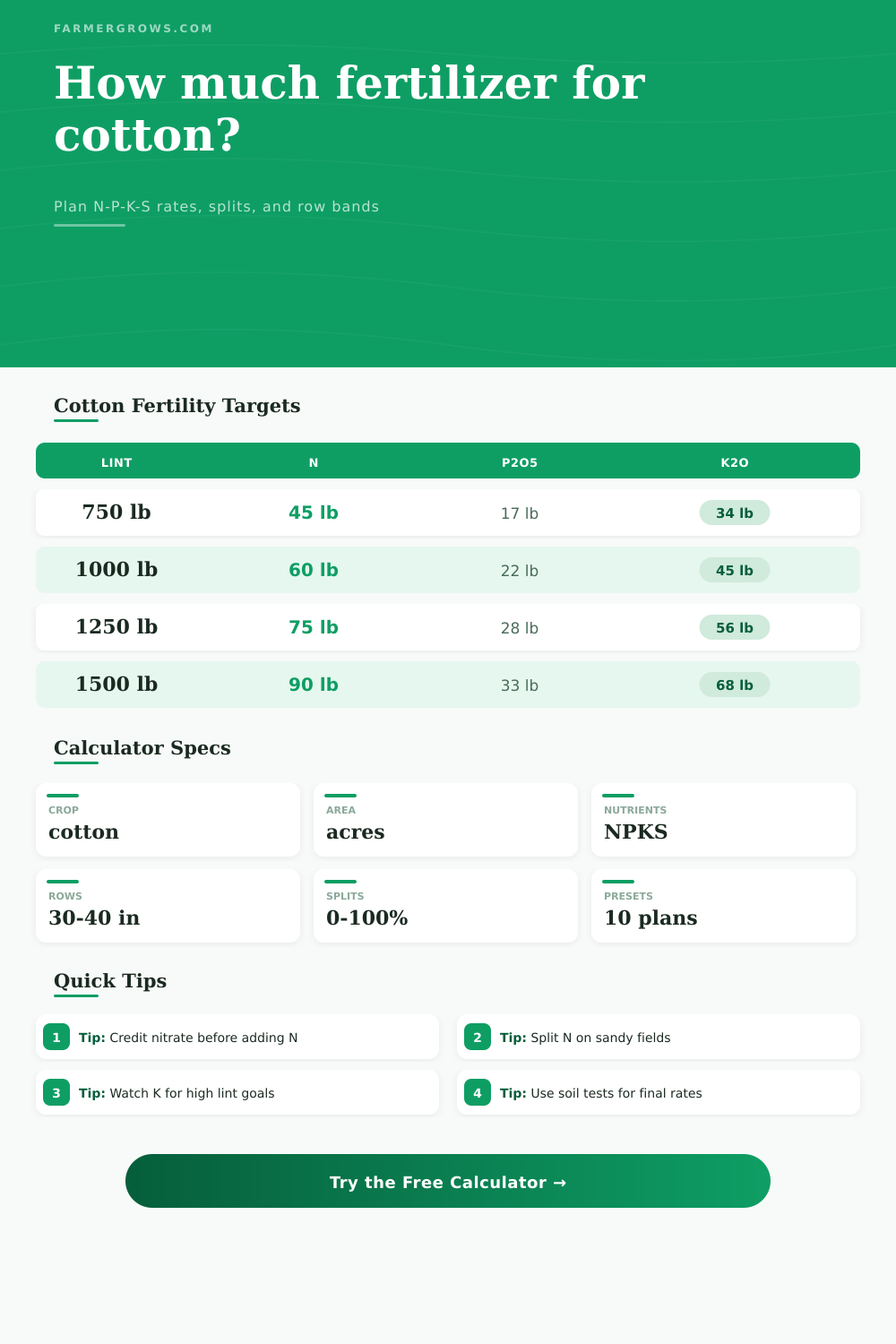
Planning targets: about 45 lb N, 17 lb P2O5, and 34 lb K2O before soil credits are counted.
Planning targets: about 60 lb N, 22 lb P2O5, and 45 lb K2O for a moderate cotton yield goal.
Planning targets: about 75 lb N, 28 lb P2O5, and 56 lb K2O where stand, moisture, and fruit retention support it.
Planning targets: about 90 lb N, 33 lb P2O5, and 68 lb K2O, with K and split N timing checked closely.
Cotton Fertilizer Results
Enter a cotton field plan and calculate fertilizer per acre.
| Lint yield goal | Planning N target | Planning P2O5 target | Planning K2O target | Best use |
|---|---|---|---|---|
| 750 lb/ac | 45 lb/ac | 17 lb/ac | 34 lb/ac | Dryland or lower yield potential fields. |
| 1,000 lb/ac | 60 lb/ac | 22 lb/ac | 45 lb/ac | Common planning target for moderate cotton. |
| 1,250 lb/ac | 75 lb/ac | 28 lb/ac | 56 lb/ac | Good stands with reliable moisture. |
| 1,500 lb/ac | 90 lb/ac | 33 lb/ac | 68 lb/ac | High yield plan with close K monitoring. |
| Texture and water setting | N/S efficiency effect | Split tendency | K watch | Calculator impact |
|---|---|---|---|---|
| Sandy dryland | Lower availability | Strong split response | Leaching and low reserve risk | Raises product needed for N or S. |
| Loam limited irrigation | Moderate availability | Balanced split timing | Use soil test and yield goal | Middle efficiency factor. |
| Irrigated loam | Higher availability | Split still useful | Removal increases with lint goal | Often lowers N product rate. |
| Clay or heavy soil | Moderate availability | Avoid wet loss windows | Fixation can hide shortage | Shows caution when K remains short. |
| Fertilizer analysis | Main nutrient fit | Example product rate | What it supplies | Likely supplement |
|---|---|---|---|---|
| 11-52-0-0 | Starter phosphate | 100 lb/ac | 11 N and 52 P2O5 raw | K and S if needed. |
| 32-0-0-0 | Sidedress N | 200 lb/ac | 64 N raw | P, K, and S if short. |
| 0-0-60-0 | Potash build | 100 lb/ac | 60 K2O raw | N, P, and S if short. |
| 21-0-0-24 | N plus sulfur | 150 lb/ac | 31.5 N and 36 S raw | P and K if soil credits are low. |
| Row spacing | Row feet per acre | 100 lb/ac product | 250 lb/ac product | 400 lb/ac product |
|---|---|---|---|---|
| 30 inches | 17,424 ft | 5.7 lb/1,000 ft | 14.3 lb/1,000 ft | 23.0 lb/1,000 ft |
| 36 inches | 14,520 ft | 6.9 lb/1,000 ft | 17.2 lb/1,000 ft | 27.5 lb/1,000 ft |
| 38 inches | 13,756 ft | 7.3 lb/1,000 ft | 18.2 lb/1,000 ft | 29.1 lb/1,000 ft |
| 40 inches | 13,068 ft | 7.7 lb/1,000 ft | 19.1 lb/1,000 ft | 30.6 lb/1,000 ft |
Use soil and nitrate credits first. Cotton can lose yield from both shortage and excess vegetative growth, so the best rate usually starts with local soil-test recommendations and realistic residual nitrate credit.
Split nitrogen where loss risk is high. Sandy soils, heavy rainfall, and long irrigation seasons usually benefit from putting less N up front and moving more product into sidedress timing.
You’re looking down on that spreadsheet, the planter’s loaded and sun’s shining high in the sky. At this point, cotton shifts from hope to math. Fertilizer application isn’t about throwing it out there and hoping for the best; it’s matching the crop’s actual demand to what’s currently held in the soil. It’s about getting your fertilizer per acre rightly. And the calculator (above) do most of the grunt work. It takes your soil test results and your yield goal and converts them into a list of products and application times. No more guesswork.
Your starting point is what’s known as a lint goal; your agreement with field. Let’s say you want a thousand pounds of lint. The crop will remove some potassium, phosphorus, and nitrogen from the earth according to expected removal rates. The tool uses standard removal rates for estimation: For instance, on average cotton removes roughly six pounds of nitrogen per 100 pounds of lint. That’s just part of doing business; you don’t have a choice in it. And the catch is knowing how much of that cost your soil has already covered.
How to Use the Fertilizer Calculator
The type of fertilizer grade don’t matter as much as the amount of phosphorus and residual nitrate already available in the soil. Many farmers are familiar with their nitrogen requirements, yet tend to forget about phosphorus in the soil test (and the potential for “soil test P”). Remember: if your soil test indicates a high level of available phosphorus, then you don’t necessarily need additional fertilizer even though bag may claim otherwise. The calculator will deduct any such credits from desired nutrient balance. It compels you to focus on what’s really lacking; instead of what would be convenient to purchase. That slight modification guards against over-applying the fertilizer, saving you money while also preventing crop from growing too much greenery.
Soil type matter… So does texture and whether it’s well-irrigated or not. Sandy soils retain water and nutrients less well; too much N applied all at once are likely to be lost before those squares emerge. The tool takes that into account by changing its efficiency factors depending on your soil type. You’ll notice on sandier soil it recommends splitting up your N application. Apply part at planting to get things going, but apply the rest later once the crop can take advantage of it. With clay, the danger is either fixation or runoff from surface, so again, proper timing and placement are essential to make sure roots have a chance to find the nutrition.
There’s no biological difference to the plant that results from the row spacing, the biology doesn’t care whether you space your rows at 30 inches apart or 40 inches. But as far as application logistics go: If you’re using 30-inch spacing instead of 40-inch, you’ll apply same total fertility across an acre of ground, but it will take twice as many row feet (hence “thousand”) to do so. For folks side-dressing or calibrating their planter, this is a significant detail. Your equipment operator doesn’t work with the per-acre rates; they works with pounds per thousand row feet. And this is where the calculator comes in, closing the gap between the agronomic plan and the mechanics of how you do it.
For high yield cotton, it’s all about potassium, but it’s often the quiet assassin. Note how quickly K demand increase as we increase our lint goals (see the tables on this page). Fifteen hundred pounds of lint translates to almost seventy pounds of potash per acre. Adding more nitrogen won’t help if your soil test is low; you still won’t prevent bad boll retention. Another frequently overlooked player, particulary on low-organic-matter soils such as sand, is sulfur. This secondary nutrient play an important role in fiber quality and protein synthesis. Don’t skip sulfur; there’s an input for it on the tool.
All that said, however, it’s just a planning tool, not a replacement for a proper soil test. It offers a starting point that makes economic sense as well as farming sense. You should of used one earlier. Feel free to change the percent splits. Take into account any existing nitrates. Round up or down the totals based on how many bags of seed you can get in your truck. The idea is to go out there with some sort of plan that fits what soil reality is, different than your yield goals. When those seeds are in the ground, the math is complete and now we’re waiting for the rains to finish the job.