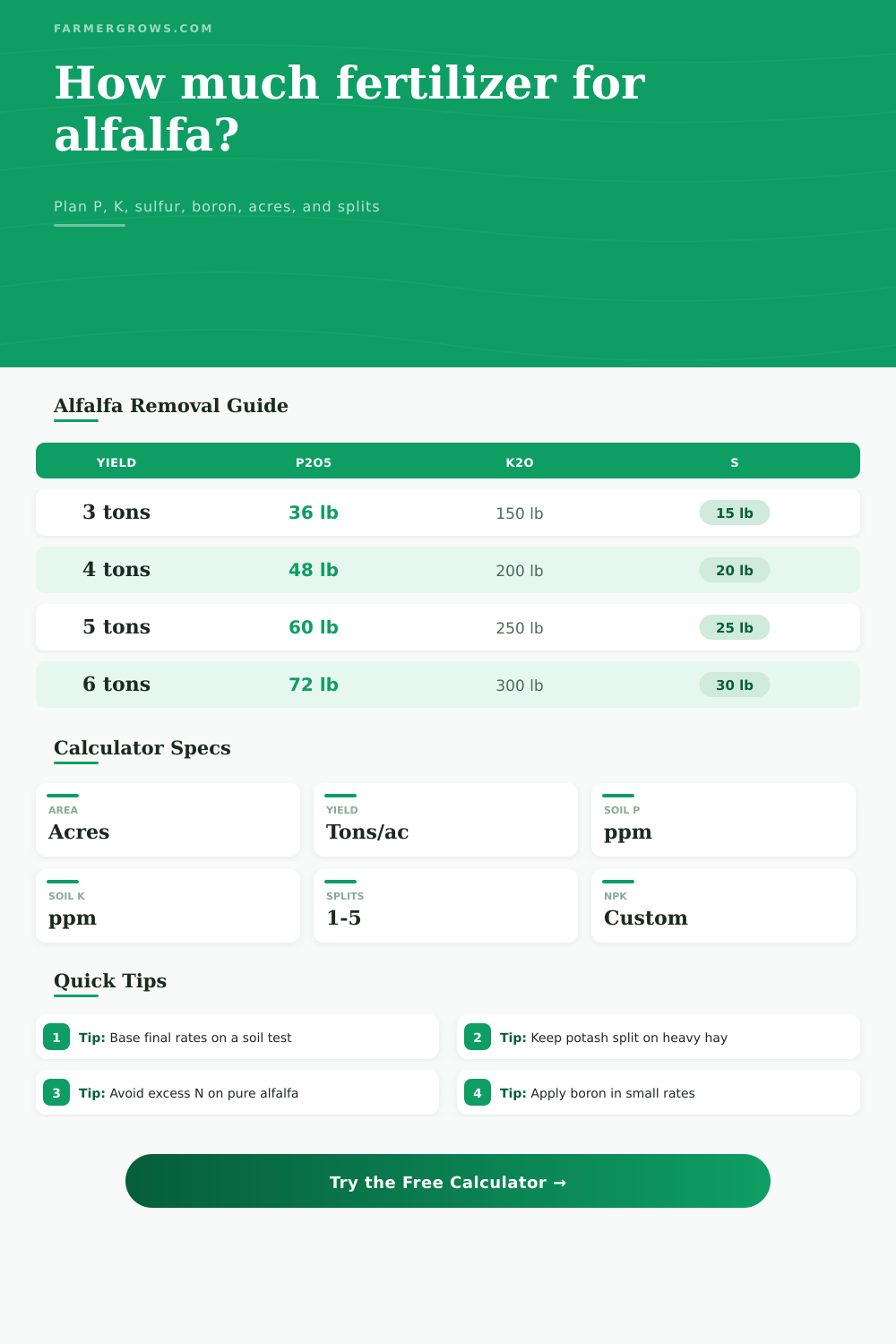
Fertilizer Per Acre for Alfalfa Calculator
Estimate alfalfa fertilizer per acre from yield goal, soil phosphorus and potassium tests, pH, stand age, custom N-P-K analysis, manure credits, sulfur, boron, cutting count, and split applications.
Choose a field situation, then adjust soil-test values, fertilizer analysis, manure credit, sulfur, boron, cutting count, and application split for your own recommendation sheet.
Alfalfa Fertilizer Plan
Rates are shown per acre and for the total field.
P below 10 ppm or K below 90 ppm adds strong buildup fertilizer above crop removal.
P near 10 to 15 ppm or K near 90 to 130 ppm adds a moderate buildup amount.
P near 16 to 25 ppm or K near 131 to 180 ppm uses removal plus a smaller cushion.
Higher tests reduce fertilizer to maintenance or drawdown rates, depending on local guidance.
| Dry hay yield | N fixed or removed | P2O5 removed | K2O removed | S removed |
|---|---|---|---|---|
| 3 tons/ac | 165 lb/ac | 36 lb/ac | 150 lb/ac | 15 lb/ac |
| 4 tons/ac | 220 lb/ac | 48 lb/ac | 200 lb/ac | 20 lb/ac |
| 5 tons/ac | 275 lb/ac | 60 lb/ac | 250 lb/ac | 25 lb/ac |
| 6 tons/ac | 330 lb/ac | 72 lb/ac | 300 lb/ac | 30 lb/ac |
| 7 tons/ac | 385 lb/ac | 84 lb/ac | 350 lb/ac | 35 lb/ac |
| Soil test class | Phosphorus P ppm | Potassium K ppm | Calculator adjustment | Field meaning |
|---|---|---|---|---|
| Very low | 0 to 9 | 0 to 89 | Removal plus strong buildup | Do not skip fertilizer on productive stands. |
| Low | 10 to 15 | 90 to 130 | Removal plus moderate buildup | Soil reserve is not keeping pace with hay removal. |
| Medium | 16 to 25 | 131 to 180 | Removal plus small cushion | Good place to maintain and watch trends. |
| Optimum | 26 to 40 | 181 to 250 | Maintenance replacement | Replace crop removal if long-term alfalfa is planned. |
| High | 41+ | 251+ | Drawdown or reduced rate | Local soil-test guidance may call for lower rates. |
| Split plan | Best fit | Typical timing | Potash handling | Watch point |
|---|---|---|---|---|
| One pass | Lower yield or stable soils | Early spring or after first cut | All product in one application | Avoid leaf burn with dusty material. |
| Two splits | Most 4-cut hay fields | Spring and midseason | Half rate each time | Useful when K2O exceeds 180 lb/ac. |
| Three splits | High yield or sandy soils | Spring, after first cut, after third cut | Smaller K doses | Match rain chances and traffic windows. |
| Four splits | Intensive 5-cut systems | After several cuttings | Lowest per-pass salt load | Keep equipment timing realistic. |
| Factor | Common range | Calculator use | When to be cautious | Management note |
|---|---|---|---|---|
| Sulfur | 10 to 30 lb S/ac | Auto follows yield removal and manure credit | High organic matter may need less | Use sulfate or planned elemental S timing. |
| Boron | 0.5 to 2 lb B/ac | Auto estimates a modest alfalfa need | Too much B can injure seedlings | Blend evenly and avoid overlap streaks. |
| pH | 6.8 to 7.2 target | Adds a warning when pH is low | Low pH hurts nodulation | Lime planning is separate from this fertilizer rate. |
| Nitrogen | Usually 0 lb N/ac | Shows N delivered by the chosen blend | High N can favor grasses and weeds | Pure alfalfa relies on biological fixation. |
Tip: When the calculator sizes product from a blended fertilizer, check the delivered P2O5 and K2O rows. A blend that fits potassium may oversupply phosphorus on high-P fields.
Tip: For heavy alfalfa hay removal, split potash after cuttings when practical. Smaller doses reduce salt load and keep potassium available during regrowth.
When alfalfa growers see their soil test report before spring, it’s often a time of quiet panic. The numbers look okay…but you know your field were under stress last year. You know potassium dissapears with every ton of hay. And you know that applying N to pure alfalfa is just throwing money down hole… And potentially damaging your stand in the process.
Enter your soil tests and yield goals and the calculator does the math for you. You don’t have to guess at conversion factors or coefficients. You don’t have to convert complex parts per million into real-world bag counts.
Why You Need an Alfalfa Fertilizer Calculator
Because alfalfa is hungry for nutrients, it makes its own nitrogen in root nodules, so you normally don’t have to top up with N-fertilizer (except maybe when the stand is young or failing). Phosphorus and potassium are more the issue. In fact, they’re the drain.
Specifically, it’s the potassium that you should of worry about. Each time you harvest five tons of dry hay off one acre, you’re taking away some 250 pounds of potash. A big chunk of nutrient capital goes off your farm. If your soil test indicate medium amounts, then you aren’t even replenishing what you’ve removed. If your soil test indicates low amount, you’re drawing down on reserves. The calculator use your individual soil test results to add a buildup amount if you are below optimum.
It’s harder to manage phosphorus, since it lingers in the soil. You’re not merely feeding this year’s crop. You’re making a deposit in an account. Future crops will use it for up to another three years’ worth of life from the stand.
New stands require a bigger initial investment to develop strong crowns and deep roots. Existing stands, particularly older ones that has thinned out in their fourth or fifth year, require maintenance to sustain the remaining crop. The tool takes stand age into account. For older fields with developed root systems, it slightly lowers the recommended amounts.
It allows you to account for manure credits, too: If you apply compost or manure, the tool recognizes the potassium and phosphorus present in these materials and gives you credit for it. Failing to do so means you’ll end up applying more then necessary. This is not good for earth or your pocketbook.
Sulfur and boron are the silent assassins. You only need a little; not having it will really tank your yield, especially on high-yielding fields or those with sandy soil. Organic matter plays a big role in making sulfur available. Low organic matter? Chances are good that some sulfur is going to be necessary. It bases its estimate on yield using the calculator, though you’ll still want to look out for yellow leaves in young growth.
Boron is even touchier. An excess of it burns off seedlings. A lack of it results in poor persistence and hollow stems. Margins for error are slim here so the tool recommends modest rates.
The calculator also makes sense for spreading out applications. It’s not smart to put down all your potash in one large springtime dose. It makes for a high-salt load that stresses soil biology. Splitting it out lets the crop tap into nutrients gradualy during the growing season. It reduces run-off and leaching from heavy rains. It is better to use four small doses rather than one large push if you’re running a five-cut hay system.
How do you want to divide? The tool takes the total product rate and divides by the number of times you’ll make passes. It gives you a reasonable per-pass rate.
The master switch is soil pH. When the pH is less than 6.8, your nitrogen-fixing nodules don’t function well. Phosphorus gets locked up in the soil. Applying any amount of fertilizer won’t help if you have a pH issue. The calculator alerts you to a low pH. It reminds you that adjusting the pH (liming) is an additional and critical step. Don’t try to fertilize your way out of poor soil chemistry.
This tool is for planning. Yes, ultimately. It removes the guesswork from making up a fertilizer blend. You know exactly how many bags of each component to reach your desired rate.
But it doesn’t tell you that there will be no rain in the coming week. It doesn’t tell you about weeds that sprout between the row. Know your base rates with this tool. Now go in the field and pay attention to what the plants say. The numbers get you there, your eyes on the ground confirm it.