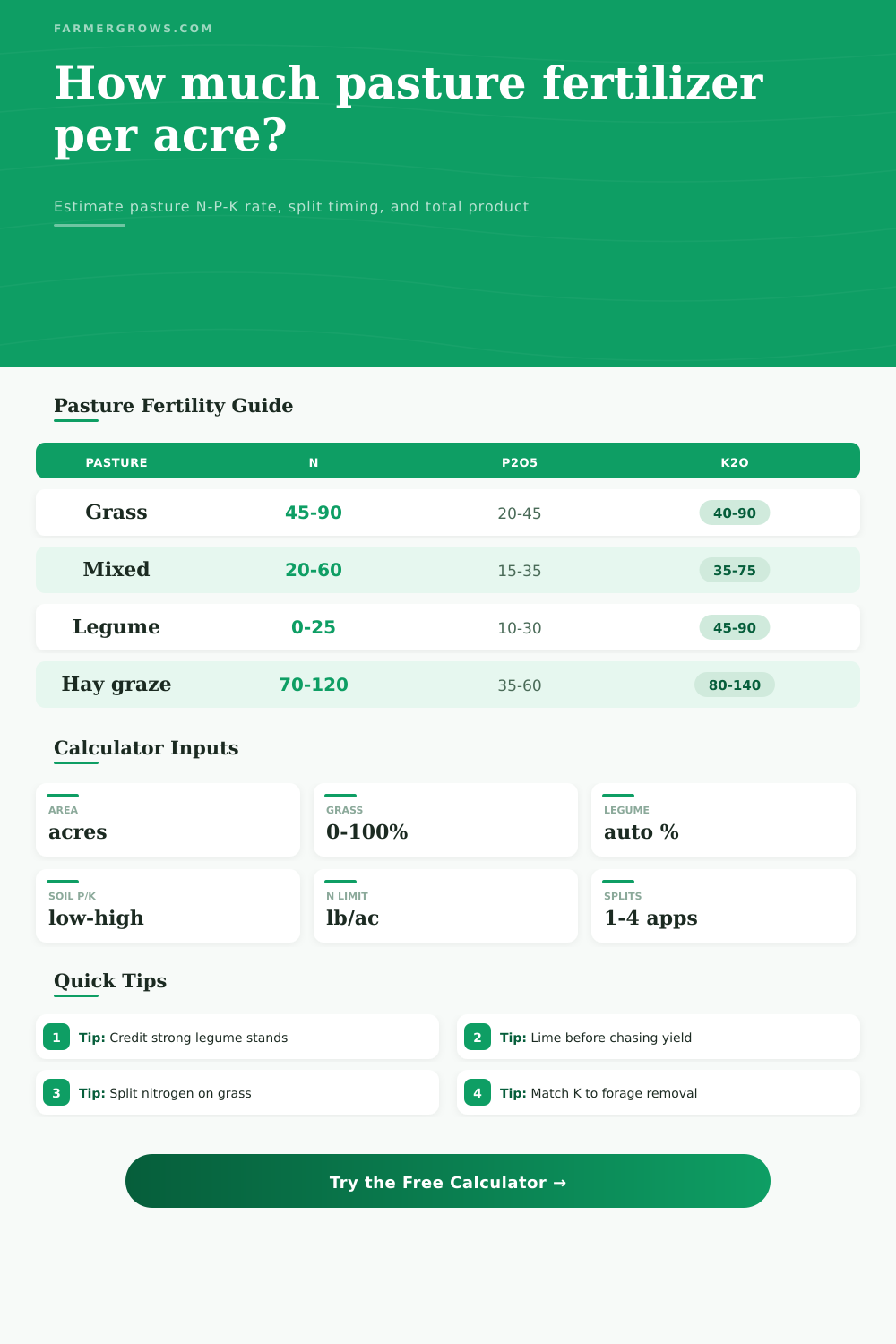
Fertilizer per Acre for Pasture Calculator
Estimate pasture fertilizer from grass and legume percentage, stocking pressure, grazing intensity, soil P and K status, lime condition, nitrogen limits, product analysis, acreage, split timing, and application efficiency.
Pick a pasture situation, then adjust the stand mix, grazing pressure, soil test status, lime status, fertilizer product, efficiency, and acreage for your field plan.
Guaranteed analysis on the fertilizer label
Pasture Fertilizer Estimate
Results update as you change the pasture inputs.
Detailed Breakdown
Uses nitrogen well when moisture is adequate, but benefits from split timing and a clear seasonal N cap.
Moderate nitrogen keeps grass productive without suppressing legumes; P and K keep nodulation and persistence strong.
Usually needs little nitrogen, but it can require steady potassium and pH correction to protect stand life.
Forage removal exports potassium, so K2O often becomes the product-sizing nutrient after soil credits.
Moderate fertility supports regrowth, but lime and reseeding choices may matter more than extra product.
Smaller applications after grazing events can support regrowth while lowering nutrient loss risk.
| Pasture situation | Typical N plan | P2O5 planning range | K2O planning range |
|---|---|---|---|
| Cool-season grass maintenance | 35 to 70 lb/ac, often split spring and fall | 15 to 35 lb/ac where soil P is not high | 35 to 75 lb/ac for grazed pasture |
| High-use stocker or dairy pasture | 60 to 120 lb/ac with multiple splits | 25 to 50 lb/ac depending on soil status | 60 to 110 lb/ac when forage removal is high |
| Mixed grass and clover | 15 to 60 lb/ac, lower when legumes are strong | 15 to 40 lb/ac to maintain stand balance | 45 to 90 lb/ac to protect legume persistence |
| Legume-dominant pasture | 0 to 25 lb/ac unless grass recovery is desired | 10 to 35 lb/ac after soil test review | 50 to 100 lb/ac when hay or silage is removed |
| Hay plus grazing field | 70 to 120 lb/ac split by cut or grazing cycle | 35 to 60 lb/ac for replacement and maintenance | 80 to 140 lb/ac because harvested forage exports K |
| Soil test category | P2O5 effect | K2O effect | Calculator behavior |
|---|---|---|---|
| Very low | Build aggressively | Build aggressively | Adds the largest P and K requirement before product sizing. |
| Low | Build plus crop need | Build plus crop need | Raises the target so fertility improves over time. |
| Medium | Maintenance rate | Maintenance rate | Uses a moderate replacement target for routine grazing. |
| Optimum | Light maintenance | Light maintenance | Uses a smaller target unless hay removal or heavy stocking is selected. |
| High | No added P by default | No added K by default | Sets that nutrient near zero unless the chosen blend delivers extra. |
| Product | Best fit | Strength per 100 lb | Pasture caution |
|---|---|---|---|
| 19-19-19 complete blend | Balanced pasture startup or renovation | 19 lb each N, P2O5, K2O | Can overapply P if the soil test is already high. |
| 10-20-20 grass pasture blend | P and K support with modest nitrogen | 10 lb N, 20 lb P2O5, 20 lb K2O | May not supply enough N for high grass demand. |
| 0-20-20 legume blend | Clover, alfalfa, or legume-forward stands | 0 lb N, 20 lb P2O5, 20 lb K2O | Good when added nitrogen would suppress legumes. |
| 46-0-0 urea | Grass nitrogen response | 46 lb N only | Needs rain, incorporation, or lower efficiency planning. |
| 0-0-60 muriate of potash | K replacement after hay or heavy removal | 60 lb K2O only | Does not supply P or N, so check the nutrient row. |
| Timing plan | Typical use | Efficiency range | Field reminder |
|---|---|---|---|
| Single spring pass | Low to moderate maintenance | 75% to 90% | Works best when rainfall can move nutrients into the root zone. |
| Spring plus late summer | Cool-season grass or mixed pasture | 80% to 90% | Supports two growth windows without putting all N on at once. |
| Spring, summer, fall | Intensive rotation or dairy grazing | 80% to 92% | Small doses match regrowth and reduce loss risk. |
| Four rotational splits | High-stock-density pasture | 82% to 94% | Use only when spreading logistics and soil moisture support response. |
Use lime status as a gatekeeper. If pH is below target, nutrient availability and legume nitrogen fixation can be limited. Correcting lime first can make the same fertilizer rate work harder.
Do not force one blend to solve every shortage. A single N-P-K product is sized by the limiting nutrient, so review the nutrient row for extra P or K before spreading across all acres.
Nitrogen becomes this magical “on/off” button for most pasture owners. You throw down one broadcast application in the spring and assume you’re covered for the rest of the grazing season, this almost never happens. Grass grows in pulses; it’s not a steady stream. Your forage stand has its own biological pulse, and you’d better have a plan that matches it. Using the wall calendar isnt cutting it.
Once you enter your stocking pressure and grass-legume mixture into the calculator above, it will do the number crunching for you. No more fiddling around with conversions and coefficients. No more converting the abstract language of soil tests into concrete amount of product. But it requires understanding what those inputs represent for your field.
How to Use the Fertilizer Calculator
Composing a proper stand is the first thing. A lot of people has an alfalfa or maybe a clover stand that’s really thick. Legumes like alfalfa and clover fixes nitrogen from the air. Putting extra nitrogen on it can be harmful to your production. It causes the grass to go real tall. The grass then shades out the legumes. Legumes are what’s actualy working for you for free. The tool lowers the amount of nitrogen needed based off the percent of legume in your stand. That’s a little tweak in the interface but it makes a huge impact on the overall health of the pasture and the bottom line.
And then there’s this: What exits the field? Most nutrients are returned through manure from the grazing cattle. If you remove the hay, however, that’s a one-way ticket. Phosphorus and potassium get exported when you bale forage and send it off to market. Those nutrients will never return to that acre. This is why hay-grazed pastures requires so much more potassium. The calculator accounts for this by adjusting your potassium target to match whether you’re harvesting forage or grazing in place. It’s a subtle but significant difference. Get it wrong and you’ll deplete the soil, undoing that will take you years, and thousands of dollars.
If you believe that you’re feeding the grass, you’re wrong. Unless you replace what’s gone out with the bales, you’re mining the soil. Everything starts from the ground up, that is, soil status. Putting down fertilizer on bad soil is like putting water in a bucket with a hole in the bottom. The root system has no access to the fertility of the soil. Correct the soil with lime. The tool uses lime status as a key input. It will determine how well each of the other nutrient performs. No matter how much nitrogen and potash you put down, none of it will work if your pH is wrong. Fix the chemistry first. It takes time but it’s the only thing that makes those fertilizer dollars you invest actualy work.
Rates are important, but so is timing. Making multiple passes isnt a premium practice. It’s necessary when trying to match nitrogen release rates to plant demand while minimizing losses. Early-spring applications of a lot of N in one go will tend to get lost via volatilization. Or it can leach out before the lawn has had time to consume it. Making smaller application over two or more passes aligns supply with demand, keeping the plants fed without excess fertilizier being wasted. You’ll see that on the calculator, which breaks the full weight of the product into workable split amounts. It then shows you what to apply each time. This means better spreader calibration and better logistics too. It’s all laid out in the reference table on the page.
And I think what this does is teach us that it’s all about balance. This isn’t a bag-of-fertilizer purchase, it’s an exercise in managing a living system. If you have a rotational dairy pasture or a cow-calf operation, the thing to remember is: The objective is to grow and sustain the stand. Don’t overwhelm it. Too much fertilization and your forage might be lush but also weak and full of disease and poor nutrient density. Not enough and you leave yield on the table. You invite weeds to take over the place. The challenge is to find that narrow band of adequacy.
Your starting point is your soil test. Honor the amount of legumes you’ve got growing there. Apply half at a time. You should of let the tool do the math on the heavy-lifting part.