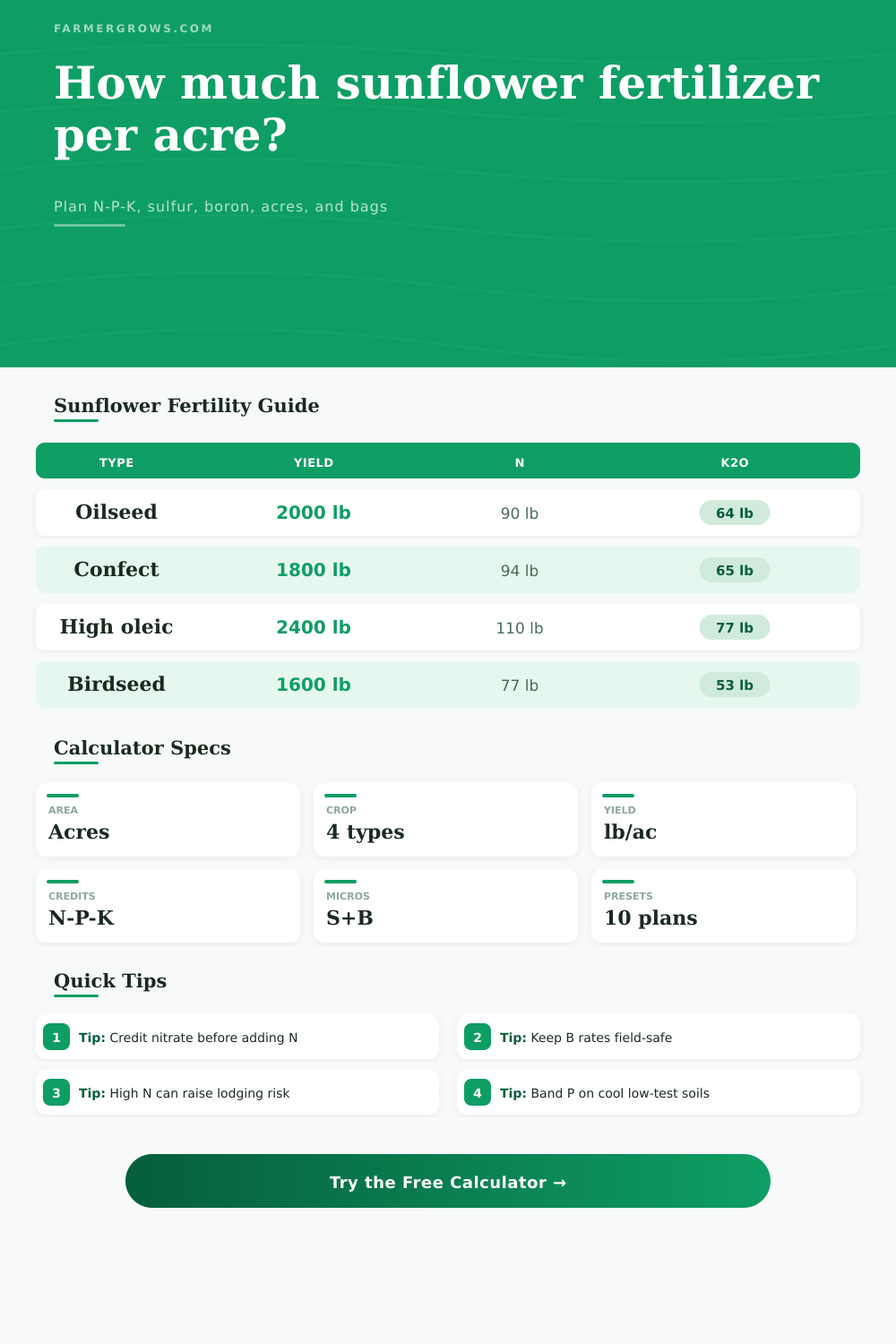
Fertilizer Per Acre for Sunflowers Calculator
Estimate sunflower fertilizer per acre from crop type, yield goal, soil N-P-K credits, custom fertilizer analysis, previous crop, sulfur, boron, row spacing, moisture regime, and lodging risk.
Choose a starting plan, then fine tune acreage, sunflower market type, soil-test credits, fertilizer grade, previous crop, moisture, row spacing, and lodging risk.
Sunflower Fertilizer Plan
Rates are shown per acre and for the full field, with soil credits and previous crop credit deducted before sizing the selected fertilizer grade.
Good default for black oilseed fields. Use moderate N and keep P and K aligned with soil test levels.
Similar to oilseed, but higher yield goals often justify slightly higher N-P-K demand.
Plans tend to support larger seed and strong grain fill, while avoiding excess N that delays maturity.
Often planned like oilseed, with rates adjusted to contract yield and available soil nutrients.
| Sunflower type | Example yield goal | N target | P2O5 target | K2O target |
|---|---|---|---|---|
| Oilseed | 1,500 lb/ac | 68 lb/ac | 27 lb/ac | 48 lb/ac |
| Oilseed | 2,000 lb/ac | 90 lb/ac | 36 lb/ac | 64 lb/ac |
| High oleic | 2,400 lb/ac | 110 lb/ac | 43 lb/ac | 77 lb/ac |
| Confection | 1,800 lb/ac | 94 lb/ac | 38 lb/ac | 65 lb/ac |
| Birdseed market | 1,600 lb/ac | 77 lb/ac | 30 lb/ac | 53 lb/ac |
| Product or blend | Analysis | Best fit | Watch point |
|---|---|---|---|
| MAP | 11-52-0 | Low P fields with some starter N | Will not supply K2O |
| DAP | 18-46-0 | Phosphate plus more N credit | Use care near seed |
| Urea | 46-0-0 | N-only adjustment after soil credits | Protect from volatilization |
| Potash | 0-0-60 | Correcting K2O need | Often separate from N source |
| Balanced blend | 10-20-20 | Maintenance blend on low P and K | May oversupply one nutrient |
| Previous crop | N credit used | Planning note | Best adjustment |
|---|---|---|---|
| Small grain stubble | 10 lb/ac | Common sunflower rotation | Check residue tie-up |
| Corn or sorghum | 0 lb/ac | High residue can immobilize N | Use soil nitrate test |
| Soybeans or peas | 20 lb/ac | Legume residue can reduce N need | Confirm with yield history |
| Clean fallow | 25 lb/ac | Often has stored nitrate and water | Avoid overdoing N |
| Alfalfa or clover | 40 lb/ac | Strong legume credit possible | Adjust for stand age |
| Manured field | 30 lb/ac | Credit depends on analysis and timing | Use manure test when available |
| Factor | Calculator effect | Field meaning | Management note |
|---|---|---|---|
| Dryland moisture | 0.92 demand factor | Yield may be water limited | Keep N tied to realistic yield |
| Irrigated moisture | 1.08 demand factor | Higher yield potential | Split N where practical |
| 15 to 20 inch rows | Lower row stress note | Faster canopy closure | Useful where lodging is watched |
| 36 inch rows | Wide-row note | More bare soil between rows | Protect moisture and placement |
| Sulfur need | Adds actual S lb/ac | Separate source usually needed | Common on sandy low OM soil |
| Boron need | Adds actual B lb/ac | Small but important rate | Do not exceed label limits |
Use the soil test first: Sunflowers can root deeply, so nitrate-N and subsoil moisture should guide the yield goal before extra nitrogen is added.
Mind seed safety: Keep fertilizer placement, boron rate, and starter salt load within local extension and product label limits, especially in dry soils.
At first glance, sunflowers seem easy: just stand up straight and flower. But getting there takes some complex nutrition. From emergence until harvest, it’s like having a nutrient vacuum in your field.
Nitrogen is critical, but so are phosphorous and potassium. What’s in your soil matters too. Feed the crop right. Otherwise, it will never fill out, blow over in the wind, or even shatter its seeds. Match nutrients to soil reserves and you’re on track.
How to Plan Sunflower Fertilizer Use
From there, most growers begin by plugging their yield goal into the equation. Your yield goal is a bet based off your soil quality, hybrid, and weather. That’s what guides everything else. For instance, a two-thousand-pound oilseed goal requires a different nutritional contract than an eighteen-hundred-pound confection seed field. Confection seeds is bigger and need more bulk nutrients to fill them out.
Once you plug-in your yield expectation and crop type, the calculator does the rest of math, sparing you from flipping through extension manuals to calculate conversion factors. It takes that desired yield and converts it into precise pounds of nitrogen, phosphorus, and potassium that the crop will remove from your field.
Nitrogen is the one that trips me up the most. It’s mobile; prone to loss through leaching and evaporation. So not something you can just slap on at the same rate each year. Most folks leave a piece out of this process. The tool take into account both previous crop credits and soil nitrate credits.
You get a credit from previous crops. Legumes fix nitrogen, so if you’re planting sunflowers after soybeans, there’s free nitrogen in the ground already. Coming off wheat stubble? It’ll be less of a credit as residue ties up some of the nutrients temporarally.
Not accounting for credits results in over-applying, wasting your money, and risking lodging. Lodging happens when the plant grows too fast and becomes leggy, leaving it with a weak stalk that cannot hold up the head. Being conservative with your nitrogen is a soil health decision, but also keeps the harvest crew safe.
Now there’s something different with phosphorus and potassium, which are both fixed into the soil structure. They don’t migrate about. Where you put them makes a difference. If they’re band-placed near seed row, the young roots can tap into those right away.
When you plug your soil test credits (for K2O and P2O5) into the calculator it deducts what you have already. This prevents you from buying more than you realy need. You can also indicate your own fertilizer grade. Maybe you use DAP, or maybe MAP, or even some custom blend? This is important because a 20 percent phosphorus product contains twice as much nutrient per ton as a 50 percent one, and so on.
Micronutrients like boron and sulfur may be used in only small amounts, but they have a huge impact. Oil synthesis is dependent than sulfur, so sunflowers has a high need. This element tends to be lost in sandy soils or where there’s little organic matter in the field. Another key one for seed set, boron has a very narrow window, too much of it can cause trouble. With the tool, you’re able to add in small amounts without accidently overshooting.
It considers row spacing and moisture levels. For example, narrow rows will close the canopy quicker than wide rows, helping retain moisture and aiding weed control. That affects how nutrients is taken up. Wide rows mean more soil surface exposed, changing the microclimate around the plant.
You’ll get a total across your field (rounded up to the next bag size) and then a product rate-per-acre. If there’s a gap here, the tool will show it to you exactly. So maybe it tells you: “Your nitrogen looks good; your potassium isn’t.” That would mean you’d like a different mix of products, or perhaps want to do a side-dress. It can make for a transparent process, no more guessing.
In many areas, fertilizer is the most expensive input after seed and land rent on your farm. Protecting your margin means getting the rate right, making sure each dollar spent is working toward a bushel, not feeding the atmosphere or the weeds. That’s the key to fertility planning: alignment.
Nutrient demand must match nutrient supply at the right moment. The calculator gives you the starting point; what you see on the ground validates the plan. Feel how the soil feels; check its moisture level; examine last year’s residue. Your yield goal may need adjusting if the ground is dry. This means your fertilizer need will be reduced. Use the data as a beginning, but allow field to complete the story.
A tall, full and clean-harvested sunflower is a sign of a plant that was well fed. That’s what we’re shooting for; so why wouldn’t we should of done everything possible to make sure it happens?