Fertilizer Per Acre for Potatoes Calculator
Estimate potato fertilizer per acre from acres, yield goal in cwt per acre, potato type, soil N-P-K credits, fertilizer analysis, band or broadcast efficiency, split nitrogen timing, organic matter, irrigation, pH, and scab risk.
Pick a real potato fertility starting point, then edit field acres, cwt yield goal, soil credits, fertilizer grade, placement efficiency, split N, organic matter, irrigation, pH, and scab pressure.
Long-season russets usually need strong potassium support for bulking, solids, and storage quality.
Fresh-market red potatoes often use a lower N target to protect skin set and tuber finish.
Chipping crops balance N and K carefully because maturity, dry matter, and sugar levels matter.
Seed fields usually run more conservative N rates to manage vine growth and tuber size profile.
Potato Fertilizer Plan
Results show product rate, whole-field product, plant-available N-P-K after soil credits, and split nitrogen timing.
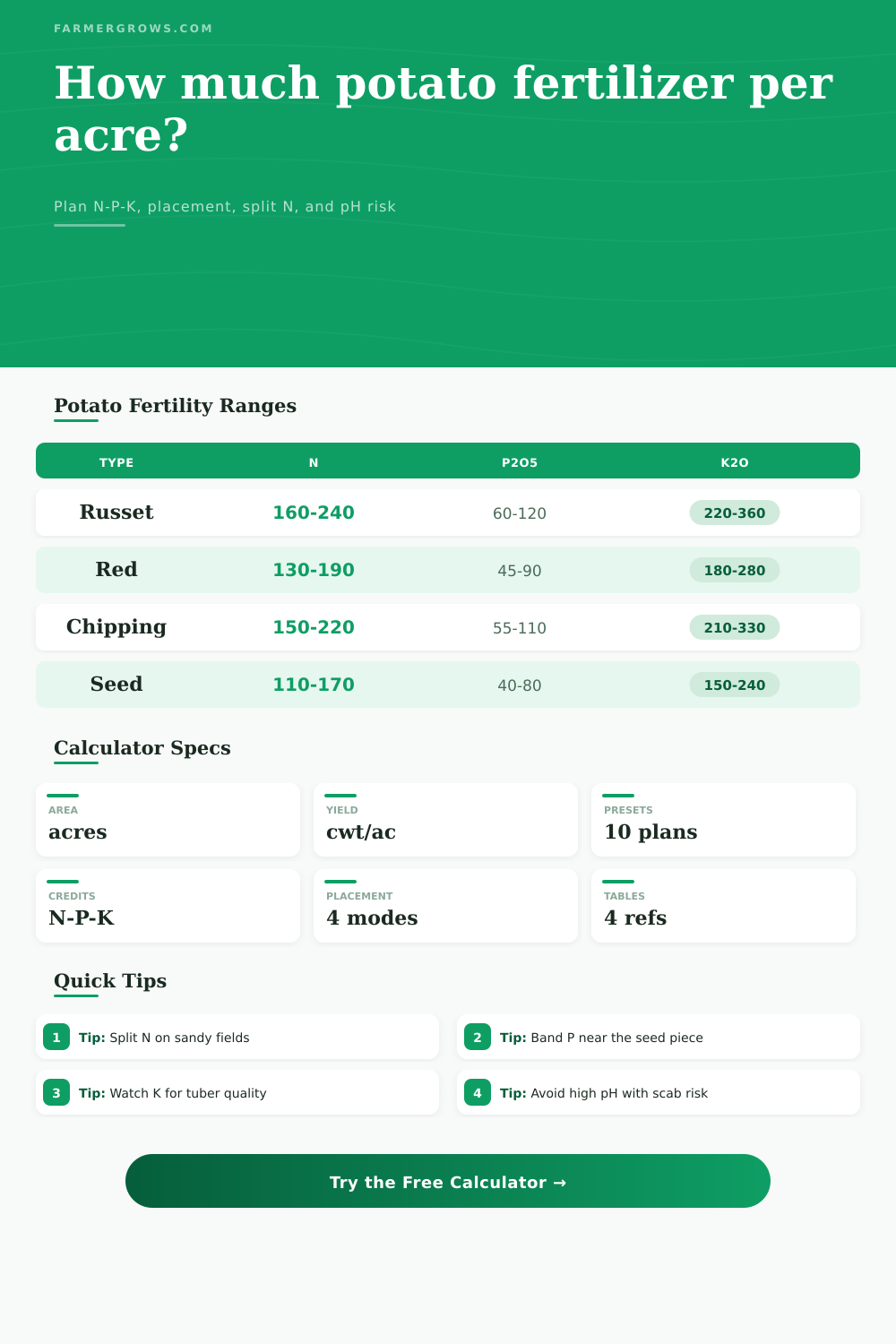
| Potato type | Typical yield goal | N planning range | P2O5 planning range | K2O planning range |
|---|---|---|---|---|
| Russet processing or baking | 400 to 650 cwt/ac | 160 to 240 lb/ac | 60 to 120 lb/ac | 220 to 360 lb/ac |
| Red or yellow fresh market | 250 to 450 cwt/ac | 130 to 190 lb/ac | 45 to 90 lb/ac | 180 to 280 lb/ac |
| Chipping potatoes | 350 to 550 cwt/ac | 150 to 220 lb/ac | 55 to 110 lb/ac | 210 to 330 lb/ac |
| Seed potatoes | 200 to 400 cwt/ac | 110 to 170 lb/ac | 40 to 80 lb/ac | 150 to 240 lb/ac |
| Placement | N efficiency | P efficiency | K efficiency | Best fit |
|---|---|---|---|---|
| Banded near row | 90% | 95% | 90% | Starter P, early root access, low-testing fields |
| Broadcast incorporated | 82% | 78% | 82% | Whole-field blends worked into the hill zone |
| Broadcast surface risk | 70% | 68% | 76% | Programs exposed to runoff, volatilization, or delayed incorporation |
| Fertigation or spoon-fed N | 94% | 80% | 88% | Split N through drip or pivot with careful scheduling |
| Split after emergence | Preplant share | In-season share | Where it helps |
|---|---|---|---|
| 25% | 75% | 25% | Loam soils, moderate rainfall, lower leaching risk |
| 45% | 55% | 45% | Balanced plan for sprinkler irrigated table stock |
| 60% | 40% | 60% | Sandy soils, long season russets, steady irrigation |
| 75% | 25% | 75% | Fertigation programs with frequent tissue or petiole checks |
| Soil pH | Scab history | Calculator flag | Planning note |
|---|---|---|---|
| 5.0 to 5.5 | Any history | Low pH risk | Often favorable for scab suppression, but still check crop and soil tolerance. |
| 5.6 to 5.8 | Medium or high | Watch zone | Avoid casual lime applications without a current soil test and local recommendation. |
| 5.9 to 6.5 | Medium or high | Scab caution | Use resistant varieties, clean seed, water management, and careful amendment choices. |
| Above 6.5 | High | High caution | Confirm plan with local potato fertility guidance before raising pH further. |
Tip: Use this calculator as a planning bridge between your soil-test recommendation and the fertilizer analysis on the product you actually intend to spread or fertigate.
Tip: Potatoes respond to placement and timing, so review banded starter limits, chloride sensitivity, petiole tests, and irrigation scheduling with local extension guidance.
Even if you purchase premium seed potatoes, neglecting the fertility plan based off what’s in the soil will result in subpar crops. Most growers starts with bag of generic blend and hope for the best. For lawns, that strategy is fine, but it won’t work for tuber crops that must recieve exact nutritional support as they bulk up.
Enter your soil credits and yield goal into the calculator, and let it do the math. You don’t have to guess what coefficients to use, and the tool makes you confront true limitations of your ground before you spend your money.
How to Feed Potatoes the Right Way
Potatoes is hungry critters, particularly in the area of potassium. They’re hungry critters, particularly in the area of potassium. Each year a good crop of Russets will take several hundred pounds of potash from the soil. That tab gets paid back by the land; and then some, out of next year’s yield if you don’t top up the balance.
Nitrogen can be more of an unpredictable issue. Not enough nitrogen, and you get small tubers as the vines stall out. Too much nitrogen, and what you have is too much leaf growth (at the expense of tuber formation). This result in delayed maturity and green skins.
Why ask about type of potato? Seed-potato fields requires conservative rates of nitrogen, which keeps vine vigor in check. Processing russets call for heavier support (storage quality, solids) and calculator factors that into its nutrient curve. No one-size-fits-all here; it tweaks the nutrients to match crop physiology.
Beyond what you apply, where you place it also counts. To start: Early-season root growth depends on getting phosphorus early, so banded application, right next to seed piece is best. Nutrients applied broadcast may be stranded outside of the root zone. That’s naturaly an issue on sandy soil where any nutrients applied are always at risk of being leached out. The chart on the page illustrates the efficiency difference this makes. With phosphorous, applying it in rows boosts efficiency up to ninety-five percent, rather than potentially wasting thirty percent of your investment if spread across whole field.
If you irrigate via drip, consider adding fertilizer instead (that is, applying a bit of nitrogen when the crop is bulking). That way you matches nutrient delivery to when the crops need it most. It is a little detail, but it is important.
There’s one more factor: soil chemistry. Alkaline soils are favored by common scab. Beware high-pH amendments like lime if your pH is greater than six. When you plug those numbers into the calculator, it flag scab risk as well. Again, no solution here for the disease itself… But at least a warning before you make it worse.
There is also a consideration regarding organic matter. High levels in fields will slowly release nitrogen throughout the season. You’ll over-apply fertilizers without taking that credit into account; harming the environment and wasting money in the process. For every point of organic matter more than two percent, the tool give a little extra nitrogen credit. Not a massive change, but eighty acre adds up.
Why do we always split our nitrogen application? Applying it all at once at planting time increases the risk of loss from leaching or turning into gas, especially in wet springs. Apply half after emergence (or during initial bulking), when the crop is most actively growing and can use the nutrient. The breakdown of the pre-plant vs. In-season needs is in the results… Split plan will show up there. This allows you to plan around crop stage and potential weather windows.
Soil tests and residual nutrients are subtracted from the output giving you net crop need. Then it converts the need into an exact amount of product (based on the grade you enter) in terms of bag counts. You should of used better data first. The math will translate pounds of nutrients required into how many bags of a certain product. So whether you buy MAP or Urea or some custom blend, this bridges the gap between the agronomic theory and the delivery ticket. Now you aren’t just guessing at tonnage. You are buying exactly what the crop need.
It’s not about spreading, it’s about when to feed the plant what it needs, when it wants to eat. Mismatch potatoes, and they won’t forgive you for it. Never give them too little Nitrogen or there will be no canopy (they will go hungry). No can do with potassium either. That must be available to build tubers. Too much of any one thing, and the potato will forget to make fruit.
You can eliminate guessing by basing your fertility plan on how the product is applied and using real data from the soil. The conversions get stripped away by the calculator. All that remains is knowing how to feed the root zone when it matters most.
Start with good seed. End up with a fertilizer plan that respects the soil. Finish with tubers that meet the grade.