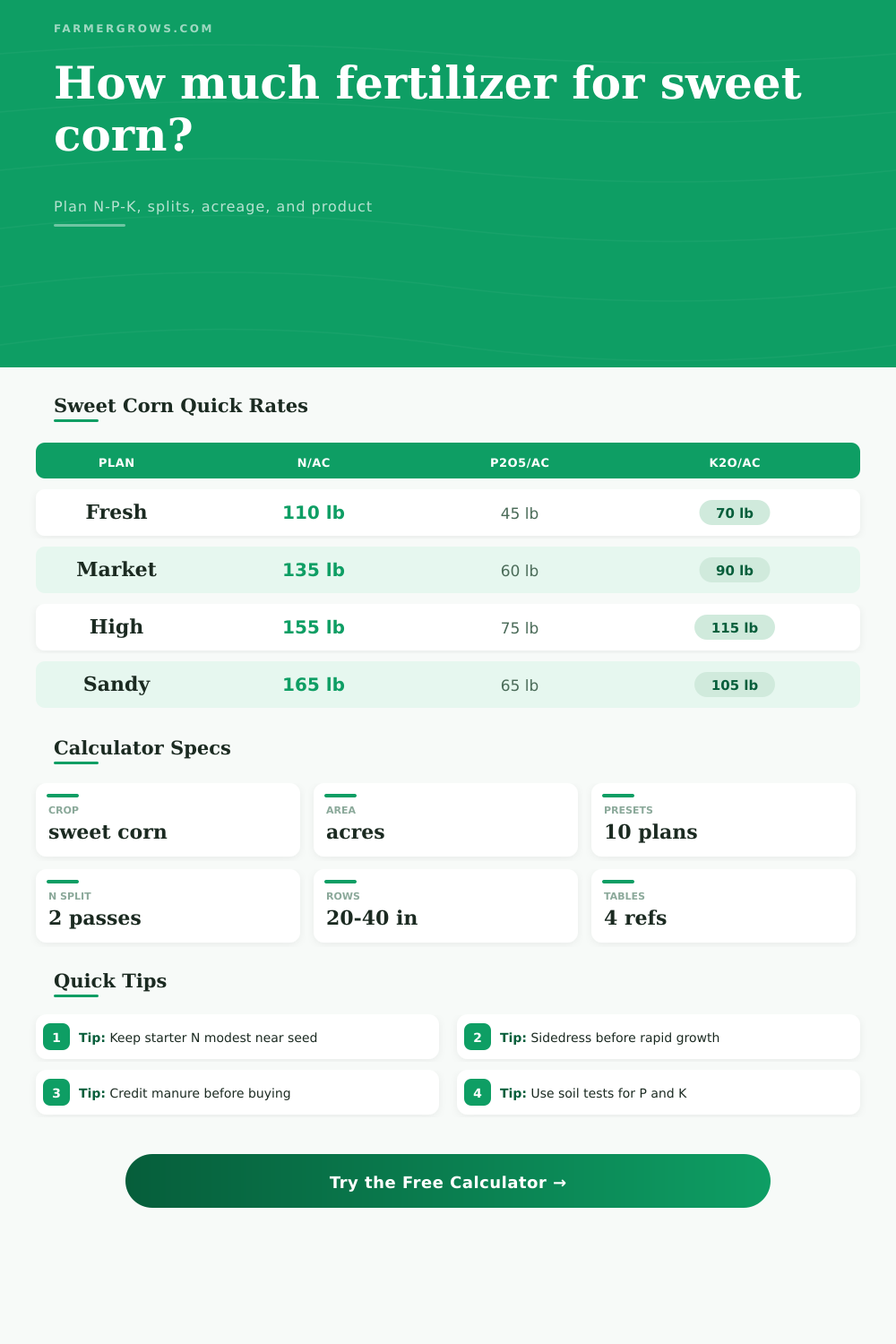
Fertilizer Per Acre for Sweet Corn Calculator
Plan sweet corn fertilizer by acres, expected ears per acre, stand density, row spacing, soil N-P-K credits, manure credit, organic matter, irrigation, fertilizer analysis, and preplant-to-sidedress split.
Choose a field situation, then edit the acres, expected ear count, soil credits, fertilizer grade, population, irrigation, and split timing for your local recommendation.
Place P and K from the soil-test plan and a modest share of N where roots can reach it early.
Seedlings need available P and a small N supply, but excess salt near seed can reduce stand.
Most rapid N uptake is ahead. This is the main sidedress window for many sweet corn fields.
Keep moisture steady and avoid late nutrient stress; large rescue N rates are less efficient now.
Soil-test and manure credits, lb/ac
Fertilizer analysis, percent by weight
Sweet Corn Fertilizer Plan
These results estimate fertilizer product and nutrient delivery per acre after soil, manure, and organic matter credits.
Nutrient and field breakdown
| Sweet corn plan | Expected ears/ac | Seasonal N | P2O5 | K2O |
|---|---|---|---|---|
| Home or direct-market patch | 14,000-17,000 | 95-120 lb/ac | 35-50 lb/ac | 55-75 lb/ac |
| Fresh-market standard | 17,000-20,000 | 120-140 lb/ac | 45-65 lb/ac | 70-95 lb/ac |
| High population irrigated | 20,000-24,000 | 140-165 lb/ac | 60-80 lb/ac | 90-120 lb/ac |
| Sandy or leaching-prone soil | 18,000-23,000 | 145-175 lb/ac | 55-75 lb/ac | 85-115 lb/ac |
| Row spacing | Plants/ac at 8 in | Plants/ac at 10 in | Plants/ac at 12 in | Use note |
|---|---|---|---|---|
| 24 inch rows | 32,670 | 26,136 | 21,780 | Narrow rows, high canopy |
| 30 inch rows | 26,136 | 20,909 | 17,424 | Common fresh market |
| 36 inch rows | 21,780 | 17,424 | 14,520 | Good equipment clearance |
| 40 inch rows | 19,602 | 15,682 | 13,068 | Lower stand density |
| Fertilizer grade | Best use in sweet corn | Product for 100 lb N | P2O5 supplied | K2O supplied |
|---|---|---|---|---|
| 10-10-10 | Balanced garden blend | 1,000 lb | 100 lb | 100 lb |
| 19-19-19 | High-analysis balanced blend | 526 lb | 100 lb | 100 lb |
| 34-0-0 | N sidedress source | 294 lb | 0 lb | 0 lb |
| 46-0-0 | Concentrated N source | 217 lb | 0 lb | 0 lb |
| Timing pattern | Preplant share | Sidedress share | Field fit | Caution |
|---|---|---|---|---|
| Conservative split | 25% | 75% | Sandy or wet springs | Do not miss sidedress window |
| Standard split | 35% | 65% | Most loam fields | Watch starter salt near seed |
| Heavy preplant | 50% | 50% | Fine-textured soils | Higher early loss risk |
| Drip fertigation | 15% | 85% | Drip irrigated blocks | Requires reliable injection plan |
Credit before calculating: Soil nitrate, manure, compost, and organic matter can materially reduce the purchased N rate. For P and K, use soil-test recommendations first because repeated balanced fertilizer can build excess levels.
Split nitrogen with crop demand: Sweet corn takes up much of its N after early vegetative growth begins. A preplant plus sidedress plan usually fits the crop better than one heavy early pass.
Sweet corn is picky about its nutrition. Timing matters for when to apply it too. “Just topdress with a general fertilizer mix” you may think, as if that’s all there is to it, but not knowing soil chemistry won’t help.
Enter your expected number of ears and your soil credits into the calculator above. And out comes math (no more guesswork about nutrient coefficients).
How to Use the Sweet Corn Calculator
How is that nitrogen moving? Soil can also has it turn into gas and leach away. What happens to nutrients depends on soil organic matter and irrigation conditions.
A nitrogen credit for organic matter (generally between eight pounds per acre per percent of soil organic matter) are included in the estimate. That’s a credit for nitrogen already stored in your soil biology. You don’t want to pay to replace what you already own; if you ignore this credit, you will. It’s a little bit of an input adjustment but it could of saved you big bucks on a large acreage.
Nitrogen isn’t the only nutrient: Phosphorus and potassium doesn’t work like nitrogen. They’re less mobile; their levels can be built up gradualy. Standard rates (the ones shown in table of references) are target rates, not commandments. When soil tests indicate that phosphorus is abundant, for example, use the calculators function to input the soil credit so it will calculates lower amounts to purchase. That saves money, and keeps those nutrients from running off into waterways where they pollutes. No need to add what’s already there in abundance.
The calculator adjusts figure for total demand by accounting for credits to show result.
Timing is a key variable in sweet corn production. If you apply all of your nitrogen at planting time (as is common) you risk losing some of that N to leaching in a wet spring. A better strategy: Use a split application, dividing the product between a preplant pass and a sidedress application later in the season. Maximum take-up occur around five to eight leaves; this also coincides with most active growth phase for crops. Feed the plant when it want to eat.
The connection is based off plant population density. A field planted at 22,000 plants per acre require sufficient nutrients to get that many ears. So it will check your expected number of ears compared to how dense your stand is. That assures your fertilizer plan meet your expectations. It is easy to under-fertilize a high-density field or over-fertilize a sparse one.
The result breaks down what each nutrient equal and what the total product weighs so you know if you’re ordering the right amount of material.
Not all corn is green; it’s also profitable. To get full ears, we want lots of nitrogen. Strong stalks requires potassium. Healthy roots come from phosphorous.
By adjusting the input, the calculator shows you what your corn require in each area and makes the difficult decision-making process easy by balancing simple choices. It becomes a doable plan. There are still factors like checking the field and watching the weather, but this sets the baseline.
Sidedressing at the right time? Know exactly when and how much to put down. No more guessing during the season.