Fence Picket Calculator
Estimate pickets, posts, rails, gate deductions, fasteners, and coating coverage for privacy, garden, livestock yard, and decorative picket fence runs.
Use the run length along the fence line, then enter gate openings separately so the calculator counts pickets only where boards are installed. Final spacing should still be checked against local code, terrain, and the exact lumber on hand.
Fence Material Estimate
Your picket, post, rail, gate, fastener, and coating plan will appear here.
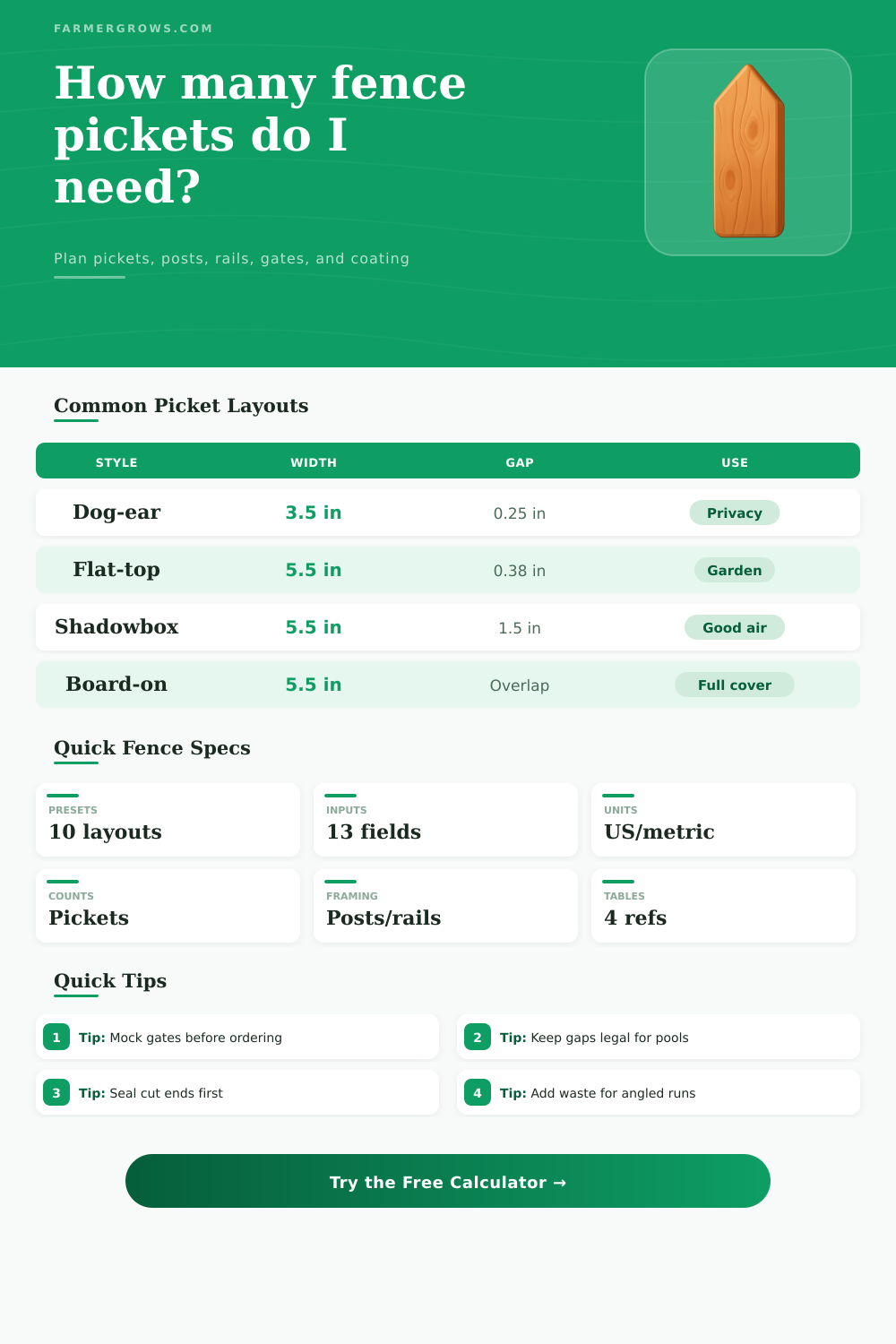
| Actual picket width | Example board name | Typical visible gap | Approx pieces per 100 ft |
|---|---|---|---|
| 3.5 in | 1x4 nominal picket | 0.25 in for tight privacy | 320 boards before waste |
| 5.5 in | 1x6 nominal picket | 0.25 to 0.5 in privacy gap | 209 to 220 boards before waste |
| 5.5 in shadowbox | Alternating 1x6 boards | 1.25 to 1.75 in offset gap | 310 to 360 boards before waste |
| 5.5 in board-on-board | Base pickets plus cover boards | 1.25 to 2 in covered gap | 290 to 340 boards before waste |
| 2.5 in | Narrow decorative picket | 1.5 to 2.5 in open spacing | 240 to 300 boards before waste |
| Fence height | Common rail count | Use case | Layout note |
|---|---|---|---|
| 3 to 4 ft | 2 rails | Garden, walkway, low yard fence | Keep rails level and pickets proud of soil splash. |
| 5 to 6 ft | 3 rails | Privacy and pet containment | Add a middle rail to control picket bowing. |
| 7 to 8 ft | 4 rails | Tall screening or wind-exposed runs | Check post depth, bracing, and local height rules. |
| Shadowbox any height | Match face-picket height | Wind relief and neighbor-friendly finish | Rail count stays the same, pickets double up by layout. |
| Stepped slopes | Same rails per panel | Uneven grade with flat panels | Expect more trimming and waste at each step. |
| Coating type | Typical coverage per gallon | Porous fence adjustment | Best use |
|---|---|---|---|
| Transparent oil stain | 150 to 250 sq ft | Use lower end on rough cedar | New cedar or pine pickets where grain should show. |
| Semi-transparent stain | 150 to 300 sq ft | Add a second coat for even color | Privacy fences needing color without hiding texture. |
| Solid stain | 200 to 350 sq ft | Rough boards absorb more | Older fences, mixed boards, or stronger color blocking. |
| Exterior paint | 250 to 400 sq ft | Prime raw end grain | Decorative picket fences and matching trim colors. |
| Clear sealer | 125 to 250 sq ft | Heavy first coat on dry wood | Moisture protection where natural color is preferred. |
| Fence condition | Fasteners per rail crossing | Example for 3 rails | Use this pattern when |
|---|---|---|---|
| Light decorative pickets | 1 | 3 per picket | Short boards, low fence height, sheltered garden line. |
| Standard privacy pickets | 2 | 6 per picket | Most 5 to 6 ft wood privacy fences. |
| Wind-exposed or warped stock | 3 | 9 per picket | Wide boards, stronger wind, or boards needing extra hold. |
| Gate leaf boards | 2 plus bracing allowance | About 12 extra per gate | Hinged openings, diagonal bracing, or latch-side boards. |
| Board-on-board cover boards | 2 | 6 per cover board | Cover strips need their own fasteners, not just base boards. |
Mock the first bay: Lay out one post-to-post section with scrap spacers before ordering. A small gap change can shift the total count by many boards over a long run.
Separate gates from fence run: Gate openings remove line pickets, but the gate leaf still needs its own boards, bracing fasteners, and coating on exposed edges.
Building a fence requires the determinations of the number of fence boards that will be needed in order to build the fence. The number of boards require is not based solely upon the length of the fence to be built; the width of the boards, the size of the gaps between the boards, and the need to accommodate any unevenness in the ground all plays a role in the total number of boards that are required. Additionally, the number of boards that the fence builder require to build fences that contain openings for gates will be less than fences of the same length that does not include gates.
Knowing the number of boards required will save the fence builder money and prevent them from running out of fence boards prior to the completion of the fence. The fence board calculator allows a fence builder to enter the length of the run of the fence, the finished height of the fence, and the dimensions of the fence pickets. The calculator will automatically account for the width of the gate openings, and will calculate how many fence boards is required to fill in the remaining sections of the fence.
How to Count Fence Boards and Other Materials
Fence styles that may be selected include standard face mounted fence pickets, shadowbox alternation, spaced decorative boards, and overlapped board on board fence pickets. Each of these styles will require a different number of fence boards for the fence of a given length. For example, a fence of a sixty-foot run with shadowbox alternation fence pickets will require more boards than a fence of the same length and height with standard face-mounted fence pickets.
In addition to the fence pickets, the fence include posts and rails. The number of fence posts is not determined by the length of the fence to be built; additional fence posts are required for the corners of the fence, for the gates in the fence, and to mark the ends of the fence line. The fence calculator determine the number of fence sections that are to be built, and then adds the number of additional fence posts that are required for the gates and the ends of the fence.
The number of fence rails is determined by the height of the fence; taller fences requires more rails so that the fence boards will not bow, while fences of shorter heights require fewer fence rails. The number of fence rails is determined by the fence height in the fence calculator, and the number of eight-foot fence boards is determined by that number of fence rails. It is important to account for the waste that will be created when building the fence.
Fence boards will be cut to accommodate the angle of the ground, to step the panels to accommodate ground elevation changes, and to account for the length of the fence boards to be cut to the fence posts. The waste field in the fence calculator allow the fence builder to determine the percentage of additional fence boards to order in addition to those that are calculated. By ordering the total number of fence boards that the calculator determined, including the percentage for waste, the fence builder avoids buying additional fence boards during the fence building process.
In addition to fence boards, additional materials will be required to complete the fence. The number of fasteners, nails, or screws will be required to attach the fence pickets to each of the fence rails. The number of fence rails is determined by the fence height, which is used in the fence calculator to determine the total number of fasteners that will be required to complete the fence.
An additional material that must be purchased for the fence is the fence coating or finish that will cover the boards. The area of each of the boards of the fence, both the front and back faces, and each of the edges is calculated. The total area of the boards is multiplied by the number of coats of fence coating that are to be applied to the boards.
The total area of the boards is divided by the coverage rate of the fence coating, which can be found on the product label, to determine how many gallon of the coating will be required to finish the fence. Fence boards are often built onto uneven ground; therefore, the fencing process will change in response to the unevenness of the ground. Areas of dips in the ground may require the use of racked fence rails or stepped fence panels.
Both of these types of fence construction require more materials than solid fence panels. Gates will reduce the length of the fence that must be covered with fence boards; however, gates also include additional fence boards that must be purchased. Finally, local rules may impact the construction of the fence; fences may be locally regulated to limit the gaps between fence boards, for instance.
These local rules and regulations is outside of the parameters of the fence calculator; however, these variables must be accounted for manually prior to ordering the fence boards. The purpose of the fence calculator is to provide a list of the materials that are required to build the fence. After determining the number of each of the materials that will be required for the fence, it is important to measure the area where the fence will be built to account for the unevenness of the ground.
The number of fence boards will have to be adjusted according to the complexity of the terrain on which the fence will be built. By taking these steps prior to purchasing the fence boards, the list of materials that will be purchased will be accurate to the materials that will be required to build the fence.