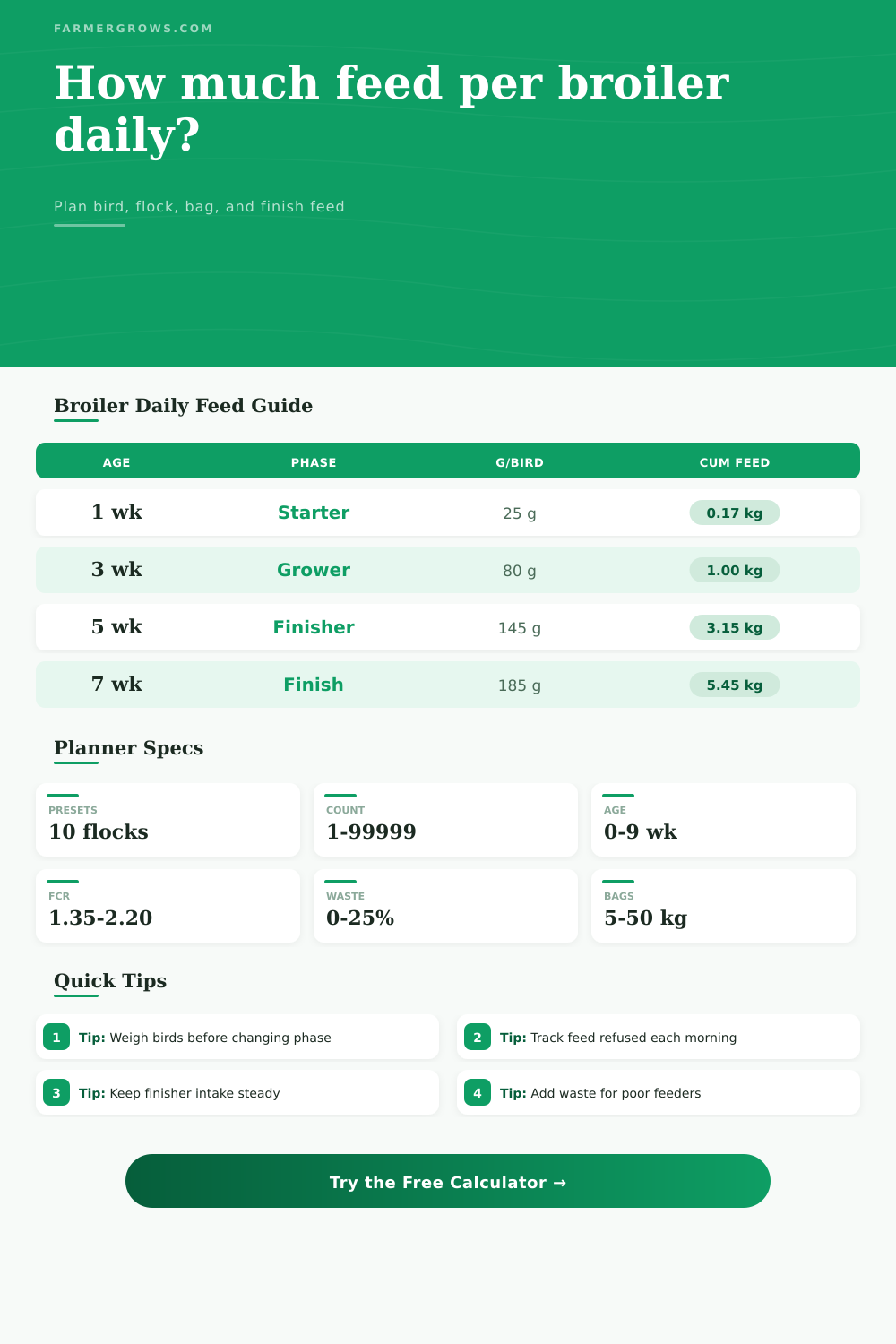
Feed Per Broiler Chicken Per Day Calculator
Plan daily feed per broiler, total flock feed, bags needed, and finishing feed from bird count, age, target market weight, feed phase, FCR, mortality, waste, and strain pace.
Choose a named broiler flock, then adjust count, week, target market weight, mortality, waste, FCR, feed phase, bag size, and growth pace to match your birds.
Broiler Feed Plan
Results combine phase intake, estimated current weight, FCR needed for the remaining gain, mortality, waste, and bag size.
Fine crumbs, high protein, very small daily portions. Watch crop fill, water access, and brooder temperature.
Rapid frame and muscle start. Daily feed climbs sharply, so feeder space matters more than bag count alone.
Bulk growth phase with rising feed draw. FCR and litter condition usually decide whether waste needs a larger buffer.
Highest daily intake. Use the market-weight target and days remaining to avoid under-ordering the final feed run.
| Broiler age | Likely phase | Daily feed per bird | Estimated live weight | Cumulative feed per bird |
|---|---|---|---|---|
| 0 to 1 week | Pre-starter crumbs | 15 to 28 g | 0.04 to 0.18 kg | 0.10 to 0.20 kg |
| 1 to 2 weeks | Starter | 35 to 55 g | 0.18 to 0.45 kg | 0.40 to 0.55 kg |
| 2 to 3 weeks | Starter to grower | 65 to 90 g | 0.45 to 0.85 kg | 0.95 to 1.15 kg |
| 3 to 4 weeks | Grower | 95 to 125 g | 0.85 to 1.35 kg | 1.75 to 2.05 kg |
| 4 to 5 weeks | Grower to finisher | 130 to 160 g | 1.35 to 1.90 kg | 2.85 to 3.35 kg |
| 5 to 6 weeks | Finisher | 160 to 190 g | 1.90 to 2.45 kg | 4.10 to 4.85 kg |
| 6 to 7 weeks | Final feed | 180 to 220 g | 2.45 to 3.05 kg | 5.30 to 6.25 kg |
| FCR level | Farm interpretation | Feed for 1 kg gain | Common causes | Planner adjustment |
|---|---|---|---|---|
| 1.45 to 1.55 | Very efficient | 1.45 to 1.55 kg | strong genetics, dry litter, steady temperature | Use only if flock weights confirm it |
| 1.56 to 1.70 | Good broiler result | 1.56 to 1.70 kg | balanced ration and low feed spill | Good default for fast strains |
| 1.71 to 1.90 | Moderate field result | 1.71 to 1.90 kg | weather swings, moderate waste, mixed sex | Add waste and check average weight |
| 1.91 to 2.20 | Slow or stressed flock | 1.91 to 2.20 kg | heat stress, disease pressure, poor feeder height | Use a conservative bag order |
| Bag size | Metric weight | Bird-days at 100 g | Bird-days at 150 g | Use case |
|---|---|---|---|---|
| 10 kg bag | 10.0 kg | 100 bird-days | 67 bird-days | small pen or trial group |
| 20 kg bag | 20.0 kg | 200 bird-days | 133 bird-days | backyard grower phase |
| 25 kg bag | 25.0 kg | 250 bird-days | 167 bird-days | common farm feed bag |
| 40 lb bag | 18.1 kg | 181 bird-days | 121 bird-days | imperial bag ordering |
| 50 lb bag | 22.7 kg | 227 bird-days | 151 bird-days | larger farm bag |
| Scenario | Age and target | Daily feed guide | Remaining feed | Management note |
|---|---|---|---|---|
| 25 backyard broilers | 3 wk to 2.4 kg | 2.0 to 2.6 kg flock/day | 50 to 65 kg | Watch feeder lip height as birds grow |
| 100 fast broilers | 4 wk to 2.6 kg | 12 to 16 kg flock/day | 165 to 220 kg | Use current weights before final feed order |
| 300 pastured broilers | 5 wk to 2.8 kg | 48 to 62 kg flock/day | 430 to 560 kg | Raise waste buffer when feeders move daily |
| 1000 commercial birds | 5 wk to 2.5 kg | 145 to 175 kg flock/day | 1450 to 1750 kg | Daily bin checks prevent late shortages |
Weigh weekly: Use a sample of birds each week. Current weight is the fastest way to correct the feed-per-day plan before the finisher phase.
Measure waste: If feed is in litter or under feeders, raise the waste percentage and adjust feeder height before ordering extra bags.
Then you start growing broilers from tiny chicks who grow fast. It’s impressive at first and then it gets tricky as they reaches week four. Because they eat so much feed so fast, their feed cost rise substantialy. By the time you switch them onto finisher feed, their metabolic need change massively. This create a tricky balancing act. You have to figure out how to feed these bird correctly without over-feeding them or wasting money on inefficient feed.
To start with an example: most farmers estimate how much they should of be feeding chicks each day by looking at their initial food consumption. One chick will eat roughly twenty-five grams during its first week of life, this sounds reasonable. But that same chick could consume almost two-hundred grams by week six. Based off your desired final weight, as well as how many birds you have, the calculator spits out a total amount of feed needed. It turns theory into practice, putting nutrition in line with farming logic.
How to Feed Your Broilers
The secret to making money is the feed conversion ratio. To make money, you need to understand the feed conversion ratio. A moddern broiler has a feed conversion ratio of roughly 1.55 (i.e., it gain one kilo of weight per 1.55 kilos of feed consumed). Anything over 2.0 and you’re losing money with every single bird. Adjust for your situation; change the feed conversion ratio in the calculator accordingly. A higher number assume slower growing birds or wet litter. Take into account heat stress, disease, improper feeder height, etc.
The amount of food wasted can impact total cost as well. Some food will be spilled (a bird scratching around) and some food might be stolen by wild birds that visit coop. The calculator assumes you’ll estimate how much is lost. Five percent seems low, but over a hundred birds it represent a large loss of profits. If you have an open trough with strong wind in the shed, perhaps you should assume 10% or more loss.
One mistake that many people make has to do with phase changes. Week five is no time to be feeding them starter crumbles; it’s bad for their health and not very efficient. By the time they’re at week five, you need to time your transition to finisher based on how fast they grow. Too early, and you risk leg problems; too late, and you pay for extra protein.
The graph above details when each day’s amount goes up. This helps you spot where the growth curve begins to rise more rapidely. Planning helps you use bags efficienty, but how much should you plan? The number of bags matter. If you’re down to just a few days before market and have run out of feed, the birds won’t keep growing until market day. Plan in advance to determine how many twenty-five kilogram sacks to purchase during the last two weeks. This will help you get the best price on feed (since it’s purchased in bulk) and ensure that you don’t run out of feed midway into growing your birds!
Feeding efficiency decreases with heat stress. As temperatures increase, birds will consume fewer calories due to their focus on cooling rather than growing. If you have raised birds in the summer months, you should account for a reduction in growth rate. The calculator allows you to choose different rates of growth. This update the total projected feed to reflect a slower schedule. It’s always better to be slightly over prepared then hungry birds at the end of the growth stage.
To do this, weigh some of your birds once per week and adjust accordingly based on their weight. Have some that are overweight? Reduce their feeding budget. Have some that is underweight? Increase it. This creates a feedback loop that keeps expenses in check.
Broiler production is quick, biologically speaking. You’re dealing with a system whose growth outpace any plan you may have made for it. When you know how much they need in total, and at what rate per day, there’s no more guesswork. No longer do you have to fear running out of food. You get to focus on taking care of those birds.