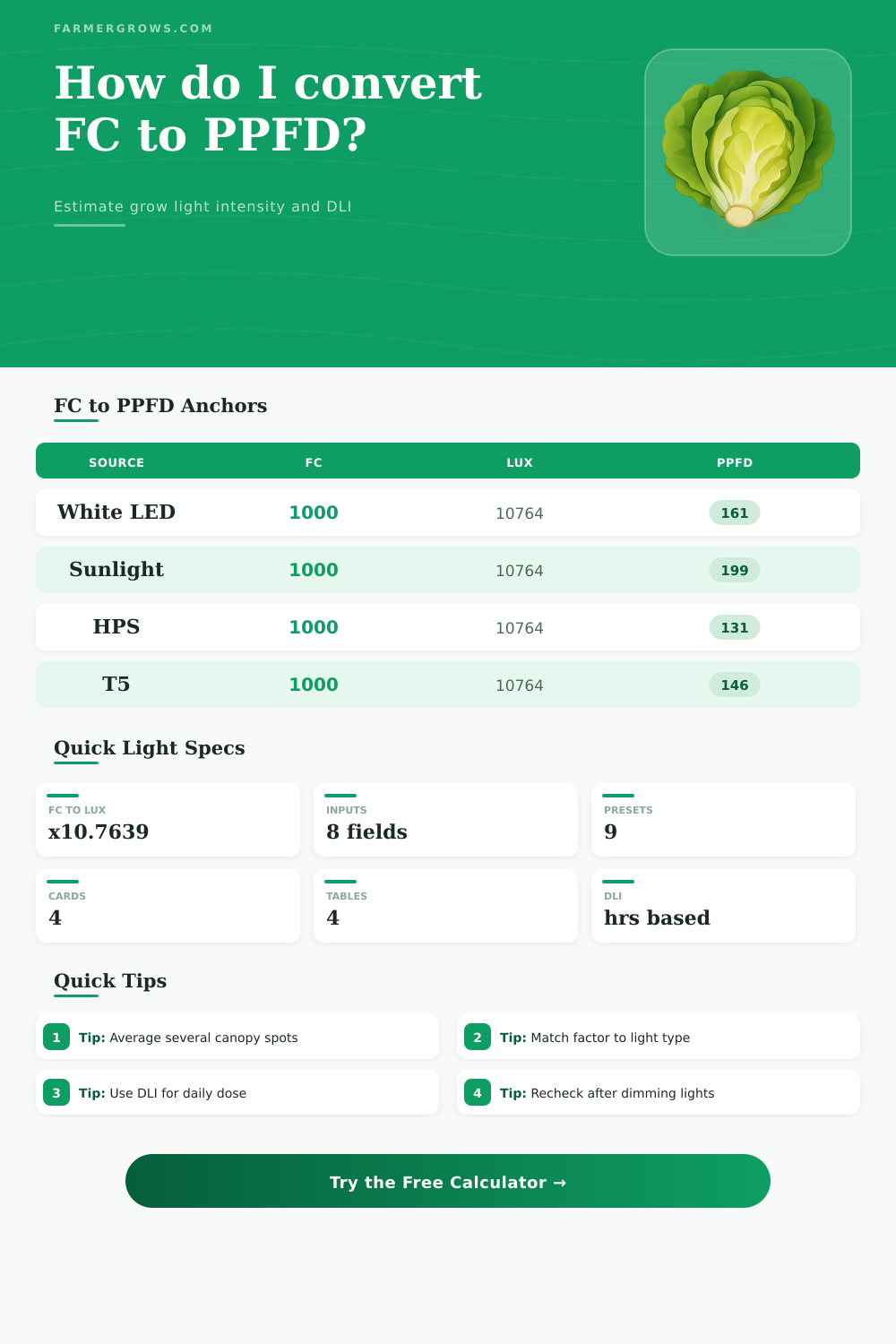
FC to PPFD Calculator
Convert foot-candles to lux, estimated PPFD, and daily light integral for grow rooms, benches, seedling racks, and greenhouse crop checks.
Foot-candle meters measure visible brightness, not plant photons directly. This calculator keeps the base conversion exact, then applies a light-source factor, spectrum adjustment, sensor correction, canopy multiplier, and photoperiod to estimate useful grow-light values.
Good default for broad-spectrum grow LEDs and most mixed white diode fixtures.
Use for greenhouse readings when direct and diffuse daylight dominate the crop.
Lux appears high under yellow-orange lamps, so the PPFD factor is lower.
Useful for propagation shelves, seed starts, and low-profile nursery racks.
Light Conversion Results
| Foot-candles | Lux | White LED PPFD | Sunlight PPFD |
|---|---|---|---|
| 500 fc | 5,382 lux | 81 µmol/m²/s | 100 µmol/m²/s |
| 1,000 fc | 10,764 lux | 161 µmol/m²/s | 199 µmol/m²/s |
| 2,000 fc | 21,528 lux | 323 µmol/m²/s | 398 µmol/m²/s |
| 4,000 fc | 43,056 lux | 646 µmol/m²/s | 797 µmol/m²/s |
| Crop group | Common PPFD range | Default target | Use case |
|---|---|---|---|
| Microgreens | 120-180 | 150 | Compact trays and short cycles. |
| Seedlings | 150-250 | 200 | Propagation before transplanting. |
| Leafy greens | 200-350 | 280 | Lettuce, kale, chard, and basil starts. |
| Tomato or pepper | 450-700 | 600 | Fruiting crops under stronger fixtures. |
| PPFD | 12 hours | 16 hours | 18 hours |
|---|---|---|---|
| 150 µmol/m²/s | 6.5 mol/m²/day | 8.6 mol/m²/day | 9.7 mol/m²/day |
| 250 µmol/m²/s | 10.8 mol/m²/day | 14.4 mol/m²/day | 16.2 mol/m²/day |
| 400 µmol/m²/s | 17.3 mol/m²/day | 23.0 mol/m²/day | 25.9 mol/m²/day |
| 600 µmol/m²/s | 25.9 mol/m²/day | 34.6 mol/m²/day | 38.9 mol/m²/day |
| Correction setting | Multiplier | When to use | Effect on PPFD |
|---|---|---|---|
| No calibration | 1.00 | General FC meter estimate. | No change. |
| Meter reads low | 1.05-1.15 | Checked against a PAR sensor. | Raises PPFD. |
| Meter reads high | 0.85-0.95 | Bright-biased meter or phone app. | Lowers PPFD. |
| Edge average | 0.85-0.95 | Canopy corners included. | Shows usable average. |
Take readings at plant height across the center, edges, and corners, then enter the average foot-candle value.
Use a PAR meter for final crop trials; this calculator is best for comparing FC readings and checking whether a setup is close.
The exact FC-to-lux conversion creates a stable base, while the PPFD factor adjusts that brightness reading for the light source spectrum and the crop target.
A foot-candle meter can measure how bright a surface is to the human eye, but it dont measure the specific light that the plant require to perform the processes necessary for growth. Because plants only respond to certain light wavelength, the foot-candle meter can indicate inaccurate measurements of the amount of light that the plants are receiving. A conversion tool is necessary to transform the foot-candle meter readings into the type of measurement that relate to the light that the plants require for growth.
The conversion from foot-candle to PPFD begins with determining the relationship between foot-candles and lux, and then performing the conversions towards an estimate of the PPFD that the plants are receiving. The estimate of the PPFD that the plants are receiving can differ based off the type of light that is being provide to those plants. For instance, the sunlight contain more usable photosynthetic photons per lux than high-pressure sodium lamps contain, and different brands of LED lights may contain different ratios of useful light to that which is visible to the human eye than high-pressure sodium lamps.
How to Convert Foot-Candles to PPFD
Each of these variable must be accounted for in the calculation of PPFD, as the type of light source will determine the relationship between foot-candles and PPFD. Another of the factors that must be considered in the calculation of PPFD is the light spectrum that is being utilized, as well as the meter that is being use to measure the light. Most foot-candle meters are calibrated to provide accurate measurements of the amount of light that is visible to the human eye.
Because plants do not respond to the same wavelengths of light as humans, these meters may register either a higher or lower measurement of the actual amount of light that is being received by the plants. In this case, the use of a correction multiplier may allow for adjustments to the measurement to account for this discrepancy in measurement. A correction factor may be used if the growers have compared the measurements from the foot-candle meter to a PAR sensor reading.
If growers dont adjust these meters for the correction factor, growers may base their light plans according to incorrect measurements of the amount of light that the plants is receiving. Another of the variables to consider is the position of the plants canopy relative to the foot-candle meter. Single measurements can be made with the meter with the canopy’s center, but light level tend to diminish towards the edges of the bench upon which the plants are established.
Taking several measurements and calculating the average will provide a more accurate measurement of the amount of light that the plants are receiving. A canopy multiplier may be incorporated into the calculations to account for the difference in light that fall on the plants canopy to that which is measured by the foot-candle meter. After determining the PPFD that is being provided to the plants, it is important to ensure that the measurement is appropriate for the type of crop that is being grown.
Different types of plants require different amounts of light throughout their growing periods. For instance, the light requirement of tomato seedlings may be different than the light requirements of established tomato plants that are producing fruit, and different amounts of light may be required at different stage of the growth of the same type of plant. For instance, microgreens require less light intensity than young tomato plants if the photoperiod is long enough.
Therefore, the PPFD that can be calculated is only one that may be used to determine whether the amount of light that is being provided to the plants is appropriate, as long as that target PPFD is an appropriate target for that species of plant during that growth period. Another of the measurements that can be used is the Daily Light Integral (DLI). The DLI is a measurement of the total amount of light that is provided to the plants over the length of one growing day.
Two benches may register the same amount of PPFD at noon, but the plants on one bench may be exposed to the lights for a longer period of time than the plants on the other bench. By incorporating the photoperiod of the lights into the calculation of the amount of light that is falling on the plants, the DLI can help to determine whether the lights provide enough light to support the growth of the plants. The DLI is an important measurement for growers who wish to understand the reason for the differing growth rates among grow rooms that each have the same type and number of light fixtures installed.
It is important to understand that real measurements will always contain a level of uncertainty in their measurements. The accuracy of the foot-candle readings may be affected by a variety of factors, such as the height of the lights relative to the plants, the reflectivity of the reflector that is reflected off of the sides of the grow rooms, and the amount of dust that may be visible on the sensor that measures the light. The uncertainty of the measurements can be reduced by taking additional samples of light measurements of the plants canopy.
The calculator incorporates the ability to track the number of samples of light that are measured, as more samples will lead to a smaller range of errors in the measurements. Instead of providing the growers with a precise measurement of the amount of light that the plants are receiving, the measurements will be provided as a range of possible value, which will allow the growers to make additional observations of the canopy during the growing cycle of the plants. It is also important to recheck the measurements if any change are made to the light source that is provided to the plants.
For instance, if any high-pressure sodium lights are replaced with LED lights, the spectrum of light that is provided to the plants will change, as will the distribution of that light. Therefore, the calculations that were made with that old average of PPFD will no longer be an accurate description of the amount of light that is being provide to the plants. The lighting plan must be rechecked after any changes to the lighting fixtures within a grow room to prevent the type of error that may be made with the assumption that the old measurements will apply to the new type of grow light.
The placement of the foot-candle meter relative to the canopy may also impact the accuracy of the measurements of PPFD. A meter that is held at eye level will indicate a different amount of light to the plants than if the meter is place at the height of the upper leaves of the plants, and the upper canopy will expose the plants to a different amount of light than the lower portion of the canopy. A canopy multiplier will help account for the difference in light that is provided to the upper canopy versus the lower canopy, but only if the plants leaves intercept the amount of light that is observe.
If growers began to use the measurements of PPFD and DLI in place of the old foot-candle meters, growers would no longer have to ask the question of whether the lights that are provided to the plants appear bright enough. Instead, growers would ask if the amount of light that is provided is the same as the requirement of the plants that are growing within those area. Furthermore, growers would also be able to determine if the amount of light that is provided to the entire grow room is uniform in strength.
By automating the calculations that determine PPFD and DLI, growers can dedicate their effort towards making the observations necessary to manage the grow rooms lighting.