Water Storage Calculator
Estimate farm water storage from livestock, crop and garden demand, irrigation depth, household emergency needs, rainfall capture, tank capacity, refill rate, drought buffer, leakage, and freeboard.
This planning calculator uses gallons. It sizes storage from daily demand, then checks usable tank volume after freeboard against refill and roof-capture assumptions. Add a safety margin for hot weather, water quality, pump outages, and local livestock guidance.
Farm water storage summary
Results update from herd, irrigation, rain capture, refill, leakage, freeboard, and reserve inputs.
| Livestock | Typical gal/day | Hot weather range | Planning note |
|---|---|---|---|
| Beef cow or cow-calf pair | 12 to 20 | 20 to 30 | Use higher values for lactation, heat, dry feed, or long walks. |
| Dairy cow | 30 to 50 | 45 to 70 | Milk production and wash water can dominate the farm total. |
| Horse | 8 to 12 | 12 to 18 | Work, lactation, hay intake, and summer heat raise intake. |
| Sheep or goat | 1 to 3 | 2 to 5 | Small stock vary sharply with feed moisture and shade. |
| Growing pig | 2 to 5 | 4 to 8 | Check nipple flow and pen heat before sizing storage. |
| Layer or broiler chicken | 0.05 to 0.12 | 0.10 to 0.20 | Small per bird, but flocks need clean backup water. |
| Irrigation conversion | Gallons per week | Gallons per day | Use case |
|---|---|---|---|
| 1 inch on 100 sq ft | 62 gal | 9 gal/day | Small raised bed group or seedling zone |
| 1 inch on 1,000 sq ft | 623 gal | 89 gal/day | Large garden, hoop house block, or nursery pad |
| 1 inch on 5,000 sq ft | 3,117 gal | 445 gal/day | Market garden plot with drip lines |
| 0.5 inch on 1 acre | 13,577 gal | 1,940 gal/day | Survival irrigation or orchard pulse |
| 1 inch on 1 acre | 27,154 gal | 3,879 gal/day | Full field inch for comparison only |
| Tank size | Usable at 10% freeboard | Days at 250 gal/day | Best fit |
|---|---|---|---|
| 275 gal IBC tote | 248 gal | 1.0 day | Garden station, small poultry, portable reserve |
| 1,000 gal poly tank | 900 gal | 3.6 days | Homestead or short barn outage buffer |
| 2,500 gal vertical tank | 2,250 gal | 9.0 days | Small herd, greenhouse, or rainwater cistern |
| 5,000 gal storage tank | 4,500 gal | 18.0 days | Mixed livestock and garden drought reserve |
| 10,000 gal storage tank | 9,000 gal | 36.0 days | Market garden, dairy reserve, remote pasture |
| Reserve goal | Demand level | Storage before freeboard | Planning note |
|---|---|---|---|
| 3 days | 100 gal/day | 300 gal | Basic outage bridge for a small homestead. |
| 7 days | 250 gal/day | 1,750 gal | Useful for pump repairs or delayed delivery. |
| 14 days | 500 gal/day | 7,000 gal | Common dry-spell target for mixed farms. |
| 21 days | 750 gal/day | 15,750 gal | Remote sites need firm refill assumptions. |
| 30 days | 1,000 gal/day | 30,000 gal | Large drought reserve; verify structure and water quality. |
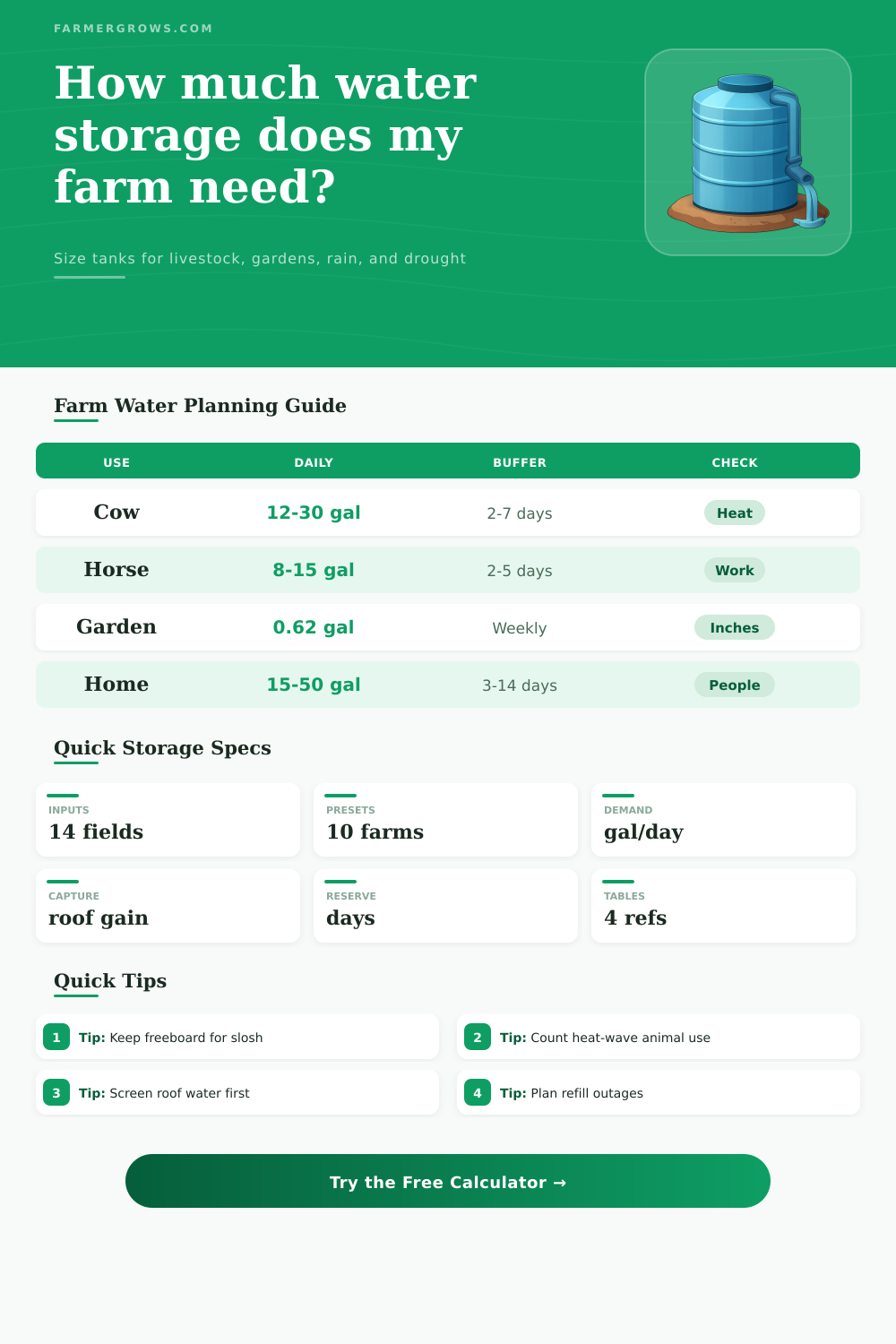
For livestock: Size for the hottest realistic week, not the average spring day. Heat, lactation, salt, dry hay, and walking distance can change daily water draw fast.
For rain capture: Roof gallons are only useful when gutters, screens, first-flush handling, overflow, and tank inlets can move the storm volume without wasting it.
Determining how much water is needed for the farm when the pump isnt working or when it is raining requires the farmer to determine the numbers of animals on the farm and the number of acres of the farm. In addition to these variables, the farmer should add a safety margin to the calculation made of the number of animals and the number of acres of the farm. Furthermore, it is also necesary to calculate how many days it takes for the farm to experience a dry spell and how much water the roof will collect from the rain during certain periods of the year.
The water tank that is constructed on the farm should be able to hold the amount of water necessary to last the length of the driest spell of the year, and the water tank’s capacity should be equal to its refill rate and the loss of water from the tank. The amount of water that is needed daily on the farm may not always be the average amount of water that the animals drinks. For instance, a beef cow may only consume 20 gallon of water on a mild day but may consume 30 gallons of water if the weather is hot and the hay is dry.
How to Calculate Water Needs and Tank Size for a Farm
Horses that live on a farm and run in an arena will require more water than herbivore that live on a farm’s pasture. Furthermore, the acres of land that may be used to grow food will also require water. A garden that requires 1 inch of water per week on 5,000 square feet of the land will require a quantity of water that the farm’s livestock does not account for in the quantity of water that is consumed.
Additionally, the water used for irrigation of the farm and the water that is used for household emergencies are not the same. Therefore, these two variables should be accounted for separately. The amount of water that may be captured from the rain that falls on the farm’s roofs may be a great amount, but there will be some loss of that water to the run-off from the farm’s gutters that are often clogged with leaves.
The amount of water that falls from the storm may be great, but the water tank may not be able to recieve all of the water that falls on the roof in one afternoon. The roof may be able to provide water for the farm during normal weather spells but will not provide any water on dry spells. Therefore, the amount of water that is stored should include a drought buffer and a refill rate for the water tank that is independent of the amount of water that falls on the roof from rain.
Furthermore, the amount of water that may be collected from the well may be limited to a small fraction of the total amount of water that is used daily on the farm. In such a case, the water tank should hold enough water to compensate for this deficit for every day that it does not rain on the farm. The amount of water that is stored within the tank will be less than the amount of water that is stored due to additional factors that will reduce the amount of water that is usable within the tank.
For instance, 10% of the tank should be left free-board to allow for the sloshing of the water and to allow for the water to expand within the tank’s structure. In a 5,000 gallon water tank, leaving 10% of the tank free-board will reduce the usable volume of the tank by 500 gallons of water. Furthermore, water will also be lost from the tank due to leakage from the fittings of the tank, the evaporation of the water, and the waste water from the farm’s animals.
The loss of 8% of the water from the tank will continue to accumulate over the length of the drought period. In order to calculate the total amount of water that is required for the farm, the farmer should use an online calculator because these percentage losses of water are also accounted for in the calculation to ensure that the tank that is purchased for the farm wont be too small to last the animals during dry spells. The reference tables that are included in this article will allow the farmer to determine the amount of water that is needed based on the types of livestock that is on the farm and the amount of water that can be produced from 1 inch of rain on the acreage of the farm’s roofs.
However, these tables are only a guide as to the amount of water that is needed on the farm. The amount of water needed can be further determined through observation of the farm itself. For instance, the water needs of a dairy farm will differ from those of a beef farm.
Furthermore, 5,000 acres of pasture may not require the same amount of water as a small remote pasture that contains only a few animals. Furthermore, the farmer can calculate the number of animals on the farm on the page to determine the amount of water that is required for the animals. Furthermore, the number of drought days can also be increased to calculate the number of water tanks that is required should the water refill that comes from a river or another water source be seasonal.
Many farms will require the construction of two water tanks rather than one large tank due to the limitations of the well that refills the tank with water. In order to ensure that the storage plan for water that is created for the farm is successful, the reserve of usable water that is within the tank should be sufficient to provide water for the animals should the pump break down during the hottest week of the year. Furthermore, the usable water that is within the tank should be sufficient to ensure that there is no need for the use of emergency household water should a repair occur for the pump.
The farmer should adjust the plan for the water that is to be stored for the animals on paper prior to the animals experiencing a lack of water. It’s important to do this because the farmer should of planned ahead.