Acreage Calculator
Estimate farm, garden, pasture, orchard, and homestead acreage from real shapes, unit systems, setbacks, slope adjustment, usable percentage, and multiple parcels.
Choose a named field, lot, or farm block to load realistic dimensions, buffers, slope, and usable land assumptions.
Acreage Results
Your land totals will appear here after calculation.
These cards update from usable acreage so you can compare garden rows, pasture carrying space, orchard trees, greenhouse pads, wildlife plots, and hay-field scale.
| Unit | Square Feet | Acres | Metric Equivalent |
|---|---|---|---|
| 1 acre | 43,560 sq ft | 1.000 | 0.4047 hectares |
| 1 hectare | 107,639 sq ft | 2.471 | 10,000 sq m |
| 1 square mile | 27,878,400 sq ft | 640 | 259 hectares |
| 1 square meter | 10.764 sq ft | 0.000247 | 1 sq m |
| 1 square yard | 9 sq ft | 0.000207 | 0.836 sq m |
| Shape | Gross Area Formula | Buffer Method | Best Farm Use |
|---|---|---|---|
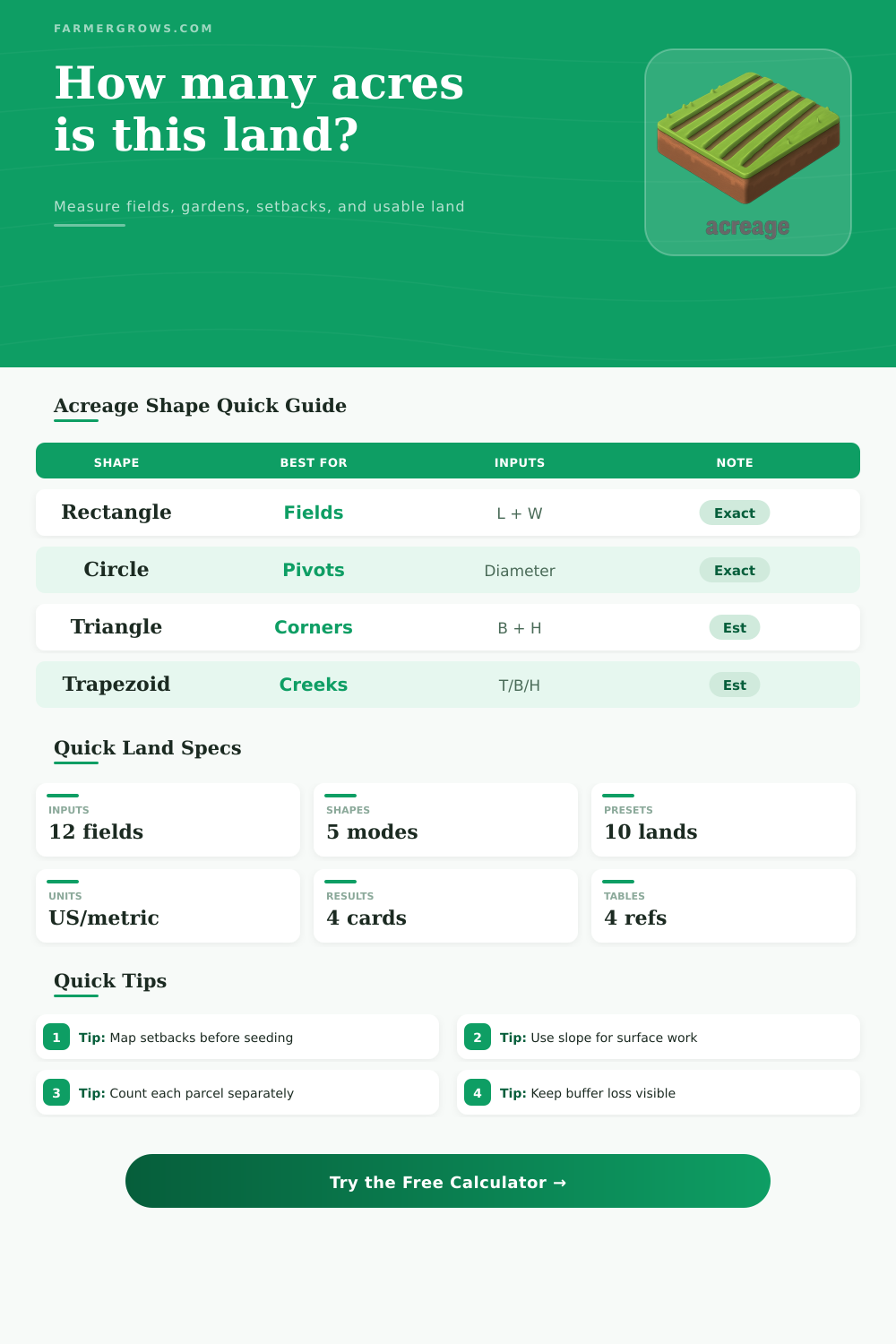
| Rectangle | Length × width | Subtract buffer from all sides | Fields, beds, paddocks, lots |
| Circle | 3.1416 × radius × radius | Reduce radius by buffer width | Irrigation circles, round pens |
| Triangle | Base × height ÷ 2 | Perimeter buffer estimate | Corner parcels and odd wedges |
| Trapezoid | (Top + base) × height ÷ 2 | Perimeter buffer estimate | Tapered land and creek bottoms |
| Custom | Entered area | Square-equivalent buffer estimate | Surveyed acreage or GIS output |
| Buffer Type | Typical Width | What It Protects | Calculator Use |
|---|---|---|---|
| Equipment headland | 10 to 30 ft | Turning, access, row ends | Use for working crop area |
| Fence setback | 3 to 15 ft | Maintenance and mowing edge | Use for planted net area |
| Road or drive offset | 15 to 50 ft | Safety, dust, visibility | Use when road edge is active |
| Stream or ditch buffer | 25 to 100 ft | Runoff control and habitat | Use for conservative acres |
| Windbreak or hedgerow | 8 to 40 ft | Shelter, drift, habitat | Use when edge rows are excluded |
| Land Use | Planning Density | Good Acre Range | Notes |
|---|---|---|---|
| Market garden rows | About 108 rows per acre | 0.25 to 5 acres | Assumes 100 ft rows at 4 ft spacing |
| Orchard trees | About 108 trees per acre | 1 to 20 acres | Assumes 20 ft by 20 ft spacing |
| Cow pasture | About 2 acres per cow | 2 acres and up | Local rainfall and forage change this |
| High tunnel block | About 10 tunnels per acre | 0.1 to 3 acres | Includes lanes and service gaps |
| Hay meadow | 2 to 4 tons per acre | 5 acres and up | Use local yield history for final plans |
Buffer first: Measure gross land, then remove headlands, setbacks, wet corners, and access lanes before buying seed or planning row counts.
Slope separately: Use gross acreage for legal land area, but use slope-adjusted surface acreage when estimating mowing, spraying, cover, or ground contact.
An acreage calculator is a tool that will help you determine the actual size of your land. An acreage calculator is a helpful tool because the size of your lands is rarely the same as what is present on the survey map. Survey maps show land as a rectangle of all lengths.
However, the land may contain tree, low areas with water, or hills with slopes that takes up some of the area. An acreage calculator can calculate the area of your land after accounting for these feature. Furthermore, an acreage calculator can help you to account for the area of your land that is unusable for farming purpose.
How to Use an Acreage Calculator
Many acreage calculator will allow you to adjust the measurement of your land for the area that a slope takes up. An acreage calculator will ask you the shape of your plot of land. The most common shape are a rectangular field.
However, land plots can also be triangular or trapezoidal in shape. For triangular plots, you will need to provide the acreage calculator with the dimension of the base and the height of the plot. For plots in the shape of a trapezoid, you will need to provide the acreage calculator with the width of the plot’s top and bottom boundary.
Once you have calculate the area of your land, you must account for the buffer. A buffer is the area of your land that is not available for farming but is required for other feature of your farm. For example, fence, headlands for farm equipment, or areas reserved for protecting streams can create buffers.
You will need to enter the width of these buffers into the acreage calculator before calculating your land area. Another calculation that you will need to make is determining the percentage of the usable area of your land. This percentage takes into account the presence of building, farm lanes, wet corners, or areas with rocks that may not be usable for farming.
The percentage should be lower than 100 percent because this percentage calculate the area that is usable for farming. The percentage ensures that the area calculated for your land is honest and realistic in comparison to the total area of your land. You will also need to take into account the slope of your land.
A flat acre is equal to one acre on a map. However, if that acre is on a slope, it will contain more surface area for farmer to work with, and it will require more seed for that acre. A sloped acre will take more time to fence and will have a larger surface area.
Using the slope in your acreage calculator will allow the acres to be plan to equal the amount of working acres. This will ensure that farmers dont have to measure each slope of the land. An acreage calculator may also allow you to use a parcel count to help calculate the total area of your land.
This may be used if many field that you own are of the same dimensions. You can use the parcel count to calculate the area of each field and then multiply that area by the total number of field you own. A parcel count can be beneficial in situations in which each field may not have its own headland but share the same type of soil and slope.
Acreage calculators also provide reference table that will give you context for the number that the acreage calculator calculates. These reference tables can help you to compare your land area to other units of area. For instance, one reference table can show how many acre are in one hectare or square foot.
Another reference table can show common buffer width that are used on farms. Finally, a third reference table can help you compare the number of trees that can be planted in an acre or the number of row of crops that may be planted in an acre of your land. It is common for individual to calculate the area of there land for the first time.
For those who are new to farming or who are purchasing land for farming purposes, the initial calculation may show a larger area than is accounted for by the land itself. After accounting for the buffer area and the percentage of the land that is usable for farming, the acreage calculator will show a smaller area than was initially calculate. This second calculation is the number that should of been used for planning the farm and its activity.
The number provided by an acreage calculator are a starting point for farmers. However, these number may change with the weather and the season. For instance, the number of cow that can be sustained on a pasture can change between seasons.
A pasture that can support eight cows during the wet season may only be able to support five during the drought month. An orchard may require more area for a headland once it starts to use a sprayer to control pest. The number provided by an acreage calculator are a starting point.
However, these number may not be the whole picture for planning a farm. Therefore, a farmer should use the acreage calculator but also walk the land to ensure that the number are still accurate and helpful for planning the farm.