Excavated Soil Volume Calculator
Estimate bank cut, loose excavated soil after swell, compacted backfill after shrink, truck loads, and stockpile footprint for trenches, pits, ponds, and post holes.
Choose a job type to load realistic dimensions, soil, moisture, swell, truck size, over-excavation, and stockpile slope. You can edit every value after a preset is applied.
Excavation Volume Results
Results update after calculation.
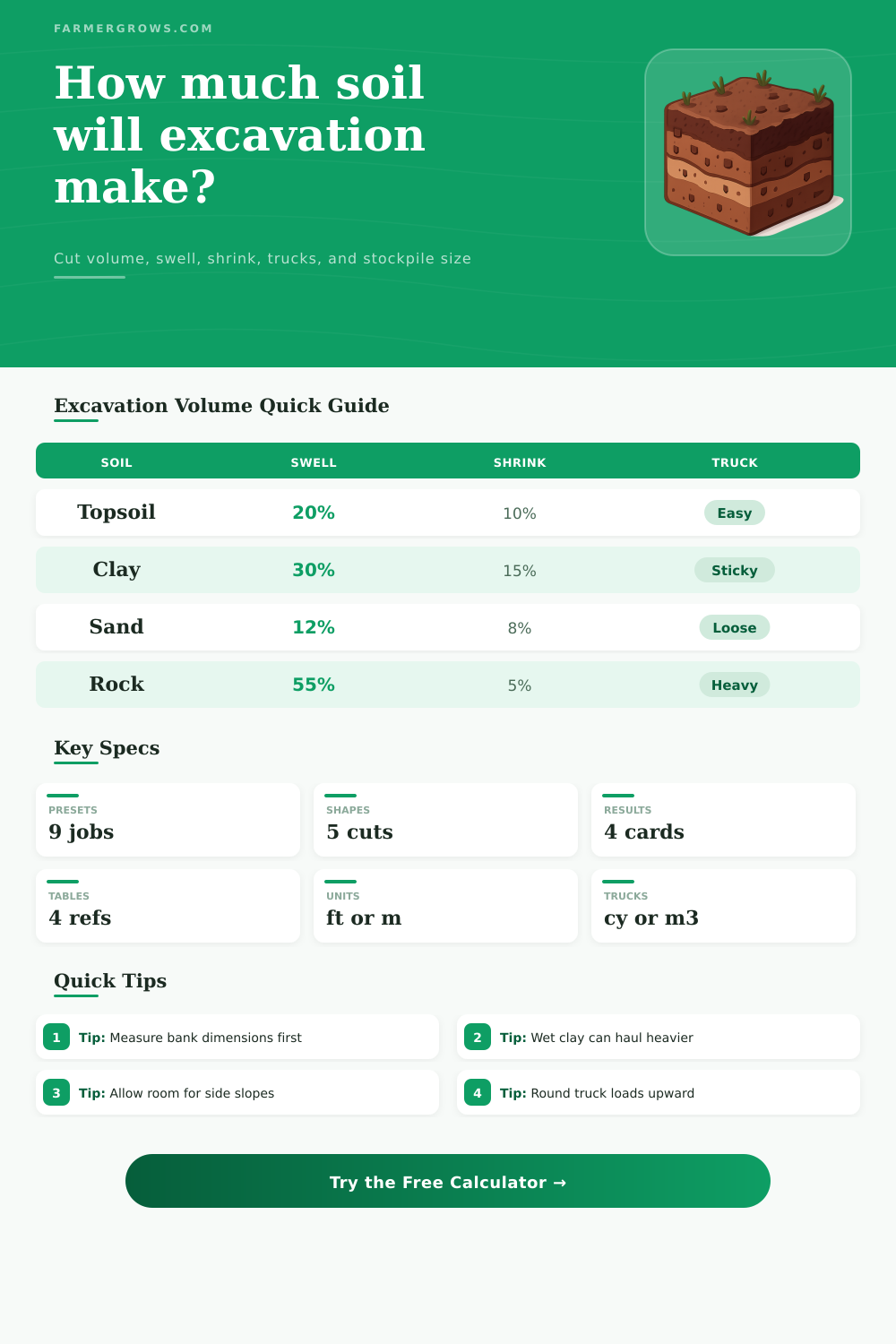
Typical swell ranges vary by texture, rock content, moisture, and how aggressively the material is broken up by the bucket or trencher.
| Shape | Bank volume formula | Best use | Field note |
|---|---|---|---|
| Straight rectangular trench | Length x width x depth | Utility lines, drains, irrigation pipe | Use the average width if the bucket wanders. |
| Sloped trapezoid trench | Length x depth x ((top + bottom) / 2) | Open drains, safe side-slope cuts | Top width captures battered sides. |
| Rectangular pit or basin | Length x width x depth | Foundations, ponds, pads, manure storage | Use average depth for uneven bottoms. |
| Round holes or shafts | Pi x radius squared x depth x count | Fence posts, piers, tanks, auger holes | Augers often loosen extra side material. |
| Known bank volume | Measured in-place volume | Survey, machine takeoff, grade model | Add swell only after bank volume is known. |
| Truck type | Typical loose capacity | Planning use | Watch point |
|---|---|---|---|
| Dump trailer | 2 to 4 cu yd | Small farm jobs and tight access | Payload weight may limit wet soil loads. |
| Single axle dump | 5 to 7 cu yd | Short hauls, driveway work, utility spoil | Good for narrow lanes but fewer yards per trip. |
| Tandem dump | 9 to 12 cu yd | Most site cuts and trench spoil | Confirm legal payload before loading heavy clay. |
| Tri axle dump | 13 to 16 cu yd | Larger basin or building-pad excavation | Needs room to turn and dump safely. |
| Semi end dump | 18 to 24 cu yd | Long haul or high-volume removal | Best on firm, open, level dumping areas. |
| Material | Loose density | Typical swell | Compaction shrink |
|---|---|---|---|
| Topsoil | 1900 to 2300 lb/cu yd | 15% to 25% | 8% to 12% |
| Loam or mixed soil | 2200 to 2700 lb/cu yd | 20% to 30% | 10% to 15% |
| Clay | 2400 to 3200 lb/cu yd | 25% to 40% | 12% to 20% |
| Sand | 2400 to 3000 lb/cu yd | 8% to 18% | 6% to 10% |
| Broken rock | 2800 to 3800 lb/cu yd | 45% to 70% | 3% to 8% |
| Side slope | Where it fits | Footprint effect | Practical note |
|---|---|---|---|
| 1.25:1 | Dry granular or short-term pile | Smallest footprint | Avoid for saturated or unstable soil. |
| 1.5:1 | Average excavated soil | Moderate footprint | Useful default for planning laydown area. |
| 2:1 | Wet, loose, or sandy spoil | Larger footprint | Better when the pile slumps after dumping. |
| 3:1 | Low working pile or near traffic | Largest footprint | Leaves a flatter pile for loader access. |
This calculator is for estimating and planning. Use local safety rules, utility locates, shoring requirements, and a qualified site plan for real excavation work.
When planning to dig a site for a project, it is important to account for the fact that the volume of the soils will change when the soil is moved. Soil volume change due to the fact that soil behaves differently when it is in the ground, when it is excavated, and when it is compacted into an excavated area. These different soil volumes the soil calculator can calculate to help ensure that the soil volume isnt misjudged during the planning of the project.
The type of soil that are to be moved will impact the volume of that soil. For instance, clay soil often swell to 30% more volume when excavated than when it is compacted back into the hole, but sandy soil doesnt swell to the same extent. The soil calculator allow for adjustments to be made for the type of soil that will be moved, as well as the moisture content of that soil.
Soil Volume Changes When You Dig
The amount of volume that will be represented by the soil that is to be excavated will allow the soil calculator to determine the number of truck load that will be required to move the soil, as well as the size of the stockpile that that soil will create. The shrink factor is the factor that is applied to the volume of soil when the soil is compacted back into the hole; this is the opposite of the swell factor. For instance, loam soil may swell 25% when excavated, but shrink 12% when compacted.
The soil calculator segment the soil volume into three separate measurements: bank cut volume, loose excavated volume, and compacted backfill volume. The bank cut volume is the volume of soil that will need to be removed, the loose volume allows the contractor to determine the size of the trucks that will be required, and the compacted volume determine if the excavated area will fill to the desired grade. The shape of the area that is to be excavated will also have an impact on the total volume of the soil that will be moved.
Many excavated areas are not in the form of rectangular trenches, but may include drainage ditches that has slopes on each of their sides. A trapezoid area on the soil calculator allow for the inclusion of the soil from those slopes in the total volume measurement. Additionally, many construction sites will require the digging of round hole for the placement of posts.
The round hole feature on the soil calculator allows for the volume of one round hole to be multiplied by the total number of round hole that will be dug. It is also important to consider the possibility of over-excavation by the site crew. Over-excavation occurs when soil is dug deeper than the original plan may have indicated; crews may have to go deeper into the soil to reach soil of the proper type, or they may have to add material to the bottom of the excavation site.
The percentage for over-excavation can also be entered into the soil calculator to provide an estimate of the volume of soil that will be excavated that includes this extra soil. It is also important to consider how much space that the soil stockpile will take up on the site. The stockpile of soil that is removed from the excavation site may form a cone shaped mound of soil with slopes on each of its side.
The soil calculator can estimate the diameter of that mound of soil and the area that it will take up on the construction site. If the soil that is removed is wet or sandy, the slopes can be flatter to reduce the chance that the mound of soil will slump into itself. The soil calculator help to show the relationship between different type of soil.
For instance, clay soils often require fewer truck loads due to the heaviness of the soil, but also swell to create a larger stockpile of soil than sandy soil. Additionally, sandy soil is lighter in weight per truck load of soil, but is more easily compacted into steep slopes than clay soil. Using the soil calculator, the size of the trucks, the location of the stockpile, and even the method of excavation can be adjusted before any of the equipment arrive at the construction site.
Furthermore, by using the soil calculator to separate the bank volume, the loose volume, and the compacted volume, the project can be kept on schedule when the planning for the project takes into account how the soil will behave when it is moved. Youll find that the soil calculator works better then most, and it should of helped with your project plan. If you dont account for the soil, your going to have alot of problems later.
Actually, its better to plan ahead to avoid mistakes. The modern equipments is alot of work to move.