Eucalyptus Trees Per Acre Calculator
Estimate eucalyptus tree density, planted positions, seedlings to order, row layout, coppice stems, canopy clearance, and stand volume from spacing, block area, survival, and rotation assumptions.
Pick a starting block, then tune spacing, layout, headlands, survival, reserve seedlings, coppice stems, canopy width, and expected merchantable volume per surviving tree.
Eucalyptus Planting Estimate
Spacing and stand summary will appear here.
| Spacing | Square Grid | Triangular Grid | Best Fit |
|---|---|---|---|
| 15 x 15 ft | 194 trees/ac | 224 trees/ac | Long timber rotations, wider crowns, grazing alleys |
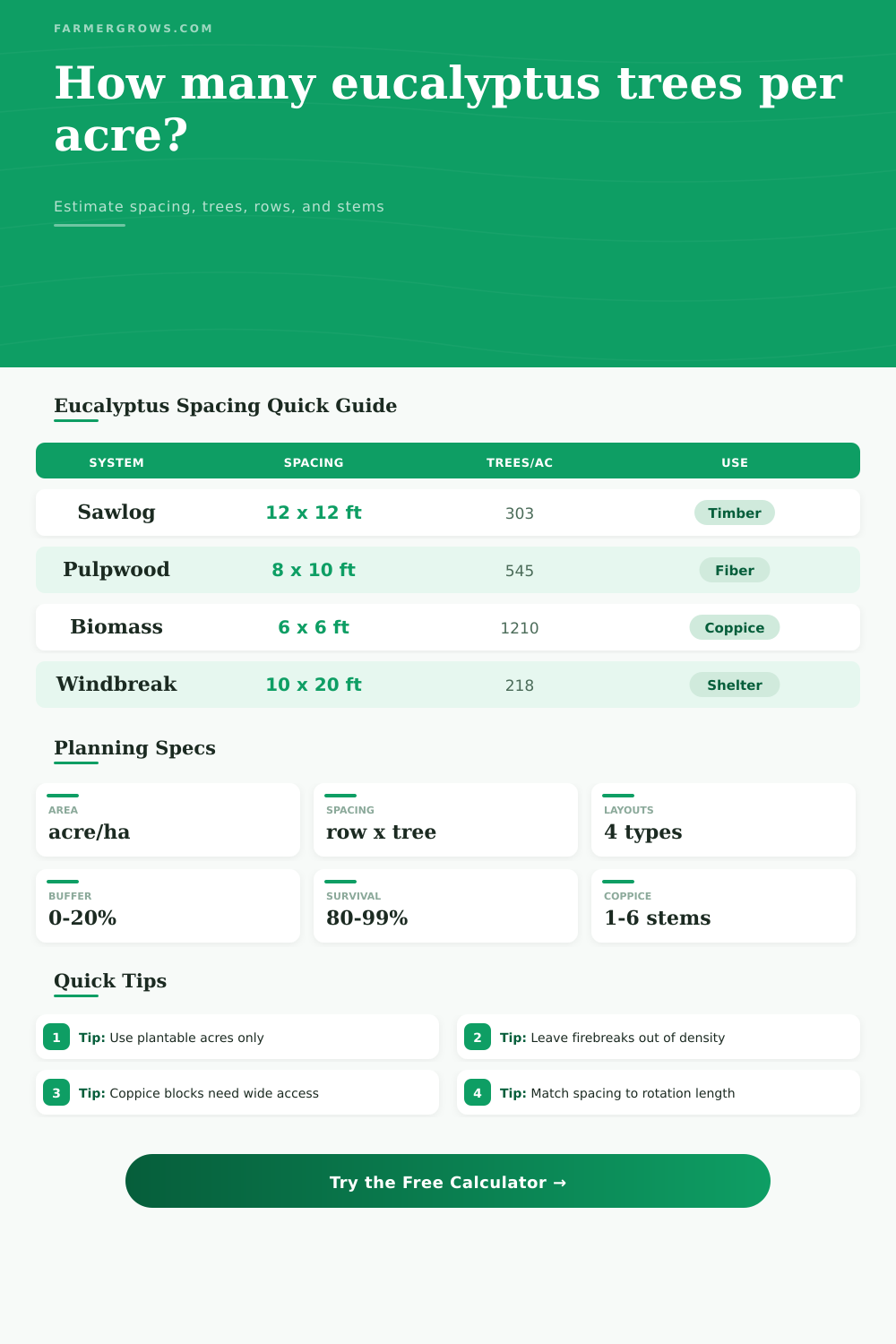
| 12 x 12 ft | 303 trees/ac | 349 trees/ac | Sawlog, poles, mixed farm shelter blocks |
| 10 x 10 ft | 436 trees/ac | 503 trees/ac | Balanced pulpwood and pole production |
| 8 x 10 ft | 545 trees/ac | 629 trees/ac | Pulpwood blocks with moderate harvest access |
| 8 x 8 ft | 681 trees/ac | 786 trees/ac | Fuelwood, fiber, and tighter coppice systems |
| 6 x 6 ft | 1,210 trees/ac | 1,397 trees/ac | Short-rotation biomass where pruning is expected |
| Block Type | Typical Deduction | Survival Target | Reserve Seedlings |
|---|---|---|---|
| Sawlog block | 6% to 10% | 92% to 96% | 5% to 8% for blanks and culls |
| Pulpwood plantation | 8% to 12% | 90% to 95% | 8% to 10% for early replanting |
| Biomass coppice | 10% to 15% | 88% to 94% | 10% to 15% for quick canopy closure |
| Windbreak strip | 5% to 12% | 85% to 95% | 10% to 20% for exposed edges |
| Scenario | Area | Spacing | Approximate Trees |
|---|---|---|---|
| Small farm windbreak | 1 acre | 10 x 20 ft | 218 positions before deduction |
| Pulpwood demonstration | 5 acres | 8 x 10 ft | 2,723 positions before deduction |
| Short biomass block | 10 acres | 6 x 6 ft | 12,100 positions before deduction |
| Timber stand | 40 acres | 12 x 12 ft | 12,100 positions before deduction |
Plantable area: Count only the ground that will actually receive trees. Firebreaks, road turns, drainage reserves, and loading decks can remove a meaningful share of a eucalyptus block.
Coppice planning: When eucalyptus is cut and allowed to resprout, the stump count stays tied to the original tree positions, but live stem density can multiply quickly.
This is an aerial view of young eucalyptus plantation. In field itself, the challenge are to ensure that there’s both room for machines to work and room for trees to grow. Getting your tree spacing wrong is an expensive mistake. You don’t want to waste potential of soil. You also don’t want trees to gets too big so that they are impossible to harvest efficienty.
The calculator does all the math for you on block size and usage, so there is no guessing required and no coefficients needed.
How to Choose the Right Tree Spacing
Spacing vary with what you’re aiming for: If it’s pulpwood, you want density, thousands of little stems, closing off the canopy fast to smother out weeds. In an eight-by-ten-foot set-up, which gives more than five hundred trees per acre, there will be a kind of environment that favors quick early growth. But if you’re after sawlogs, you’ll want room for each stem to get thick. A spacing of twelve by twelve feet or bigger keep individual stems from having to fight for light as aggressively. And let them get thick instead.
As spacing increase, density declines. See the reference table below to see how increasing spacing lowers density, which results in more volume per tree but less volume than an acre.
The headland deduction also factors in something most of us forget: land that won’t get planted. That includes all sorts of thing like the margin between the drainage ditch, firebreak, and road. Those are strips of un-planted land which aren’t a loss at all… They’re an insurance policy.
If you do your seedling-order math as if entire area will get planted, you’ll end up with raggedy edges and unsold sapling.
This tool allows you to take a percentage from such features (think of the actual site first; then consider the crop biology).
Survival rates come at an optimist’s cost: It’s tempting but risky business to order just as many trees as will fit into the calculated spots. A few will be lost to weather, pests, and bad planting. Planting experts factors a reserve of eight to 15 percent, just in case you need to fill in blanks that shows up in the second month. That way you’re never out of replacement stock.
But if you wait until later to reorder, it’s likely you’ll be waiting til next planting season… Meaning grass fills in the gaps. And those gaps prove difficult to correct later on. Your total order number include this buffer. The calculator does the math for you, so you’d of don’t have to do it in your head in the field.
If cutting the trees down and letting them resprout sounds appealing, then this method changes everything; it’s not just the initial plant spacing that matters, but also how many plants per acre is going to be present each year. By definition, every stool consist of multiple stems. In coppiced stands, there will be up to four times as much live wood in a given area. This means there is greater strength, a need for larger clearances for machines to turn around, and wider access lanes. A coppice block isn’t treated as a one-stem timber stand. Its water requirements is much greater than widely spaced timber block, so they should factor into your plans. Don’t try to plant a system beyond capacity of your infrastructure.
There’s no one “right” number for any given scenario, and the appropriate plant density depend on matching the right amount of cover to the right kind of land (and thus to the right market). A field planted with a windbreak, which prioritizes height and wind resistance, should be spaced different than one planted for biomass, which prioritizes mass and rapid turnover. But the tool let you compare all those choices head-to-head.
And it helps make abstract visions, like a beautiful green wall of foliage. Into practical instructions: How many seeds or seedlings do I order? How long a row does this represent? With a spreadsheet, it gets you from a canopy in your mind’s eye to something you can buy. But the fun part begins when you realize what you’ll put between the rows.