Epsom Salt for Tomatoes Calculator
Estimate Epsom salt for tomato plants by method, plant count, water volume, product strength, magnesium delivery, sulfur delivery, foliar concentration, and repeated-dose salt risk.
Choose a tomato scenario, then adjust the plant count, application method, water volume, rate, product purity, spoon density, and repeat schedule. Epsom salt supplies magnesium and sulfur only; it does not supply nitrogen, phosphorus, potassium, or calcium.
Tomato Epsom Salt Results
Your calculated dose will appear here.
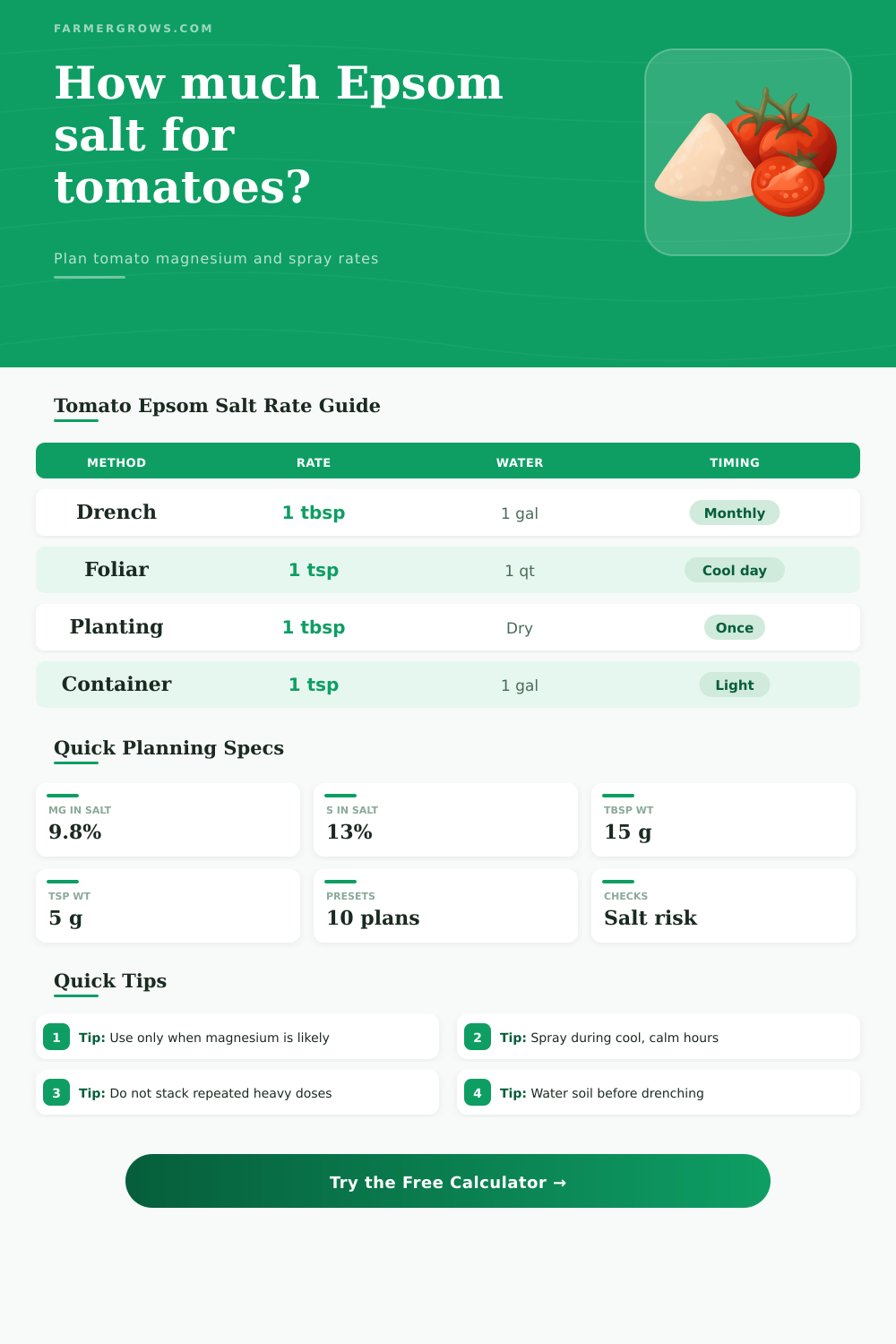
| Tomato use case | Planning rate | Water volume | Best timing |
|---|---|---|---|
| Soil drench for established plants | 1 tbsp per gallon | 0.5 to 1 gal per plant | After watering, every 4 to 6 weeks if needed |
| Light foliar spray | 1 tsp per quart | Fine leaf coverage, not runoff | Early morning or evening, below hot sun |
| Container tomato maintenance | 1 tsp per gallon | Enough to moisten root zone | Use cautiously because pots accumulate salts |
| Planting-hole dry placement | 1 tbsp per plant | Mix into surrounding soil | Only once, away from direct root contact |
| Deficiency trial strip | Half normal rate | Treat a few plants first | Compare new growth over 7 to 14 days |
| Measure | Approx grams | Magnesium supplied | Common tomato use |
|---|---|---|---|
| 1 level teaspoon | 5 g Epsom salt | 0.49 g Mg | Light container gallon or quart foliar mix |
| 1 level tablespoon | 15 g Epsom salt | 1.47 g Mg | Typical gallon drench or planting-hole dose |
| 2 tablespoons | 30 g Epsom salt | 2.94 g Mg | Stronger mix; use only with clear need |
| 100 grams | 6.7 tbsp Epsom salt | 9.8 g Mg | Batch mixing for many plants |
| Calculator status | Typical cause | What to do | Tomato note |
|---|---|---|---|
| Low | Light dose, enough water, few repeats | Apply to moist soil or spray in cool hours | Still avoid use if Mg is already adequate |
| Moderate | Higher concentration or repeated schedule | Reduce rate, increase water, or treat fewer plants | Watch leaf edges and container drainage |
| High | Strong mix, dry dose, small root zone | Do a test strip or use soil test guidance | Excess salts may worsen stress symptoms |
| Skip | Soil test says magnesium is adequate | Do not add Epsom salt routinely | Use balanced tomato nutrition instead |
| Symptom | May point to Mg? | Other common causes | Calculator adjustment |
|---|---|---|---|
| Older leaves yellow between veins | Possible | Low pH, potassium imbalance, root stress | Use light drench or foliar trial |
| New growth turns pale yellow | Less likely | Iron deficiency, high pH, cold roots | Do not assume Epsom salt solves it |
| Blossom-end rot | No | Calcium movement and watering swings | Do not add extra Epsom salt for this |
| Dark green plants, low fruiting | No | Excess nitrogen, heat, poor pollination | Skip routine magnesium additions |
Use Epsom salt when magnesium is likely low: sandy soil, known low soil-test Mg, older-leaf interveinal yellowing, or a small trial showing improvement in new growth.
Apply foliar sprays in cool, calm conditions and apply drenches to moist soil. Avoid strong dry placement against roots, stems, or newly stressed transplants.
Tomato yellowing, blossom-end rot, leaf curl, and poor fruit set can come from water, temperature, disease, pH, calcium transport, or root damage.
Several small applications can add up. Containers and raised beds need more caution because salts remain in a smaller soil volume unless leached.
We all know what tomato-growers say: Epsom salt cures all ills. Got some yellowing foliage? Is something in the soil slowing down growth? Grab the cheap, easy-to-dissolve white powder and sprinkle it. Wrong! Plants don’t grow on a diet of magic potions; they do so on soil chemistry. Applying magnesium when you should of be applying nitrogen or calcium doesn’t help, and it does harm by adding excess salts to throw off balance you’re aiming to correct.
To know just what’s going in the soil, and how much, a calculator is better then guessing. But then there’s the math. On this page, the tool makes you do the math. Most of us don’t bother, and instead we guess at a tablespoon per gallon, which is fine for quick-draining sandy soil but dangerous in containers or heavy clay that holds salts. That can be hazardous based off the case of pots, or in heavy soil.
How to Use Epsom Salt Safely on Tomatoes
So the calculator wants to know how many plants are being treated, how much water will be applied, and by what means (a drench versus a spray). Those factors all affect dilution rate and concentration. Eight big plant treated as a soil drench might mean a lot of total salt. But diluted into enough water to reach them, that won’t matter. But those same doses in two gallons of water for a couple of potted up cherry tomatoes? They’ll burn themselves trying to take it all in.
The calculator does that math for you, after you enter your details. That way no one accidentally salts out his or her soil. And you know what? Knowing what epsom salt actualy is might help here. It’s magnesium sulfate (sulfur plus magnesium). Why is that important? Because magnesium play a key role in the manufacture of chlorophyll; if it is lacking, plant will show older foliage yellowing between the veins with the veins remaining green. Sulfur aids in flavor development and supports protein synthesis.
Note that epsom salts have no potassium, no phosphorus, and no nitrogen. So if you have nitrate-deficient (stunted) tomatoes, epsom salts isn’t going to help one bit, and neither will anything until you can identify the real issue. The chart on the left of page shows how to use it safely: drenching is fine for established plants, but be careful with pots.
But how do you time it? As with everything: Timing matters. Magnesium travels very slowly in soil. It is ideal to apply a drench at any time except during extreme heat, as drenches works best when moisture in the ground helps deliver ions into the root zone. Spraying leaves is faster because nutrients are taken up directly, but you must do it carefully. A heavy spray at noon on a hot day will burn your foliage.
It includes your chosen method and how often you repeat it in the safety rating. This tells you if you are planning to exceed the maximum safe amount over time. Since you can’t see salt accumulating till it stresses the plant, this early-warning system is priceless. Also take into account what kind of soil you have. Magnesium deficiencies tends to be more common on sandy soils that leach nutrients faster, while heavy clay tends to hold nutrients tightly (and at times even lock them out of reach of the roots).
In either case, testing your soil are the best way. If you can’t do so, pay close attention: With a potential magnesium issue, older foliage might yellow, though an overall pale plant probably indicates a lack of nitrogen or light. Don’t give it a blanket solution just because you see a symptom without knowing what is actualy happening. Support good growth; don’t add stuff and hope one input will stick.
If you do opt to try epsom salt, keep it simple. Smarter: try this on a couple of plants first instead of hitting the entire garden with it. Observe the results within two weeks. Has the yellowing stopped? Does new growth look improved? Great, perhaps you’re on the right track. No change? Stop using it. Listen to your tomatoes; they’ll tell you what works.
Calculators can helps you be precise and work responsibly, but patience and your own eyes are still your best tools. Begin small, take careful notes, and let the soil do the heavy-lifting. This is how to keep tomatoes thriving; and avoid making the entire garden into a chemistry experiment gone wrong.