Epsom Salt for Plants Calculator
Estimate magnesium sulfate for soil drenches, foliar sprays, broadcast applications, and container watering with plant sensitivity, soil magnesium, pH, frequency, and salt-risk adjustments.
Choose a common garden situation, then fine-tune plant count, treated area, deficiency severity, soil-test status, pH, application method, concentration, and repeat schedule.
Epsom Salt Recommendation
Enter your plant and soil details to estimate a conservative magnesium sulfate application.
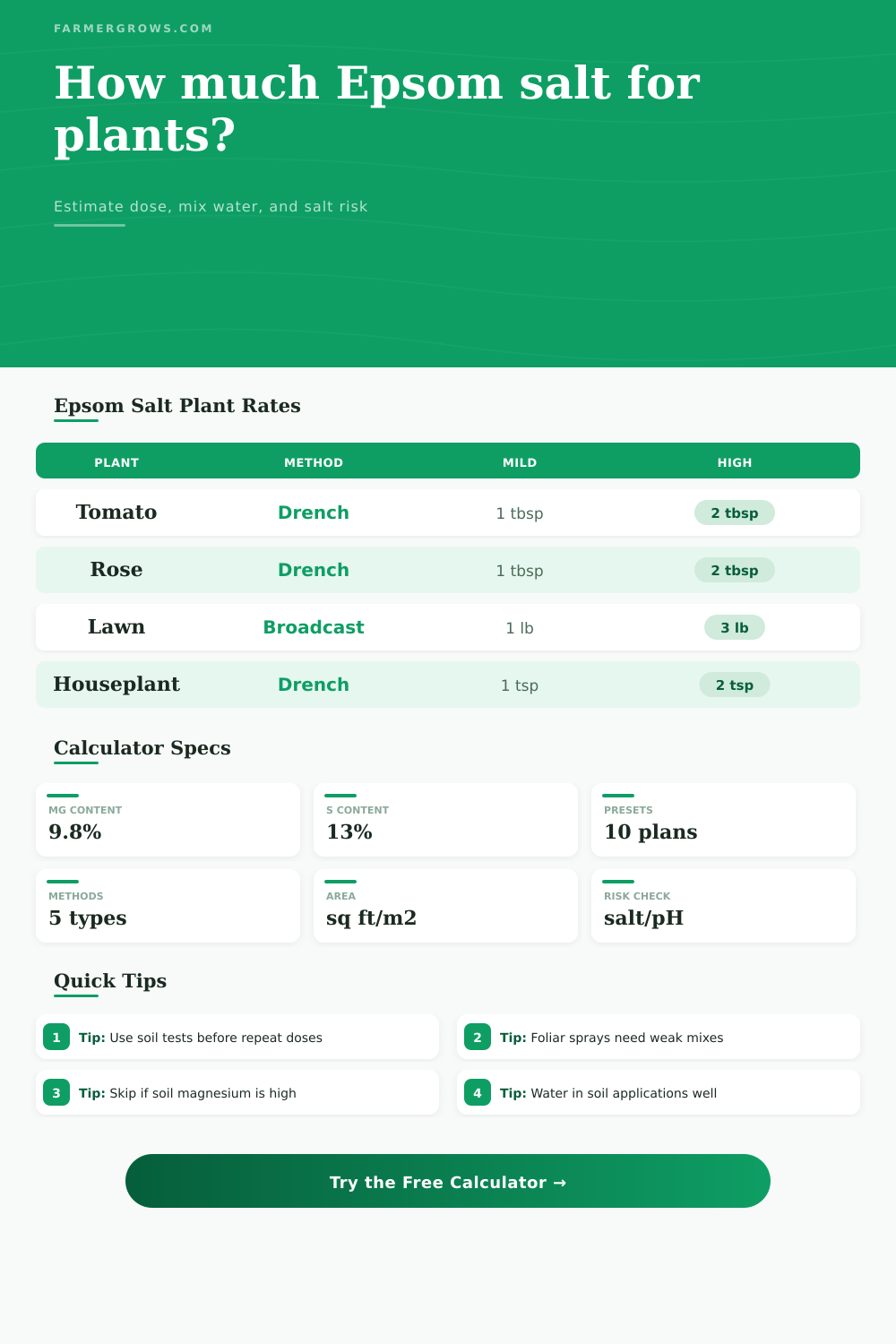
| Plant group | Count-based starter | Area-based starter | Best application | Risk note |
|---|---|---|---|---|
| Fruiting vegetables | 1 tbsp per plant | 0.12 tbsp per sq ft | Soil drench or side-dress | Useful for tomato, pepper, and cucurbit trials when Mg is low. |
| Leafy vegetables and herbs | 0.5 tbsp per plant | 0.08 tbsp per sq ft | Gentle drench | Keep rates light because leaf crops respond quickly to salts. |
| Roses and flowering shrubs | 1 tbsp per plant | 0.10 tbsp per sq ft | Root-zone drench | Use around active roots, not piled against the stem. |
| Citrus, trees, and shrubs | 2 tbsp per plant | 0.06 tbsp per sq ft | Soil drench | Large root zones may need area-based planning instead of count only. |
| Lawns and turf | 0 tbsp per plant | 0.09 tbsp per sq ft | Broadcast and water in | Do not apply to stressed, dry turf without irrigation. |
| Containers and houseplants | 0.25 tbsp per plant | 0.05 tbsp per sq ft | Container watering | Leach containers periodically to avoid soluble salt buildup. |
| Seedlings and transplants | 0.125 tbsp per plant | 0.03 tbsp per sq ft | Very gentle drench | Young roots are more sensitive; foliar rates should stay weak. |
| Acid-loving sensitive plants | 0.25 tbsp per plant | 0.04 tbsp per sq ft | Only after Mg need is clear | Blueberry and azalea plantings need extra caution. |
| Palms and magnesium feeders | 2 tbsp per plant | 0.08 tbsp per sq ft | Soil drench or broadcast | Confirm with local palm guidance where deficiency is chronic. |
| Input | Low setting | Middle setting | High setting | Calculator effect |
|---|---|---|---|---|
| Deficiency severity | Preventive: 0.40x | Mild: 0.75x to 1.00x | Severe: 1.40x | Raises or lowers the correction dose before risk limits. |
| Soil magnesium | Low: 1.25x | Unknown: 0.85x | High: 0.10x | Soil-test Mg gets the strongest weighting in the recommendation. |
| Soil pH | Below 5.5: 0.70x | 5.8 to 7.2: 1.00x | Above 7.8: 0.85x | Extreme pH adds caution because symptoms can have other causes. |
| Salt and runoff risk | Low: 1.00x | Medium: 0.85x | Very high: 0.35x | Limits soluble salt loading and warns about leaching or testing. |
| Repeat frequency | Single: 1.00x | Monthly 3x: 0.65x | Season 6x: 0.35x | Reduces each pass when applications are repeated. |
| Method | Typical concentration | Water estimate | Use when | Calculator limit |
|---|---|---|---|---|
| Soil drench | 1 tbsp per gallon | 1 gal per 4 plants or 30 sq ft | Root-zone magnesium correction is the goal. | Caps at the chosen adjusted dry dose. |
| Foliar spray | 0.5 tbsp per gallon | 1 gal per 200 sq ft canopy | A quick trial spray is preferred over soil loading. | Caps final dose to 70% and concentration to 1 tbsp/gal. |
| Dry broadcast | No tank mix needed | Water in after spreading | Lawns, wide beds, or open soil areas are treated evenly. | Uses area as the main rate basis. |
| Dry side-dress | No tank mix needed | Water along the row | Individual vegetables or shrubs need a soil-zone correction. | Reduces dose slightly to avoid stem contact risk. |
| Container watering | 0.5 tbsp per gallon | Enough to moisten mix | Pots and houseplants need a weak soluble feed. | Caps final dose to 60% and concentration to 0.75 tbsp/gal. |
| Schedule | Applications counted | Per-pass caution | Best fit | Watch for |
|---|---|---|---|---|
| Single correction | 1 | Full adjusted dose | One soil-test response or small diagnostic trial. | No improvement may mean Mg was not the main issue. |
| Two applications | 2 | 80% per pass | Moderate deficiency where split dosing is safer. | Leaf burn, wilting, or crusting on dry soil. |
| Monthly for 3 months | 3 | 65% per pass | Longer crop cycles with confirmed low Mg. | Total salts in containers and drip zones. |
| Every 6 weeks | 4 | 55% per pass | Landscape shrubs, palms, and roses under observation. | Overlapping fertilizer magnesium sources. |
| Season plan | 6 | 35% per pass | Very light feeding plans, mainly for containers. | Routine use without a confirmed deficiency. |
Established tomatoes, peppers, roses, lawns, and many palms usually handle conservative soil drenches when soil moisture is adequate.
Leafy greens, herbs, young annuals, and mixed beds should start with a reduced rate and longer interval.
Seedlings, transplants, drought-stressed plants, and compacted soils are more likely to show salt stress from repeat soluble salts.
Blueberries, azaleas, rhododendrons, containers, and saline soils should receive Epsom salt only when magnesium need is confirmed.
Separate symptom solving from routine feeding. Yellowing leaves can come from nitrogen, iron, pH, roots, water, pests, or weather, so a soil test and small trial area are safer than repeated whole-garden dosing.
Water and observe between passes. Epsom salt is highly soluble; water soil applications into the root zone and leave time to see whether new growth improves before repeating.
Got epsom salts? I bet you do. In a box somewhere in the garage. Cheap, innocuous-looking stuff. Read the Internet: Good for roses! Good for tomatoes!
No, magnesium sulfate isn’t a magic tomato- or rose-bloom-growth-hormone. It’s a particular nutrient correction. Using it as kind of overall fertilizer can be harmful. The calculator up top figure out what the real dose should of be depending on what your soil conditions are, and how sensitive that particular plant may be.
Why You Should Use a Calculator for Epsom Salts
It saves you from trial and error, which end up killing more gardens than neglect does. Magnesium issues aren’t always simply that: Yellow leaves. Overwatering, pH imbalance, iron lockout or nitrogen deficiency can all appear similar. When people notice yellow they reach for the salts. Wrong move.
Is adding more soluble salts to the soil without first knowing what’s causing the issue a bad idea? Bad idea. Use the tool; it will correct for your soil test results, including pH; and tell you if roots can absorbs magnesium. For example, if your pH is too high or low, the magnesium remain stuck in the dirt. And there it sits, waiting for some kind of chemical response that might never come.
With the treatment, as with the amount, it’s also about how you do it. For example, a foliar spray doesn’t act like a soil drench that take the nutrient to the roots. Instead, a spray bypasses the soil. Why? Because it’s fast, that way. On the other hand, a spray can be risky: Too-strong a mix can burn foliage.
The calculator automatically caps concentration on sprays. That’s because plant tissues are delicate, especially leaf tissue. They’ll burn. An effective mix is gentle. A strong one stress them. You’re trying to correct the shortage; you don’t want to scorch the canopy.
But not all plants are created equal. Some are very sensitive. For instance, some love acid, such as blueberries and azaleas. Others are heavy feeders, like tomatoes and peppers, which often need magnesium once fruit appear. Those on the reference table has lower suggested starting rates. A kid’s dose of grown-up medicine; uh-oh.
Seedlings and acid-lovers gets a caution factor in the calculator, with a big reduction in the recommendation. It is safe enough. It won’t upend the soil balance. This harms container garden because containers have limited soil volume. There is no leaching action, meaning there is no naturaly way to flush it out.
With each application of epsom salts you apply sodium and sulfate ions. Over time these ions builds up in the soil. The tool reduces the dose for containers. Also flags if there is high risk from salts.
It takes into account runoff. Salts can concentrate on slopes or where soils has little ability to hold them like clay soil. Results are uneven.
The total season feature help manage applying small doses rather than everything at once. Mimic how the roots take up nutrients over time. It’s about filling in a gap; it’s not about drowning out the ground.
Get your numbers first, then treat. Wait awhile. Observe any fresh green foliage that appears. If nothing changes on the leaves, chances are magnesium wasn’t the problem. Quit the application and rethink.
Garage salts is a good thing. They are not a silver bullet. Use them carefuly. Targeted attention will serve you better then random acts of kindness toward your plants.