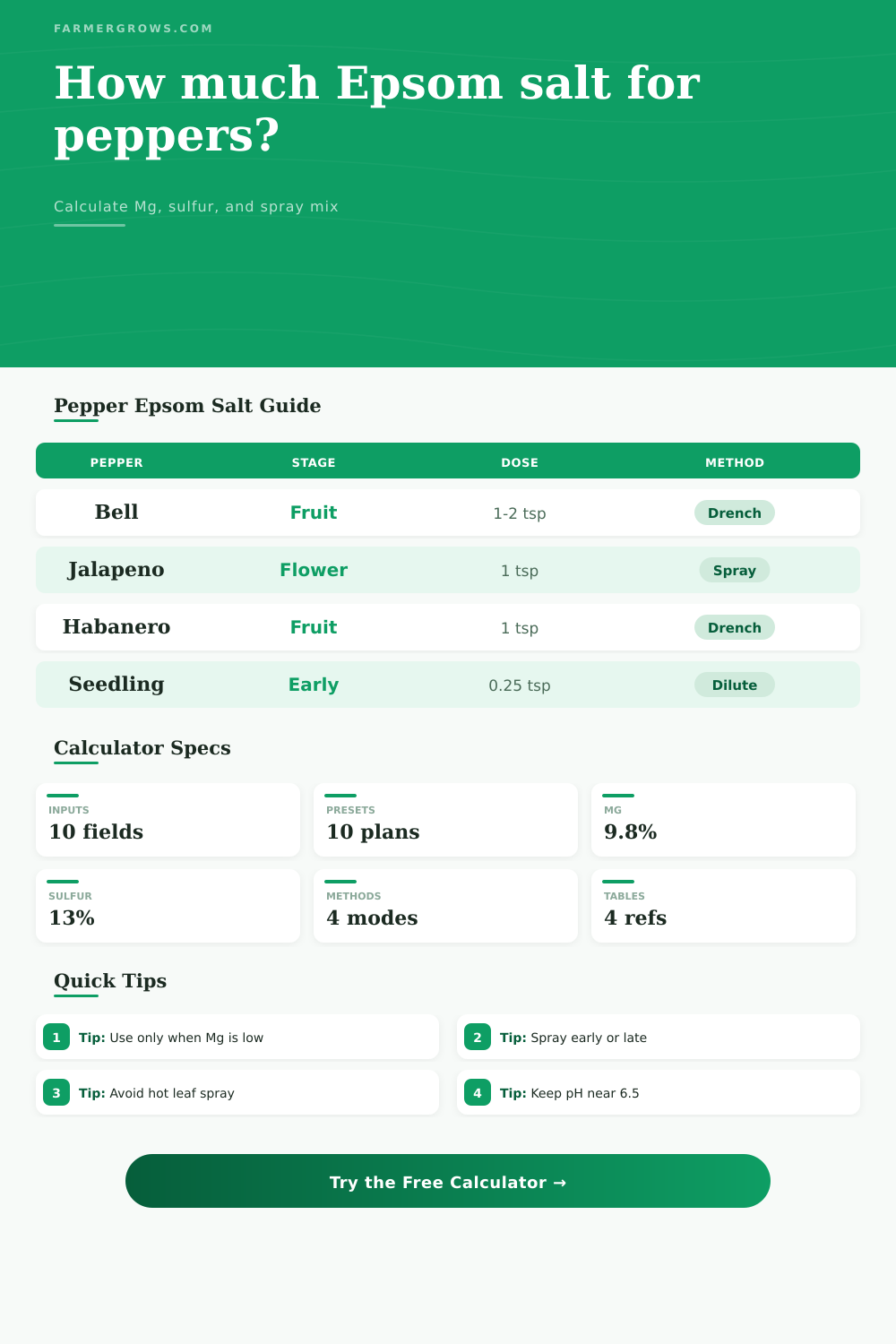
Epsom Salt For Pepper Plants Calculator
Estimate a pepper-specific Epsom salt rate from plant count, bed or container area, growth stage, visible magnesium deficiency, soil Mg, pH, application method, spray volume, and heat stress.
Epsom salt is magnesium sulfate, commonly about 9.8% magnesium and 13% sulfur by weight. Use this tool as a planning calculator, then follow a soil test or local extension recommendation when one is available.
Recommended Pepper Epsom Salt Plan
Calculated from the current pepper, soil, stage, method, and heat settings.
Highest baseline because large fruit load and steady growth can pull more Mg during fruit sizing.
Moderate rate. Foliar sprays are useful when fast correction is needed before heavy bloom.
Usually needs a lighter dose than bells unless soil Mg is clearly low.
Use careful container rates; plants are productive but often grown in smaller root zones.
Keep concentrations conservative, especially under heat or high EC conditions.
| Soil reading | Typical meaning | Calculator action | Pepper note |
|---|---|---|---|
| Below 50 ppm Mg | Low reserve in many garden soils | Raises suggested dose | Confirm calcium and potassium balance too. |
| 50-100 ppm Mg | Borderline to moderate | Uses normal to light correction | Often enough for mild symptom response. |
| Above 100 ppm Mg | Usually adequate for beds | Reduces suggested dose | Look for pH, water, or root stress causes. |
| pH 6.0-6.8 | Preferred pepper range | No pH penalty | Mg uptake is generally more predictable. |
| pH below 5.8 | Acid stress possible | Adds caution note | Lime may matter more than Epsom salt. |
| pH above 7.2 | Alkaline tie-up possible | Adds caution note | Foliar correction may work faster than soil. |
| Method | Common rate range | Best timing | Use when |
|---|---|---|---|
| Soil drench | 1-2 tsp per plant | Moist soil, morning | Low soil Mg or root-zone correction. |
| Foliar spray | 1 tsp to 1 tbsp per gal | Cool evening or early morning | Fast symptom response is needed. |
| Dry side-dress | 1-2 tsp per plant | Before irrigation | Bed soil is moist and plants are established. |
| Transplant water | 0.25-0.75 tsp per plant | At planting | Seedlings need a very gentle Mg start. |
| Stage | Relative Mg demand | Suggested approach | Caution |
|---|---|---|---|
| Seedling | Low | Very dilute only | Young roots burn easily. |
| Transplant | Low to medium | Light drench after watering | Avoid salty dry planting holes. |
| Vegetative | Medium | Correct only if symptoms appear | Too much Mg can crowd calcium. |
| Flowering | Medium to high | Normal calculator rate | Spray outside hot sun. |
| Fruiting | High | Normal to slightly higher rate | Do not repeat without checking response. |
| Observed pattern | Likely severity | Calculator setting | Before repeating |
|---|---|---|---|
| No symptoms, good growth | None | Preventive only | Skip if soil Mg is adequate. |
| Lower leaves pale between veins | Mild | Mild yellowing | Check water consistency. |
| Clear interveinal yellowing | Moderate | Moderate chlorosis | Watch new growth for improvement. |
| Necrotic spots or curled leaves | Severe or mixed issue | Severe, no burn | Rule out mites, salts, and pH first. |
Use soil-test context: Epsom salt supplies magnesium and sulfur, but it does not supply nitrogen, phosphorus, potassium, calcium, or boron. Yellow pepper leaves can come from several causes, so avoid repeating strong applications without checking the whole fertility picture.
Protect hot leaves: When peppers are wilted, drought-stressed, or above 90°F, use the heat stress setting and spray only in cool light. For containers, water first and apply diluted solution to an already moist root zone.
You see advice online about dumping some Epsom salt on those peppers that has been looking pale or growing too slowly. But magnesium isnt a magic bullet. It’s just one nutrient that do help activate enzymes and make chlorophyll.
That doesn’t mean the plant lacks it, and slathering on more won’t cause the peppers to fruit sooner. Excess can throw off the balance between other nutrients like potassium and calcium in the soil which will be bad news.
Use a Calculator for the Right Amount
We’re aiming toward precision, away from guesswork. You need to know if your soil needs it, where your peppers are in their growth cycle, and how much to use without overdoing it and burning the leaves and roots.
So what do you use? The calculator at that link bring together a number of factors most recreational growers overlook. It considers not just your weather, but your soil’s existing magnesium content and pH of your soil, because certain nutrients interact different than in an acidic or alkaline medium. It even looks at the kind of pepper you’re growing, since heavier fruiting types such as bells requires more than thin-skinned ones.
You input what applies to your situation; it calculates the right amount to add safely and effectively. And you avoid overdoing it, which is a common mistake and just as harmful as underdoing it. The right output requires understanding the right input.
Seedlings, for instance, have very little root system so they will scorch from exposure to strong concentrations. Set your growth stage to match as the base line. Set it to full fruiting mode, and things change: Those bigger plants need, and can take… More support (and a gentler beginning). That’s all taken into account in the dose adjustment.
The other thing it considers is heat stress. If the weather is hot when you spray, you want to lower the concentration to avoid leaf scorch. The tool knows this and automatically scales back the recommended rate if you tell it the temperature are high. Little details like that make a big difference for health of the plants.
In effect, you’re asking it to create an application plan that’s careful, not a blanket treatment. Numbers without context make no sense. So there’s also a series of reference tables offered with the calculator that help put those numbers in perspective. How do you interpret your soil test results? What does that mean in terms of what to do next?
For example, the calculator will tell you that adding more magnesia won’t help if your soil pH is already less than 5.8 (because uptake then becomes impossible, even with added magnesium). It points that out, and might advise correcting the pH instead. That’s important: You can’t force-feed a nutrient where the chemistry of the root-zone environment make it lock out. You want to correct the underlying cause, not mask it with something else.
Likewise, the reference tables explain when a soil drench versus a foliar spray would be best. A spray goes up into the leaves and works quickly, but risks burning if used incorrectly; a drench take longer, but is safer over time to correct things. Figure out which one makes sense for you.
People make common mistakes because they treat symptoms instead of causes. That means when leaves turn yellow, for instance, you think “Magnesium!”, even though it may be because plants aren’t getting enough nitrogen, or water, or because there’s inadequate drainage. Spraying on some magnesium won’t help a plant that is starved for nitrogen; it may even slow its certain decline without fixing the real problem. Why spend the money and time in vain?
Soil testing is so useful for just that reason. Knowing at least roughly how much magnesium is (or isn’t) in your soil can also save you from wasting efforts. You can plug in your test results if you’ve done one, or choose something close from the way things are looking. So it adapts itself to suit your situation.
All this means is that gardening is full of trade-offs: How do you help your plants thrive while maintaining the fine balance of their world? In addition to all other factors, magnesium is an important player in photosynthesis, and having it at the proper level contributes to general plant vigor. Having too much magnesium, though, can prevent calcium from being taken up, causing problems such as blossom end rot.
The calculator enables you to achieve that sweet spot. It eliminates the noise of contradictory advice; it gives you a reasoned answer that’s custom-made for you and the circumstances under which you garden. You do not need to remember the conversions and coefficients. Just enter the variables and let the math do its thing.
FIRST, ask yourself about both your soil and your plants: What do they really want? Before whipping out that supplement, ask yourself that question. Next, check the device to learn just how much to add.
That’s a measured approach to an otherwise routine chore, one that transforms the process from a hope-to-get-a-harvest tactic into a plan-for-it strategy. When you plan, it isn’t magic (or a mysterious powder) that makes your peppers flourish. But rather meeting them where they’re at. That’s the difference between planning for a harvest and hoping for one.
You should of used the calculator more often to avoid these errors. Actually, making sure your plants recieved enough nutrients is naturaly easy with this tool. It feels much more comfortabley than guessing based off old advice.