⚡ Electric Fence Joule Calculator
Find the right energizer size for your fence — enter wire length, animal type & vegetation level for instant results
| Stored Joules | Output Joules (~60%) | Max Wire (miles) | Max Wire (km) | Best For |
|---|---|---|---|---|
| 0.25 J | ~0.15 J | 0.25 mi | 0.4 km | Garden / poultry pens |
| 0.5 J | ~0.30 J | 0.5 mi | 0.8 km | Small pet / dog fence |
| 1 J | ~0.60 J | 1 mi | 1.6 km | Small cattle / sheep |
| 2 J | ~1.20 J | 2 mi | 3.2 km | Medium cattle / horses |
| 3 J | ~1.80 J | 3 mi | 4.8 km | Large pasture / deer |
| 5 J | ~3.00 J | 5 mi | 8.0 km | Large ranch / bear |
| 7 J | ~4.20 J | 7 mi | 11.3 km | Very large properties |
| 10 J | ~6.00 J | 10 mi | 16.1 km | Commercial / industrial |
| 15 J | ~9.00 J | 15 mi | 24.1 km | Extra-large operations |
| Animal Type | Min. Voltage (V) | Recommended (V) | Shock Sensitivity |
|---|---|---|---|
| Poultry / Rabbits | 1,500 V | 2,000 V | Very high |
| Dogs / Pets | 1,500 V | 2,000–3,000 V | High |
| Sheep & Goats | 2,000 V | 3,000–4,000 V | High (thick wool) |
| Cattle | 2,000 V | 3,000–4,500 V | Medium |
| Horses | 2,500 V | 3,000–4,500 V | Medium-high |
| Hogs / Pigs | 2,000 V | 3,500–5,000 V | Low (thick skin) |
| Deer | 3,000 V | 4,000–6,000 V | Medium |
| Bears | 4,000 V | 5,000–8,000 V | Very low (thick fur) |
| Vegetation Level | Description | Joule Multiplier | Notes |
|---|---|---|---|
| None | Clean wire, no ground contact | × 1.0 | Ideal conditions |
| Light | Occasional grass / weeds | × 1.5 | Common in summer |
| Moderate | Regular brush contact | × 2.0 | Reduce effectiveness by 50% |
| Heavy | Dense vegetation, wet grass | × 3.0 | Severely drains energy |
| Power Source | Output Efficiency | Best Use Case | Maintenance |
|---|---|---|---|
| Mains (AC) | Highest (90–95%) | Permanent, near buildings | Very low |
| Battery (12V) | Medium (70–85%) | Remote, temporary fences | Check monthly |
| Solar | Medium (65–80%) | Off-grid, sunny regions | Clean panels regularly |
Electric fences works by delivering a short pulse of energy to the animal that is stepping on the fence. The amount of energy measured in joules determine how effective the electric fence will be. If an electric fence has too few joules, then it wont be able to provide a shock to an animal that is crossing the fence.
However, if an electric fence has too many joules, it will cost the owner more money than necessary to purchase such an energizer for the electric fence. The amount of joules that the electric fence need is dependent on a few different variables. The first of the variables are the length of the electric fence.
How much energy does an electric fence need
The length must be measured in relation to the number of strands of wire the electric fence will have. For instance, if the electric fence is one mile in length and has two strands of wire, it will have two miles of electric fence line. The more electric fence line, the most energy it will require.
The type of vegetation surrounding the fence will also play a role in the amount of energy the electric fence will require. Vegetation will often touch the electric fence wires, creating a short circuit for the electric fence. As a result, the vegetation will drain the energy of the electric fence before it can reach the animals.
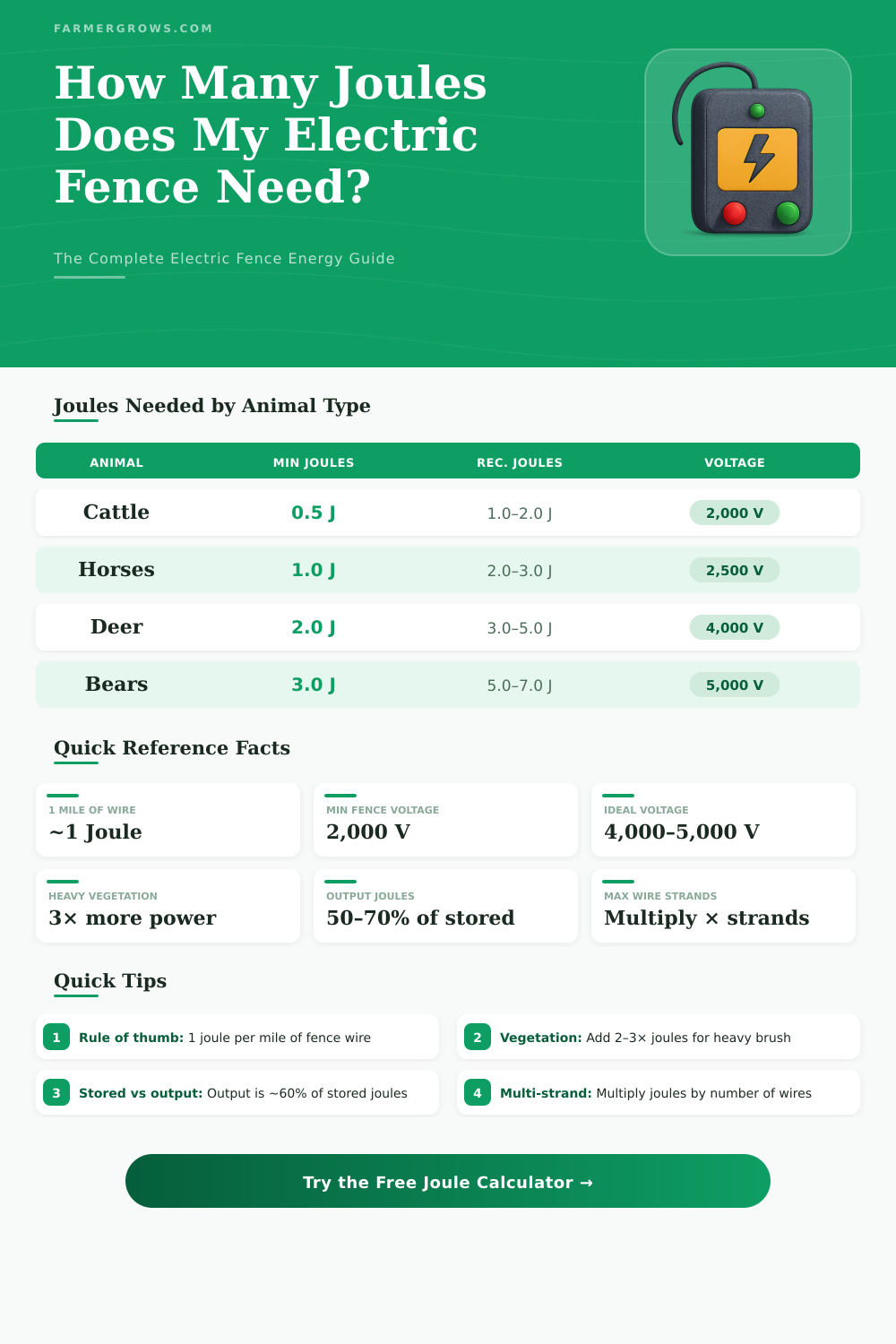
Another variable to consider is the type of animal that will be contained within the fence. Animals such as cattle may require a certain number of joules to respect the electric fence. However, horses may require more joules then cattle will require.
Predators such as deer and bears may require even more voltage than cattle because the predators has thicker fur cover to keep them from recieveing the shock from the electric fence. Soil will also impact the electric fence. Soils that are moist will allow the electrical pulse from the fence to reach the energizer.
However, dry soil will conduct the electricity poor and create the same effect as if the electric fence was not energized. The electric fence energizer will have to work harder to send the electrical current through dry soil. Another factor that may impact the energy of the electric fence is the power source for the energizer.
Electric fence energizers that are mains powered will be more efficient than those that are run on batteries or solar power. Batteries will fail in remote areas where there is no power, and solar panels will not produce power on days that are cloudy or there is no sunlight. If the voltage drops to below 2,000 volts, many animals will ignore the electric fence.
Another factor that you should consider is the grounding system. The grounding system will allow the electrical pulse from the fence to return to the electric fence energizer. A sufficient amount of grounding rods should be installed for every joule of energy the electric fence energizer can produce.
If there is insufficient grounding rod, the electric fence will not function proper. The electric fence should also be maintained by regularly trimming the vegetation. If vegetation isnt trimmed, the vegetation will drain the energy of the electric fence.
Another maintenance task is to ensure that the voltage of the electric fence is high enough to provide a shock to the animal. A digital voltmeter will measure the voltage of the electric fence. The voltage should be higher than the minimum required for the different types of animals.
If the voltage is too low, the animals will learn to ignore the electric fence. By calculating the amount of joules that an electric fence will require and by maintaining its grounding system and voltage, it will keep animals within the boundary fence design for them.