🌞 Greenhouse Shade Cloth Calculator
Estimate shade cloth area, panel count, and PAR reduction for greenhouse roofs, benches, tunnels, and summer crop protection.
Pick a real greenhouse scenario to seed the fields. Each preset sets the unit system, structure, installation mode, cloth rating, dimensions, roll width, and target PAR.
Shade cloth results
Select a preset or enter values to calculate cloth area, panel count, and PAR reduction.
Black cloth
- Best direct PAR block
- Simple 30-80% ratings
- Good for summer roofs
Aluminized cloth
- Reflects more heat
- Softens hot spots
- Strong in desert sun
White cloth
- Brighter under cloth
- Useful for propagation
- Less harsh glare
Retractable cloth
- Flexible seasonal control
- Useful for variable crops
- Easy to stage light levels
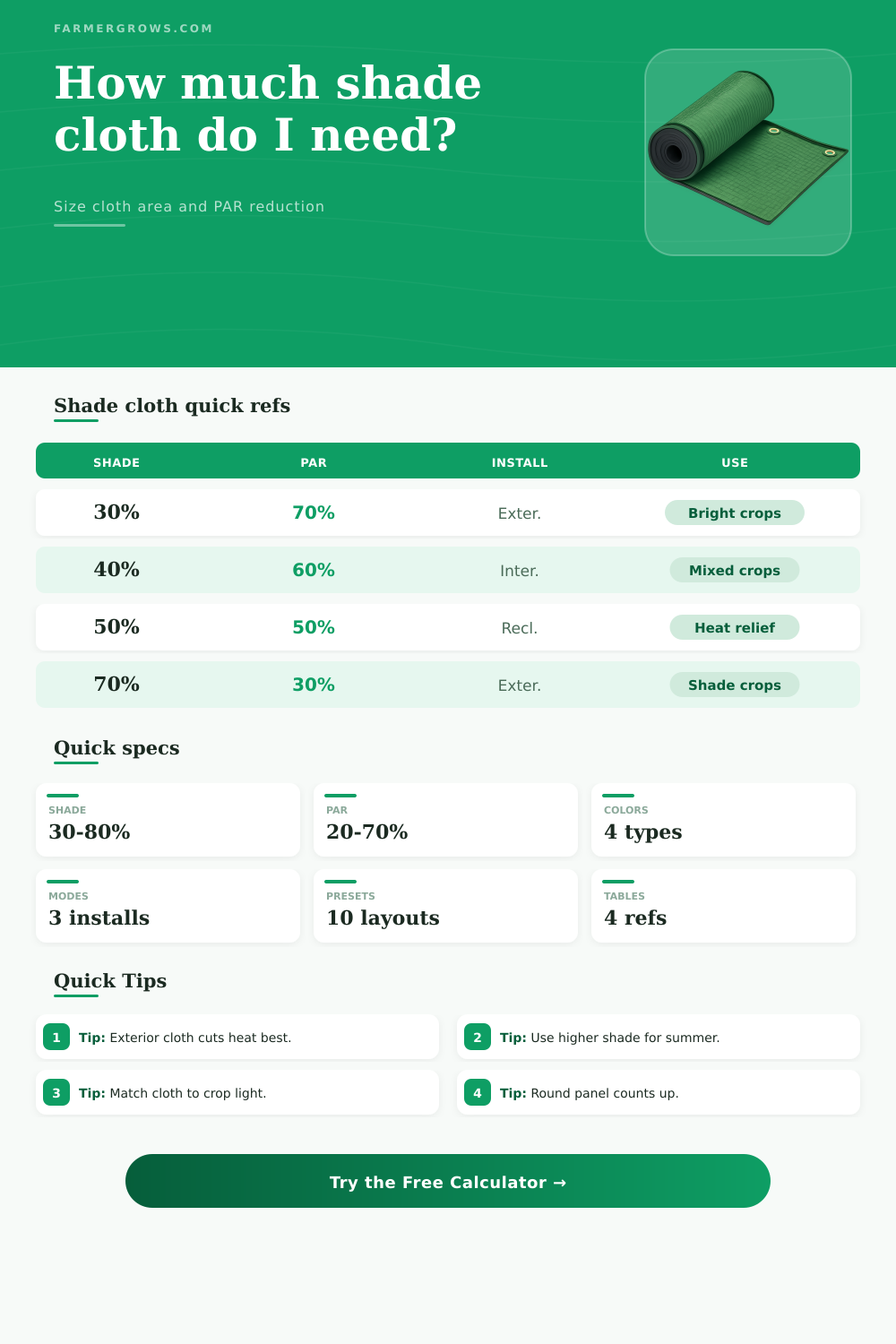
| Shade | PAR left | PAR cut | Crop use |
|---|---|---|---|
| 30% | 70% | 25-35% | Bright crops |
| 40% | 60% | 35-45% | Mixed crops |
| 50% | 50% | 45-55% | Heat relief |
| 60% | 40% | 55-65% | Propagation |
| 70% | 30% | 65-75% | Shade lovers |
| 80% | 20% | 75-85% | Extreme heat |
| Color | Light feel | Heat feel | Best use |
|---|---|---|---|
| Black | Clean block | Warm | Strong shade |
| Aluminized | Bright diffuse | Cooler | Hot climates |
| White | Soft light | Coolest | Seedlings |
| Green | Balanced | Mid | General use |
| Mode | Shade factor | Cooling effect | Note |
|---|---|---|---|
| Exterior | Highest | Best | Blocks sun first |
| Interior | Medium | Good | Easy to stage |
| Retractable | Variable | Strong | Match crop need |
| Sidewall | Lower | Moderate | Useful on edges |
| Crop | Peak PAR | Shade target | Notes |
|---|---|---|---|
| Seedlings | 300-600 | 40-60% | Gentle start |
| Lettuce | 500-900 | 30-50% | Summer crop |
| Orchids | 200-500 | 50-70% | Bright shade |
| Ferns | 150-400 | 60-80% | Deep shade |
Shade cloth is a tool that can be used in greenhouses to control the amounts of light and heat that enter the greenhouse. Many people uses shade cloth to prevent there plants from experiencing heat stress. Additionally, many people use shade cloth to prevent plants from bolting or droop.
However, shade cloth isnt a simple tool. When using shade cloth, there is two factors to consider: the light requirements of the plants and the greenhouse geometry. The effectiveness of shade cloth also depends on the angle of the sun and the shape of the greenhouse roofs.
How to Use Shade Cloth in a Greenhouse
When using shade cloth, it is important to understand the difference between the shade rating of the shade cloth and the light level in the greenhouse. The manufacturer often provides the shade rating of the shade cloth and measured it in a laboratory. If the shade cloth is placed outside of the greenhouse, it will prevent heat from entering the greenhouse.
However, if the shade cloth is placed inside of the greenhouse, the light will have already passed through the greenhouse and the shade cloth will only filter the light that enter the greenhouse. Therefore, the placement of the shade cloth will have an impact both on the temperature and light level within the greenhouse. Plants require a specific amount of photosynthetically active radiation (PAR) in order to perform the processes of photosynthesis.
PAR is the type of light that plants use in the process of photosynthesis. If there is too much PAR provided to the plants, the plants may experience tip burn and overall stressful. However, if there is too little PAR provided to the plants, the plants may experience leggy stem.
Using shade cloth is one way to control the amount of PAR that the plants are exposed to in order to ensure that they are productive and not experiencing heat stress. The color of the shade cloth can also impact how the shade cloth control the light and heat that enters the greenhouse. Black shade cloth is often used in shade cloth covering.
Black shade cloth will block light from entering the greenhouse. Additionally, aluminized shade cloth reflect infrared radiation back into the atmosphere. This type of shade cloth is used in hot climate as it keeps the air under the shade cloths length cooler.
White shade cloth will diffuse the light that enters the greenhouse. Shade cloth of this color is often used for seedlings as it will prevent the young plants from experiencing bleaching of there young leaves. The geometry of the greenhouse will have an impact on the amount of shade cloth that are purchased for that greenhouse.
Greenhouses that have curved roofs will require more shade cloth than greenhouses that have flat roof. The footprint of the greenhouse alone will not determine the amount of shade cloth that is required. The arc of the curved roof will increase the area of the greenhouse that need to be covered in shade cloth.
The roof factor is used to calculate the area of the roof of the greenhouse and the amount of shade cloth that is required to cover the greenhouse roof complete. Shade cloth can be installed in a variety of ways into the greenhouse structure. The shade cloth can be installed lengthwise along the greenhouse or installed crosswise.
Regardless of the way that the shade cloth is installed in the greenhouse, there will need to be an overlap at the seam of the shade cloth. Shade cloth will be purchased in roll of a certain width. However, due to the need to prevent light from entering the greenhouse through the seams of the shade cloth, there will be overlap between the end of the shade cloth.
Therefore, the usable width of the shade cloth will be less than the width of the shade cloth roll label. Retractable shade cloth systems allow for more control of the light that enters the greenhouse. Shade cloth systems that are retractable allow the user to move the shade cloth to allow more light to enter the greenhouse during cloudy days.
These systems are more complex to install than fixed shade cloth systems. However, the retractable shade cloth systems will ensure that the crops are not exposed to under-lighting during periods of low sunlight exposure. Regardless of the type of shade cloth system that are selected for the greenhouse, the purpose is to manage the energy budget of the greenhouse with respect to light and heat.