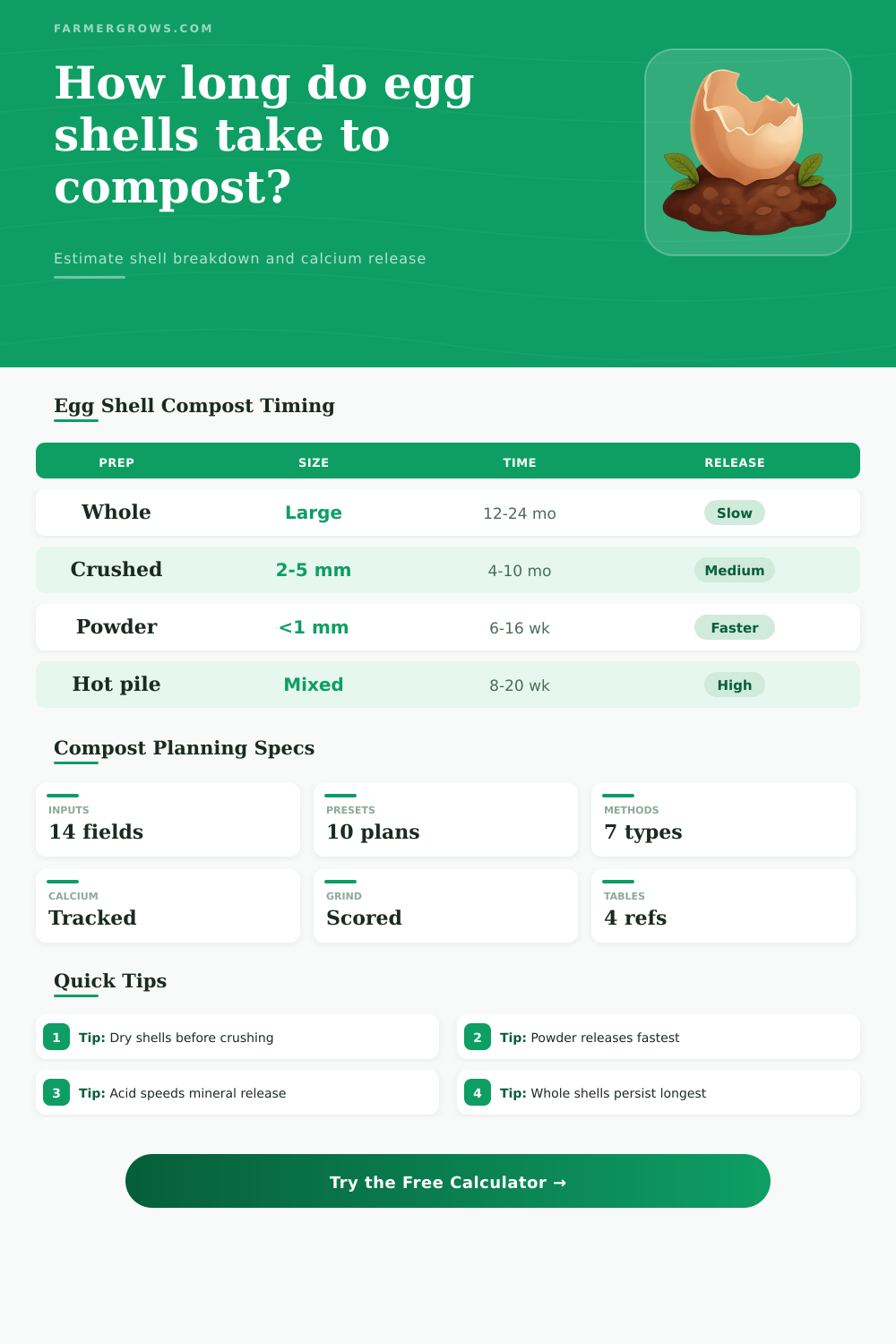
Egg Shell Composting Time Calculator
Estimate how long egg shells will remain visible in compost, when their calcium carbonate starts becoming useful to soil, and how grinding, heat, acidity, moisture, and turning change the timeline.
Egg shells are mostly calcium carbonate, so they do not disappear like vegetable scraps. This planner treats shell pieces as a mineral amendment: smaller particles, active compost, mild acidity, steady moisture, and frequent turning all increase contact area and speed useful release.
Egg Shell Composting Estimate
Use this as a planning window. Shell minerals can keep reacting in soil after the visible composting stage is complete.
| Shell form | Typical size | Visible in compost | Calcium release |
|---|---|---|---|
| Whole halves | 25 to 50 mm | 12 to 24 months | Very slow, mostly soil reserve |
| Coarse chips | 10 to 25 mm | 8 to 18 months | Slow, improved by turning |
| Crushed pieces | 2 to 5 mm | 4 to 10 months | Moderate after active composting |
| Fine grit | 1 to 2 mm | 10 to 24 weeks | Better soil contact after curing |
| Powder | Under 1 mm | 6 to 16 weeks | Fastest useful mineral contact |
| Method | Best shell form | Mixing rhythm | Expected behavior |
|---|---|---|---|
| Hot active pile | Crushed or powder | Every 3 to 7 days | Fastest organic decay and good mineral contact |
| Warm mixed bin | Crushed pieces | Every 7 to 14 days | Reliable seasonal breakdown for kitchen shells |
| Cold backyard bin | Fine grit preferred | Every 14 to 30 days | Shell pieces often survive one compost cycle |
| Worm bin | Fine grit only | Light top mixing | Useful as grit, but avoid heavy dusty doses |
| Leaf mold heap | Powder or fine grit | Rare turning | Slow mineral aging in a fungal, low-nitrogen mix |
| Shell batch | Dry weight | CaCO3 estimate | Good compost volume |
|---|---|---|---|
| 12 egg shells | 2.3 oz / 66 g | 2.2 oz / 63 g | 4 to 8 cu ft |
| 36 egg shells | 7.0 oz / 198 g | 6.6 oz / 188 g | 12 to 27 cu ft |
| 100 egg shells | 19.4 oz / 550 g | 18.4 oz / 523 g | 27 to 64 cu ft |
| 1 lb dry shells | 16 oz / 454 g | 15.2 oz / 431 g | 27 to 54 cu ft |
| 1 kg dry shells | 35.3 oz / 1000 g | 33.5 oz / 950 g | 60 to 120 cu ft |
| Use goal | Preferred shell form | Minimum curing cue | Screening advice |
|---|---|---|---|
| Finished compost | Crushed or fine grit | Compost smells earthy | Screen if pieces are larger than rice |
| Garden topdress | Crushed pieces | Material is stable and cool | Visible pieces are acceptable |
| Potting mix | Powder only | Fully cured compost | Screen carefully for roots and seedlings |
| Worm castings | Fine grit | Small steady additions | Avoid sharp large chips |
| Long soil reserve | Crushed or coarse | Any mature compost | No need to remove small pieces |
For faster mineral release: Dry the shells, crush them very fine, and mix them through moist active compost instead of leaving a thick white layer.
For clean compost handling: Rinse or heat-dry shells before storing, especially if you collect them for several weeks before adding them to the pile.
For potting mixes: Treat eggshells as a slow amendment, not an instant calcium fix. Use only powder and fully cured compost for containers.
For alkaline soils: Use smaller shell amounts and avoid relying on eggshell compost when a soil test already shows high pH or excess calcium.
Gardening articles tell you to save eggshells which contain free calcium. Crush them after drying and turn them into your compost bin. When compost is screened off as finished, those shells are often still intact but jagged shards. Why? Because calcium carbonate a mineral doesn’t rot down like starch or sugar. Chemistry and surface area comes into play here; that’s why the shell stays depending on conditions.
Treat eggshells as soil amendments instead of food scraps; changing how you think about them will change how you prepare them and when you use them to get results.
How to Use Eggshells in Compost
How long will they break down? That also depends on particle size. For example, if you have a large piece of a shell there is not much surface area exposed for the acids and other moisture to work on. You could of left it in your cold composting bin for two years before it dissolves. Pieces the size of rice might take 10 months. Ground into powder in coffee grinder? Weeks.
On the page is an online calculator to help you figure out time frame given your compost conditions and prep methods. It links the size of the ground shells to the compost biology. In hot, active compost (as opposed to a dry heap of leaf mold), naturaly acidic fruits are present that will dissolve calcium carbonate more quickest than in other conditions. This link between acid levels and shell size is factored into the calculator as well. What it tells you is when the shells go away and when the calcium becomes plant-available.
How to prepare the shells depend on what type of composting system you have: Fine grit is best for worm bin (shell particles help the worms grind up their food in their gizzards). Large shards can be harmful to worms. Static compost bins (and even better, standard backyard tumblers) are more tolerant, but then whole shells aren’t very efficient; they form air pockets and don’t mix well with microbes that break down kitchen scraps. The point here is less mineral release to the soil than mechanical aid to the worms. See chart below for how different methods needs different-sized particles. Match your compost system to the amendment it needs.
The topic of pH comes up frequently with regard to eggshells. Yes, eggshells are alkaline but they are also a slow buffer; they won’t shock the soil in the way that garden lime will. They are safe for gradually improving things, but they are not very helpful for emergency corrections. (If you’re looking for quick calcium, compost made off eggshells isn’t the tool.) Over months or years, it does its quiet work to stabilize pH and deliver a dose of trace minerals.
How much use does your setup get out of the eggshells? That’s the mineral readiness score: a high number indicate the pile is already actively releasing calcium. A low number says let it go longer or grind finer then the next time around.
Eggshell-saving is as much about patience as it is about chemistry: You’re banking on time to do what your hands can’t so easily accomplish. Don’t count on instant dissapearance. Count on slow integration. The shards are six months old. Not a failure; they just want more time (and more of both acid and moisture). Want faster results? Make the pieces finer. Got the space to let them wait? Wait some more.
In either case, you’ve closed the loop that began in the kitchen and ends up in your garden bed, converting something wasted into something structural slowy.