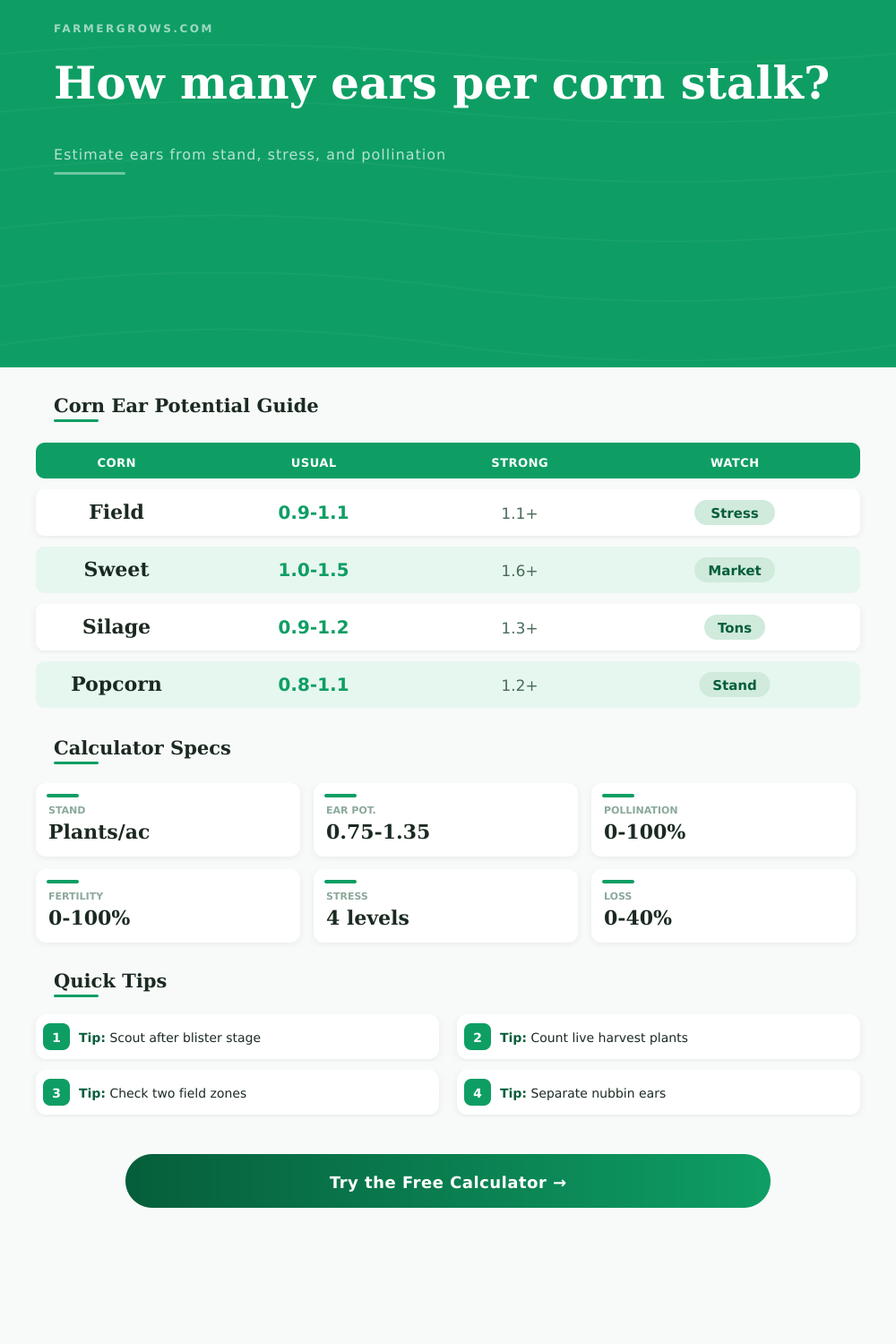
Ears of Corn per Stalk Calculator
Estimate harvestable ears per corn stalk from corn type, stand population, variety ear potential, pollination, fertility, water stress, heat stress, spacing uniformity, lodging or disease loss, and harvest goal.
Choose a common scouting situation, then adjust the stand count, ear potential, stress scores, spacing, field loss, and harvest goal to match the crop you are checking.
Corn Ear Estimate
Results update from your stand, stress, and harvest goal settings.
Modern grain hybrids are commonly managed around one primary harvestable ear per plant, with flex response in lower populations.
Sweet corn can set more than one ear, but marketable count depends on ear size, tip fill, and fresh-market standards.
Silage fields may count ears per stalk, but tonnage and starch contribution often matter more than ear number alone.
Popcorn is usually counted conservatively because uniform stand, ear size, and moisture at harvest drive usable yield.
| Corn type | Typical ears per stalk | Strong-season range | Count carefully when |
|---|---|---|---|
| Field corn grain | 0.90 to 1.05 harvestable ears | 1.05 to 1.15 where flex ears hold | Population is high, drought hits silking, or barren plants appear. |
| Sweet corn | 1.00 to 1.45 marketable ears | 1.50 or more in vigorous fresh-market patches | Second ears are small, poorly tipped, worm-damaged, or below market size. |
| Silage corn | 0.95 to 1.15 ears contributing starch | 1.20 or more in moderate stands | Ear number is good but grain fill is shallow or plants are chopped early. |
| Popcorn | 0.85 to 1.05 usable ears | 1.10 to 1.20 in uniform stands | Late disease, lodging, or uneven maturity raises sorting loss. |
| Seed corn female rows | 0.80 to 1.10 usable seed ears | 1.15 with strong female rows | Detasseling, nick timing, isolation, or seed quality standards remove ears. |
| Stress factor | Light concern | Moderate concern | Severe concern |
|---|---|---|---|
| Pollination | Score 80 to 90, minor tip blanking | Score 60 to 79, scattered skips | Below 60, blank ears or severe silk delay |
| Water stress | Short leaf rolling before recovery | Rolling through tassel or early fill | Firing, aborted ears, or poor kernel depth |
| Heat stress | Brief hot afternoons | Repeated hot days during silk | Hot, dry pollination with warm nights |
| Fertility | Slight nitrogen or potassium pressure | Visible deficiency or root restriction | Major nutrient shortage, low pH, compaction |
| Spacing | Minor skips or doubles | Uneven emergence and crowding | Patchy stand with barren competitive plants |
| Field check | How to sample | What to count | Calculator input affected |
|---|---|---|---|
| Stand population | Count live plants in several row lengths | Plants likely to remain to harvest | Harvest plant population |
| Ear set | Pull representative stalks after blister | Primary ears, second ears, barren plants | Variety ear potential |
| Kernel set | Check ear tips and skipped kernels | Blank tips, missing rows, zipper ears | Pollination score |
| Field loss | Walk lodged, diseased, and edge zones separately | Unharvestable plants or rejected ears | Disease and lodging loss |
| Harvest goal | Best use | Ear counting standard | Common adjustment |
|---|---|---|---|
| Grain yield estimate | Field corn yield scouting | Count ears that can contribute meaningful grain | Small nubbins are discounted |
| Marketable fresh ears | Sweet corn picking and sales planning | Count ears that meet size and quality standards | More strict on tip fill and damage |
| Silage ear contribution | Silage starch and chopping decisions | Count ears but read with plant biomass | Less strict on fresh appearance |
| Seed ear count | Female-row seed production | Count ears meeting seed quality standards | More strict on nick and quality |
| Scouting diagnosis | Explaining field variability | Count primary, second, and barren plants by zone | Keep zones separate |
Scouting tip: Run the calculator separately for the best area, average area, and stressed area when a field has visible soil, slope, irrigation, or emergence differences.
Counting tip: For grain, separate tiny nubbin ears from normal ears before entering ear potential so a few weak second ears do not overstate yield prospects.
Blistering is the growth-stage that are critical to estimating corn yields. Think of it as a financial check in which you is trying to manage the hidden cost (heat and stress) to maximize return.
The first part of assessment is counting the number of plants, though knowing the number of plant doesn’t tell you whether they’ll result in a successful harvest. That requires understanding what percentage of the plants will makes an ear large enough to meet your yield goal. The transition from live stalks to harvestable ears is where the yield math take place. Once you set the type of corn, the calculator make things easy.
How to Estimate Corn Yields
Genetically speaking, moddern field corn is grown so that each plant grows only one main ear. That doesn’t mean that’s what will happen; some years it won’t. In sweet corn, the genes may be setup to grow two, though market standards generaly penalize you for picking a small second ear instead. Do you consider a small ear wasted energy from the plant or part of your yield? Your choice of harvest goal change the bottom line equation. When you pick grain, toss out the little nubbins; when picking fresh market corn, maybe every ear above a minimum size (even if tips aren’t filled).
This is a point where many farmer go wrong. They count all the ears they see, but fail to weed out for quality and end up with fewer bushels in their bag than would of been expected.
The biggest factor here are pollination. Even if moisture and soil conditions is perfect, without pollination the ears won’t fill. And the calculator let you score this pollination window honestly. If the pollen from the tassel was shed before the silks has emerged, who cares? They never got their chance. High heat makes this issue worse. Pollen has a short shelf-life and doesn’t like heat much either. If a hot dry day coincides with pollination, some fields may be left with blank ends. This loss shouldn’t be discovered at harvest time; it’s best estimated now while ears is still being formed.
Kernel depth and ear size depend on fertility and water stress. Potassium deficiency tend to cause weak stalks that tip and tumble later in the growing season. A nitrogen deficiency will stunts growth and also cause poor pollination. Those plants might have perfectly filled ears, but they can’t be harvested. So even though they may be full, a lodged plant can’t be harvested. That’s why there’s a field loss percentage built into calculator. You have to take them out of the equation before figuring ears per acre. Wind or root rot takes down ten percent of your field? Subtract them from the population and go from there.
Uneven spacing leads to lower yield potential based off of how they grow. A plant’s competition with its neighbors is also strong (especially in corn). When plants bunch up, they’ll shade each other, and one of them will often abort an ear just to make it. To take this into account, the tool wants a score for how spaced out they are from one another. An eighty-eight-percent score means there are some small gaps but overall they have a decent stand; anything less than eighty-percent, though, means there’s some competition and thus fewer ears on the bush. Uneven emergence can’t be fixed once it occurs, but using this season’s information will allow you to tweak planter settings next year.
What’s an ear? How many ears does a plant have? How do we know? We balance reality and expectation in our head. Genetics determines the maximum yield. Weather, nutrients and pests sets the minimum. In practice, you go out and scout the field after the blister stage, identifying aborted ears as well as the primary ears. Pull some stalks and look at the kernel set, missing rows or blank tips are telltale signs. That visual information becomes what goes into the pollination score. A general concern becomes a specific number. From there, you’ll have the final result: your harvestable ear count, which you can then multiply by the population and average weight to arrive at a true yield estimate. It is not a perfect system, but it is better than guessing.