Ears Of Corn Per Plant Calculator
Estimate ears per corn plant, total marketable ears, dozens, harvest weight, row stand, and the plant count needed for a sweet corn, popcorn, field corn, or baby corn target.
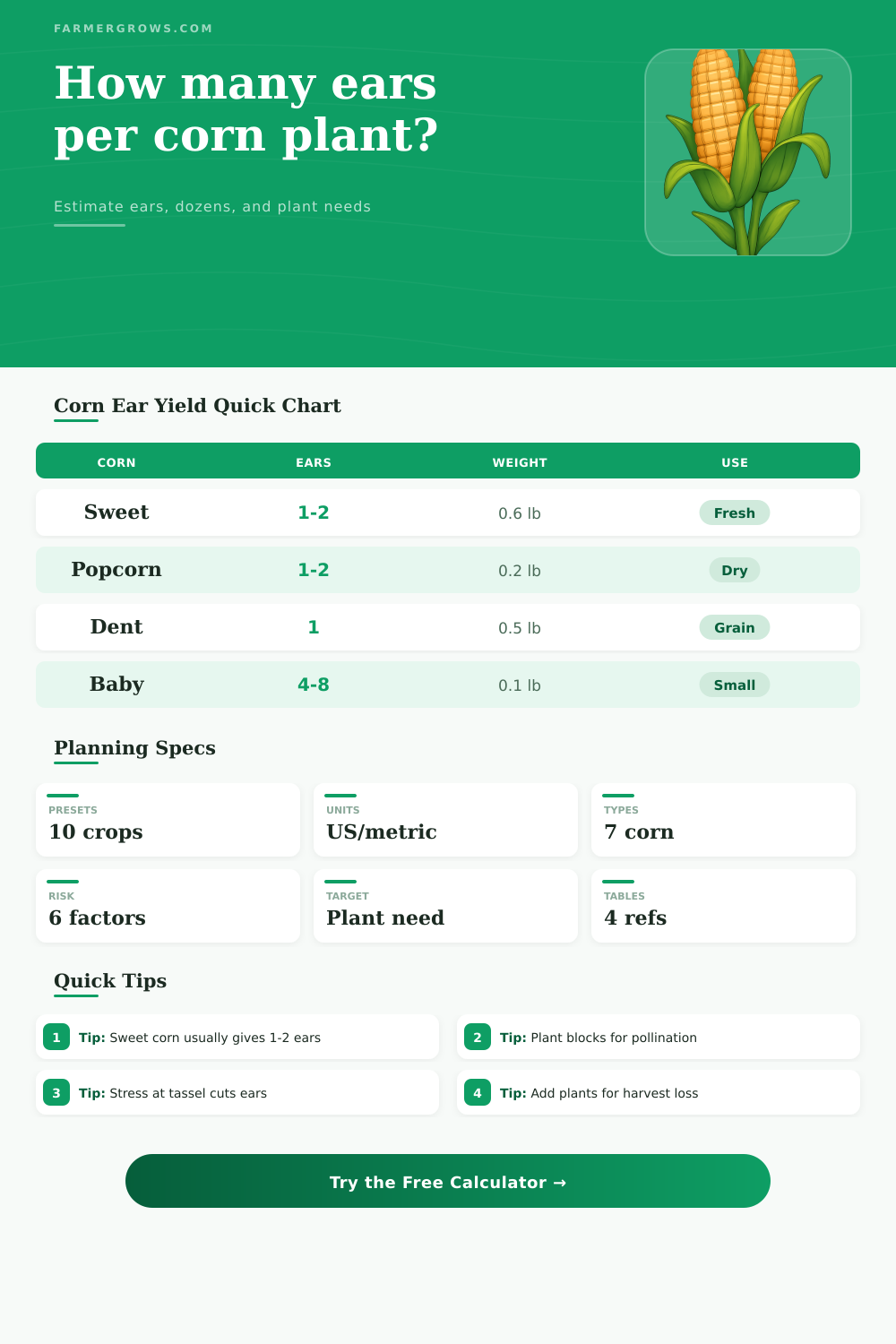
Corn usually makes one strong main ear per plant, with some varieties and low-stress spacing adding a smaller second ear. This calculator starts with a realistic ear-per-plant model, then adjusts for plant stand, spacing, pollination, fertility, water stress, and harvest losses.
Your Corn Ear Estimate
Adjust the inputs and calculate to estimate corn ears per plant.
| Corn type | Typical ears per plant | Average ear weight | Planning note |
|---|---|---|---|
| Standard sweet corn | 1.0 to 1.25 | 0.55 to 0.75 lb fresh | Best planned around one full ear plus occasional smaller second ears. |
| Supersweet or synergistic sweet corn | 0.95 to 1.2 | 0.55 to 0.7 lb fresh | Strong fresh eating quality; isolation and even maturity can matter. |
| Early sweet corn | 0.85 to 1.05 | 0.45 to 0.6 lb fresh | Short plants and early varieties often make slightly smaller ears. |
| Popcorn | 1.1 to 1.6 | 0.16 to 0.28 lb dry ear | More small ears may form, but final dry kernel yield depends on curing. |
| Dent or field corn | 0.9 to 1.05 | 0.4 to 0.7 lb fresh equivalent | Usually managed for one main grain ear at higher plant populations. |
| Baby corn | 4 to 8 | 0.04 to 0.08 lb fresh | Harvested very young before pollination; multiple picks are normal. |
| In-row spacing | Plant pressure | Ear effect | Best use |
|---|---|---|---|
| 6 to 8 inches | High | More plants, fewer second ears, smaller average ears | Good fertility market blocks where total ear count matters. |
| 9 to 12 inches | Balanced | Reliable main ears with some second-ear potential | Most home sweet corn and small market plantings. |
| 13 to 16 inches | Low | Larger plants and better second-ear chance, lower stand count | Three Sisters, flour corn, or low-input garden patches. |
| 18 inches or more | Very low | Strong individual plants but fewer ears per bed area | Hills, seed saving blocks, or very vigorous varieties. |
| Factor | Strong condition | Weak condition | Yield impact |
|---|---|---|---|
| Pollination block | At least 3 to 4 short rows | One long isolated row | Weak pollen coverage can reduce filled marketable ears. |
| Silk timing | Fresh silk during pollen shed | Silks dry before pollen reaches them | Poor timing gives missing kernels and short ears. |
| Water near tassel | Even moisture | Wilting or heat stress | Stress at tassel can reduce ear size and kernel set. |
| Nitrogen supply | Dark green leaves through fill | Pale lower leaves before tassel | Low nitrogen reduces stalk strength and ear size. |
| Stand uniformity | Even emergence | Late gaps and runts | Late plants are shaded and often make poor ears. |
| Measure | Conversion | Example | Use |
|---|---|---|---|
| Dozen ears | 12 ears | 120 ears = 10 dozen | CSA shares, crates, meals, and freezer batches. |
| Fresh sweet corn weight | 0.45 to 0.75 lb per ear | 100 ears at 0.6 lb = 60 lb | Estimate harvest handling and storage weight. |
| Cooked kernels | About 0.5 to 0.75 cup per ear | 24 ears = about 12 to 18 cups | Freezing, salsa, chowder, and meal planning. |
| Plants per row | Row length divided by spacing | 25 ft at 10 in = about 30 plants | Check whether plant count fits the planned rows. |
Plant in blocks: Four short rows usually pollinate better than one long row because pollen falls across nearby silks instead of blowing past the crop.
Use realistic second ears: Count second ears only when your variety, spacing, and fertility actually produce filled ears worth harvesting.
Protect tassel timing: Water and feed the crop before tasseling; stress during silk and pollen shed is one of the fastest ways to lose ear fill.
Add a buffer: If the target is exact, plant extra corn for skips, pests, lodging, pollination misses, and ears harvested at the wrong stage.
It starts with the number of seed packets, then ends with a stare down of a row that appears to have had a bad year. You planted thirty plants, expected thirty ears, but ended up with twelve good ones and a dozen stunted nubbins. No, you didn’t make the math error. The mistake was in thinking corn grows in isolation. Corn grow in a system that involves wind direction, timing and spacing, and that determines if your investment becomes food or mulch. There is a big difference between hoping to be a gardener and being one who actualy harvests enough to fill a freezer.
That’s where that calculator comes in; it does all the adjusting for real-world variables. It doesn’t spew out a set number of how many ears per plant (as in: “one ear per plant”). Rather, it asks about your fertility status and shape of your pollination block. Why? Since corn is wind-pollinated, a long row tend not to be as well filled-out as a compact square patch, where all your silks are right underneath the tassel of the next plant over. The pollen drops straight down, so if yours aren’t positioned right beneath theirs, you have blanks on the cob.
How to Plan Your Corn Garden
This is not theory, but fact. That’s why your neighbor’s short wide garden grows bigger cobs then yours does with their elegant single-file rows. The second silent corn yield-killer are timing. A smart trick in the tool is that it accounts for stress days surrounding silk and tassel emergence… Measuring one’s weather luck. Three hot dry days at exactly the wrong time (when the plant goes to try to flower) can result in drying out of silks before pollen finds its way to the ears. No pollen = no kernels. You may see some kind of an ear shoot up from the stalk anyhow, but it won’t be long or shapely. The calculator deducts points from your estimate for this, sparing you the work of planning a feast on imaginary produce.
Nature gets veto power over how dense you plan to plant. Your spacing decisions matter a lot as well. Growing closer together means more plants per foot…except that your plants will be competing for light and nitrogen. With wider gaps, you get bigger individual ears and an increased likelihood of second ear forming (see the reference table on the page). A second ear is wonderful IF it fills out; typically only occurs when there’s very little stress on the plant and lots of fertility in the soil. Grow too close together in a lean soil, and you’re going to create more mouths to feed without any additional food to spread around. More isn’t always better; you’ve got to weigh the amount of potential ears versus the quality of each one.
All of this assumes pollinated crops… Yet baby corn, which is picked before it ever pollinates, doesn’t abide by any such rules. That means you are literally picking multiple times per plant, getting only the ear shanks (not actual cobs). The calculator handles this oddball crop type. It knows your yield metric shifts from filled cobs to immature shoots. With more conventional popcorn or sweet types, though, where the goal is kernel fill and eventual cob weight, the emphasis is clearly on mass; not just number of ears. Six heavy ones will feed a family better than a dozen tiny ones, even though the former may have fewer total ears.
What does it look like? Look carefully at the plants required for the dozens that are your goal. Use this chart backward to plan into the future from your CSA share commitments or your freezer space. Do you need twenty dozen ears? If you need twenty dozen ears and the tool says you need four hundred plants, but you only have room for two hundred, you have a problem. Uh-oh. Time to adjust growing conditions to increase per-plant production, or just settle for fewer dozen. You should of planned more space.
In nature, there’s no such thing as a free lunch. An ear takes time, energy, and water to grow, and it needs to be successfully pollinated. It’s all about planning ahead (and saving yourself some heartache later). Figure out those variables beforehand, before you even put seed in the ground, and you’ll never be panicking halfway through summer over whether there will be enough to can from your patch. That kind of planning makes it strategy, not guesswork. You plant intentionally instead of hoping. And when you factor in all the messiness of actually growing corn, the math isn’t complicated at all. Which is what makes all the difference between a full pantry and an empty shelf.