Duck Coop Size Calculator
Plan indoor duck house floor area, outdoor run size, nest boxes, bedding volume, water-station footprint, ventilation, and predator apron dimensions from flock size and breed type.
Choose a breed size preset or enter your own square feet per duck. The calculator adds water-station area to the run because ducks splash most around drinking and wash water.
Duck coop size results
Enter your flock size to calculate the recommended house and run.
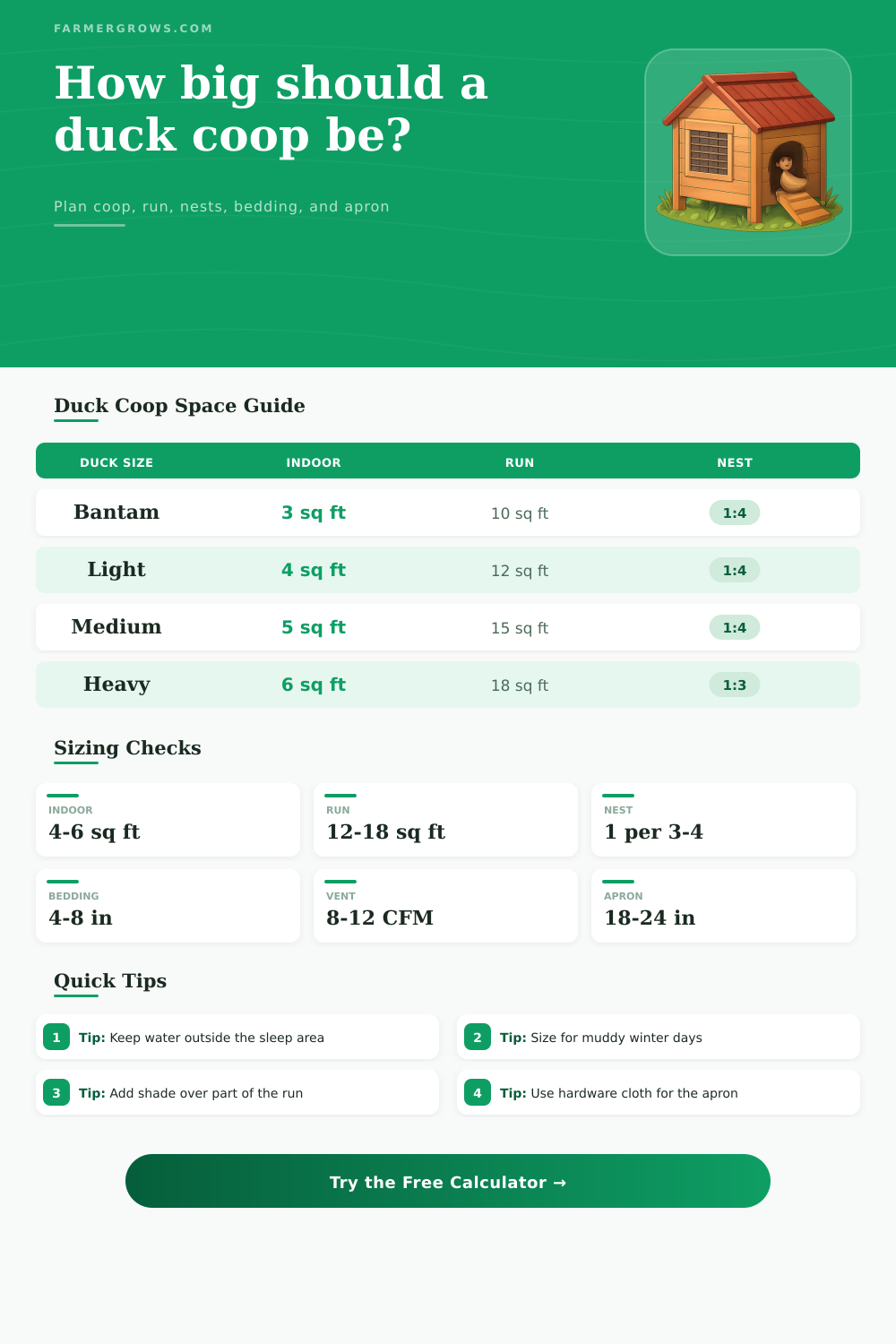
| Breed size | Indoor space per duck | Run space per duck | When to increase it |
|---|---|---|---|
| Bantam and call ducks | 3 sq ft per duck | 10 sq ft per duck | Add more if the run gets muddy, shaded poorly, or shared with feeders. |
| Light ducks | 4 sq ft per duck | 12 sq ft per duck | Use more run space when birds spend long wet-season days confined. |
| Medium ducks | 5 sq ft per duck | 15 sq ft per duck | Good default for Welsh Harlequin, Cayuga, and mixed backyard flocks. |
| Heavy ducks | 6 sq ft per duck | 18 sq ft per duck | Increase doors and turning space for Pekin, Rouen, and heavy breeding groups. |
| Very large ducks | 7 sq ft per duck | 20 sq ft per duck | Muscovy drakes and large mixed flocks need wider passages and nest access. |
| Item | Calculator formula | Output | Planning note |
|---|---|---|---|
| Indoor coop area | ducks x indoor sq ft per duck x buffer | Minimum shelter floor area | Floor space is the main duck-house comfort number because ducks do not roost. |
| Outdoor run area | ducks x run sq ft per duck x buffer + water stations | Run footprint | Water-station area is added after flock space so splash zones are not counted twice. |
| Nest boxes | ceiling(ducks / ducks per nest) | Ground nest count | Most laying groups share nests, but heavy or broody ducks need a lower ratio. |
| Bedding volume | coop area x bedding depth / 12 | Cubic feet of bedding | Full cleanouts use the whole volume; top-ups use the selected coverage percentage. |
| Feature | Typical input | Formula used | Why it matters |
|---|---|---|---|
| Water stations | 1 per 4 to 8 ducks | ceiling(ducks / ducks per station) | Separates drinkers from sleeping bedding and reduces one muddy traffic point. |
| Water station area | 4 to 8 sq ft each | stations x sq ft per station | Allows a washable tray, gravel pad, or drained tub access area. |
| Ventilation target | 8 to 12 CFM per duck | ducks x CFM per duck | Ducks add moisture quickly, so high vents should exhaust damp air without drafts. |
| Predator apron | 18 to 24 in wide | run perimeter x apron width | Hardware cloth laid flat blocks digging at the run edge. |
| Flock setup | Duck count | Indoor area | Run area |
|---|---|---|---|
| Small backyard trio | 3 medium ducks | About 17 sq ft with buffer | About 56 sq ft including water station |
| Pekin family group | 6 heavy ducks | About 40 sq ft with buffer | About 127 sq ft including water station |
| Layer flock | 10 medium ducks | About 55 sq ft with buffer | About 181 sq ft including water stations |
| Pasture mobile pen | 12 light ducks | About 53 sq ft with buffer | About 171 sq ft before frequent moves |
This calculator gives practical planning dimensions. Confirm local building rules, snow load, predator pressure, drainage, and your own management style before final construction.
Calculating the correct amount of space for the flock of ducks that you has is a necessary step in duck management. By calculating the correct amount of space for your ducks, you can ensure that they have an apropriate environment for their lives. If your duck flock dont have enough space, there bedding will become wet and the ducks will become stressed.
If your duck flock has too much space for the area that you have available for them, then you will waste time and material in setting up there housing. Therefore, you must calculate the dimension of the duck housing to ensure that you do not provide too little space to the ducks, nor too much. Ducks will use the floor of the duck housing to rest.
How to Calculate Space for Your Ducks
Ducks do not use perches in their duck housing like chickens uses for resting. Because ducks will rest on the floor of their housing, the entire indoor area of the housing will be used as a sleeping surface for the ducks. The space requirement for this sleeping area require that you provide enough square footage for each duck in the flock to turn around and preen without bumping into other ducks in the area.
Additionally, the area for nest box will have to be provided in the floor area of the duck housing as well. The calculator will assist you in determining the dimension of the duck housing that is required for your flock by asking you for the size of your flock and the type of duck breeds that you raise. The size of the breeds is an important variable in the calculation of dimensions of the housing.
For instance, breeds like Pekin ducks require more space than breeds like runner ducks. Thus, a flock of ducks that contain only large-breed ducks will require more space than a flock of ducks of only small breed. These breeding type variables ensure that the calculator can account for the need to provide the correct amount of space for each breed of duck that you raise.
The outdoor space that your ducks will use require a separate calculation from the indoor space of the duck house. Ducks naturaly create moisture when they use water. Therefore, muddy zone will form outdoors where the ducks are when they splash in the water.
For this reason, the area for the water station will need to be calculated in addition to the outdoor running area for the ducks. The calculator allows you to separate these two areas to determine the total area for outdoor space that is required. The ratio of ducks that will use the nest boxes require a calculation separate from the amount of space that is provided for sleeping ducks.
Many ducks will use the same nest box while sleeping without any conflict with other ducks who use the boxes. However, a number of ducks may require more space and individual nest boxes than others due to its size or broodiness. Thus, the calculator can adjust the duck ratio for the use of the nest boxes.
The depth of the bedding that will be used inside the duck house will vary with the time of year. Four inches of bedding may be used during the summer as the ducks will spend more time outside the duck house. However, eight inches of bedding may be required during the winter as the ducks will spend more time inside of the duck house.
Converting the depth of the bedding into cubic feet will allow you to calculate the amount of bedding that will be required to last for the season. Vents will be required in the duck house to allow moisture from the ducks to escape the house. The moisture from the ducks can lead to wet bedding and ammonia buildup within the duck house.
High vents will allow air to move through the duck house without creating drafts that may disturb the ducks. Calculating the correct amount of these high vent will ensure that the bedding will remain dry. Thus, the cubic feet per minute (CFM) number will allow you to calculate the size of the openings in the house that is required to accommodate these high vents.
Predator protection will need to be planned at the same time as the construction of the duck house. The apron of hardware cloth that is placed around the perimeter of the duck house will keep predators from digging under the perimeter fence. The width of the apron is important to ensure that it will prevent a predator from entering the duck house and its area.
The measurement for this apron can be included in the duck house layout in the calculator to ensure that it is included in the initial construction plan. The size of the duck house can include a percentage that provides extra space for any changes in the flock. For instance, the weather may change and cause the ducks to spend more or less time inside of the duck house.
Additionally, the ducks may grow in size during the year so that the percentage of space provides extra space for such changes in the flock. Duck house are often sized to provide only space for the number of ducks that a person currently has. Thus, if a person plans only for the ducks that they have at this time, the flock may grow.
Additionally, another common mistake is to place a water area within the sleeping area of the duck house; such placement will lead to wet bedding. Thus, calculating the area for the water station area separately from the sleeping area allows a person to understand the difference between these two area. The shape of the outdoor run for the ducks can also impact the amount of material that will be required to build such a run.
For instance, if the outdoor run is rectangular in shape, more fencing may be required than a square outdoor run. Additionally, more hardware cloth apron may be required if the outdoor run is rectangular in shape. Thus, the aspect ratio in the calculator will allow you to test different shape to determine how the change in shape impacts the amount of fencing and apron mesh that will be required for the outdoor run.
The calculator allows you to test different scenario for your duck house before purchasing the materials for the run. For instance, if you plan to clean your duck house very frequent, you may only need the minimum amount of space provided for ducks for sleeping. However, if your ducks will be inside the duck house for long periods of time, you will need to allow for the drainage of moisture from the ducks’ bodies.
Thus, this calculator could of helped you to determine the size of the duck house prior to the beginning of construction of the duck house.