🐄 Dry Matter Calculator for Cattle
Calculate daily dry matter intake (DMI) requirements for your herd — beef, dairy & growing cattle
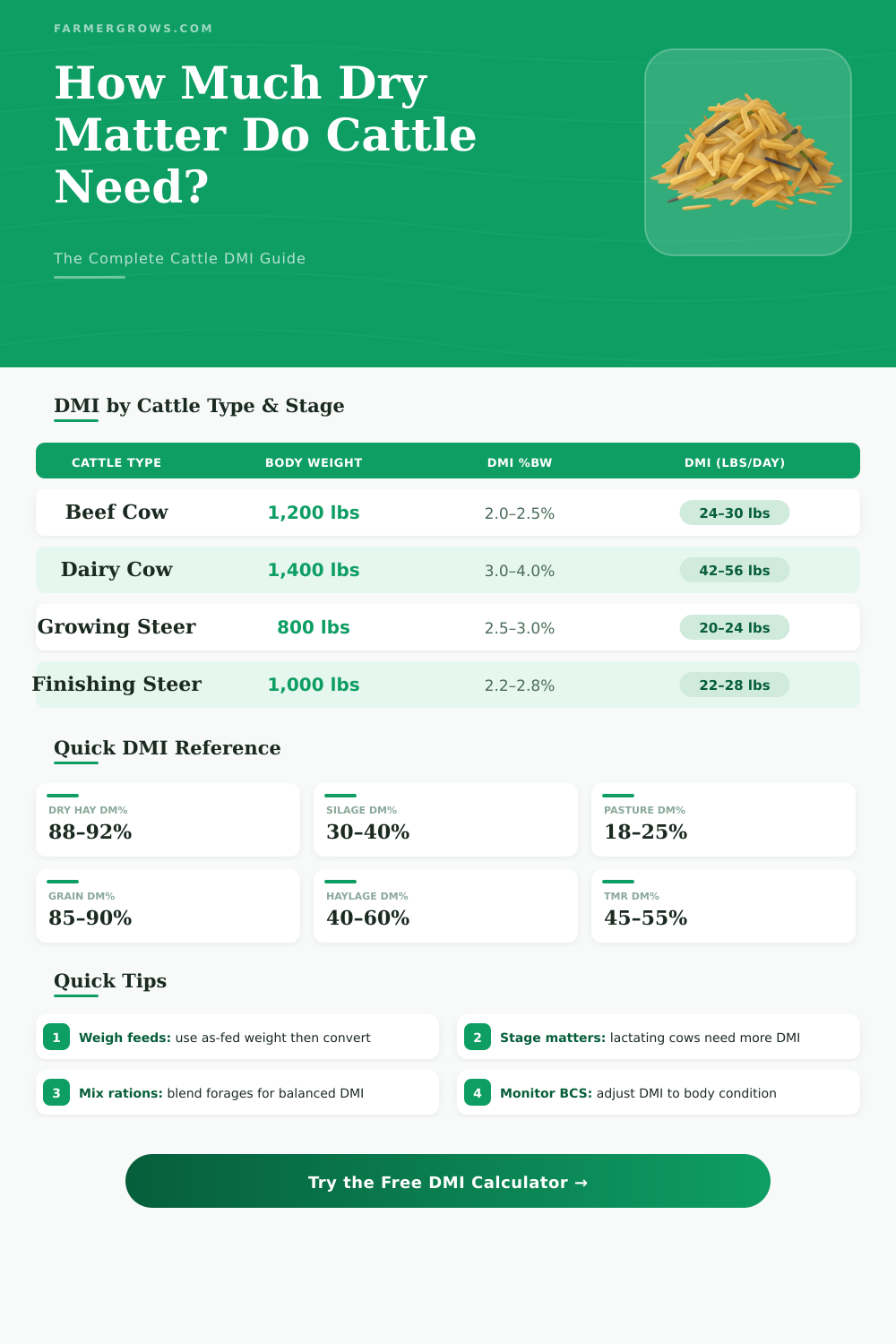
| Cattle Type | Stage | DMI % of BW | Typical BW (lbs) | Est. DMI (lbs/day) | Est. DMI (kg/day) |
|---|---|---|---|---|---|
| Beef Cow | Maintenance | 2.0–2.5% | 1,200 | 24–30 | 10.9–13.6 |
| Beef Cow | Early Lactation | 2.5–3.2% | 1,200 | 30–38 | 13.6–17.2 |
| Beef Cow | Mid Lactation | 2.2–2.8% | 1,200 | 26–34 | 11.8–15.4 |
| Beef Cow | Late Gestation | 1.8–2.2% | 1,200 | 22–26 | 10.0–11.8 |
| Beef Cow | Dry / Mid-Gestation | 1.5–2.0% | 1,200 | 18–24 | 8.2–10.9 |
| Dairy Cow | Early Lactation | 3.5–4.5% | 1,400 | 49–63 | 22.2–28.6 |
| Dairy Cow | Mid Lactation | 3.0–4.0% | 1,400 | 42–56 | 19.1–25.4 |
| Growing Steer | Growing (1.5 lb/d) | 2.5–3.0% | 800 | 20–24 | 9.1–10.9 |
| Finishing Steer | Finishing | 2.2–2.8% | 1,100 | 24–31 | 10.9–14.1 |
| Weaned Calf | Growing | 2.8–3.5% | 400 | 11–14 | 5.0–6.4 |
| Mature Bull | Maintenance | 1.5–2.0% | 1,800 | 27–36 | 12.2–16.3 |
| Bred Heifer | Late Gestation | 2.0–2.5% | 900 | 18–23 | 8.2–10.4 |
| Feed Type | DM% | lbs As-Fed per lb DM | kg As-Fed per kg DM | lbs As-Fed for 25 lb DMI |
|---|---|---|---|---|
| Dry Hay | 90% | 1.11 | 1.11 | 27.8 |
| Alfalfa Hay | 90% | 1.11 | 1.11 | 27.8 |
| Corn Silage | 35% | 2.86 | 2.86 | 71.4 |
| Haylage | 50% | 2.00 | 2.00 | 50.0 |
| Fresh Pasture | 22% | 4.55 | 4.55 | 113.6 |
| Grain Mix | 87% | 1.15 | 1.15 | 28.7 |
| TMR | 50% | 2.00 | 2.00 | 50.0 |
| Straw | 88% | 1.14 | 1.14 | 28.4 |
| DMI (lbs/hd/d) | 10 Head (lbs DM/d) | 50 Head (lbs DM/d) | 100 Head (lbs DM/d) | 100 Head / 30 d (tons DM) |
|---|---|---|---|---|
| 20 | 200 | 1,000 | 2,000 | 30.0 |
| 25 | 250 | 1,250 | 2,500 | 37.5 |
| 30 | 300 | 1,500 | 3,000 | 45.0 |
| 40 | 400 | 2,000 | 4,000 | 60.0 |
| 50 | 500 | 2,500 | 5,000 | 75.0 |
| 60 | 600 | 3,000 | 6,000 | 90.0 |
Cattle dry matter is central in farming. All cattle diets base on dry matter, so it matters to understand it. Feeds and forages always carry water with dry matter.
Simply said, dry matter stays after removal of water. It is made up of proteins, fat, vitamins, minerals and carbohydrates. Everything livestock requires to stay healthy and productive
Dry Matter and How Much Cows Eat
Dry matter intake or DMI shows how much feed cow eats daily after removal of water. Otherwise said, it is the weight of feed without moisture. DMI standardises the nutrition for whole group of cattle.
You measure it by the difference between given and uneaten feed.
Physical weight and milk production induce the real dry matter intake of cow. Also physical condition… If creature is fat or not, affects DMI.
Thin creatures eat more than fat ones. Usually cow eats around 2 % of her physical weight in dry matter daily, but it depends on factors as production and weather. Similarly happens with growing or finishing cattle: 100-kilogram cattle require 3 % of weight, so 3 kg dry matter.
Forage quality strongly affects dry matter intake. When quality mounts, so more total digestible nutrients, cow eats more. High quality forage can meet all nutrient needs if consumption is high.
Problem is fiber content, that limits meal. Livestock can eat 1.1 percent of physical weight in neutral detergent fiber.
Physical fill, metabolic processes and oxygen consumption affect dry matter intake. Also moisture, fiber content, fat in diet and forage to concentrate ratio play a part. Creatures with very wet feeds commonly do not eat enough for energy.
That happens for example with stocker cattle on high wheat forage, that even so require supplement for nutrients.
Surveillance of dry matter intake help to understand the state of livestock, their type and surroundings. Technology to estimate individual consumption in group settings will improve production and management. In suckler cows DMI peaks early and mid in milk, later decline until dry off.
DMI is needed for stocking rates and supplement needs.
To estimate dry matter intake as percentage of physical weight, you must know animal weight and dry matter percentage of every ingredient. For instance, 1200-pound cow receives 10 pounds corn silage daily on dry base; if silage have 35 % dry matter and 65 % moisture, real amount is 28,5 pounds per head daily on as-fed base.